
Most email sequences fail because they're built around what the business wants to say, not what the lead needs to hear. The result is a 5-email "nurture" sequence that reads like a countdown to a sales pitch, and the unsubscribe button gets more clicks than the CTA.
Building email sequences that actually convert requires understanding one core principle: every email must deliver standalone value while moving the reader closer to a decision. Not closer to a sale. Closer to a decision. That distinction changes everything.
GoHighLevel makes building these sequences straightforward with its workflow automation builder. You can create complex, multi-branch nurture sequences that adapt based on how leads behave, not just when they subscribed. This guide shows you exactly how.
Why Email Nurture Sequences Still Matter in 2026
With all the hype around social media, chatbots, and AI-powered everything, email feels almost old-fashioned. But the numbers tell a different story.
Email marketing consistently delivers $36-42 for every $1 spent, making it the highest-ROI channel available to most businesses. For coaches and consultants selling high-ticket services, email is even more valuable because the sales cycle is longer. A prospect who needs a $5,000 coaching program doesn't buy on the first touchpoint. They need education, trust-building, and proof that you understand their problem.
That's what nurture sequences do. They maintain the relationship between "I'm interested" and "I'm ready to buy" without requiring you to manually follow up with every single lead.
“Email marketing consistently delivers $36-42 for every $1 spent. It's not old-fashioned. It's underused.”
The businesses that win with email aren't sending more emails. They're sending better emails, timed correctly, to the right segments.
The Anatomy of a Nurture Sequence That Converts
Before touching GoHighLevel's workflow builder, you need to understand the structure. A high-converting nurture sequence has three distinct phases:
Phase 1: Indoctrination (Emails 1-3)
The first three emails establish who you are, what you believe, and why the subscriber should keep reading. This is where most sequences fail because businesses skip straight to selling.
Email 1: Welcome and Deliver (Immediately)
Deliver whatever they opted in for (lead magnet, resource, etc.)
Set expectations for what's coming
Share your origin story in 2-3 sentences
One clear next step
Email 2: The Big Problem (Day 1-2)
Articulate their problem better than they can
Show you understand the nuances and frustrations
No pitch. Just empathy and insight.
Email 3: The Framework (Day 3-4)
Introduce your approach or methodology
Give them a genuine "aha" moment
This builds authority without asking for anything
Phase 2: Engagement (Emails 4-7)
Now that they know you and trust your expertise, deepen the relationship with valuable content.
Email 4: Case Study or Proof (Day 5-6)
Show a specific result you've achieved for a client
Use real numbers and timelines
Make it relatable to their situation
Email 5: Common Mistake (Day 7-8)
Reveal a mistake most people make
Explain why it happens and how to avoid it
Position your approach as the alternative
Email 6: Quick Win (Day 9-10)
Give them something actionable they can implement today
Results from this quick win build trust and momentum
Email 7: Objection Handling (Day 11-12)
Address the biggest objection to working with you
Use a story or case study to counter it naturally
“The best nurture sequences don't feel like marketing. They feel like getting advice from someone who genuinely knows what they're talking about.”
Phase 3: Conversion (Emails 8-10)
Only after delivering consistent value do you earn the right to make an ask.
Email 8: The Bridge (Day 13-14)
Connect the problem (Phase 1) with the solution (your offer)
Explain who your offer is for and who it's not for
Soft CTA: "If this resonates, here's how we can work together"
Email 9: The Offer (Day 15-16)
Present your offer clearly
Benefits, not features
Include social proof
Clear CTA with urgency if appropriate
Email 10: Last Call (Day 17-18)
Final chance messaging
FAQ or objection recap
Move non-buyers to a long-term nurture list
This 10-email structure works for almost any coaching or consulting business. The timing can vary, but the sequence of indoctrination, engagement, and conversion stays the same.
Building Your Nurture Sequence in GoHighLevel
Let's build this inside GoHighLevel step by step.
Step 1: Plan Your Segments
Before creating a single email, define your segments. GoHighLevel lets you segment contacts using tags, custom fields, and pipeline stages. Smart segmentation means you can send different sequences to different types of leads.
Common segments for coaches and consultants:
Lead Magnet Source: Which resource they downloaded determines what sequence they enter
Business Stage: Startup vs. established affects messaging
Service Interest: Different offers need different nurture tracks
Engagement Level: Open rates and click behavior trigger branch logic
At minimum, tag every contact based on how they entered your list. A lead from a webinar needs different nurturing than a lead who downloaded a checklist.
Step 2: Create Your Email Templates
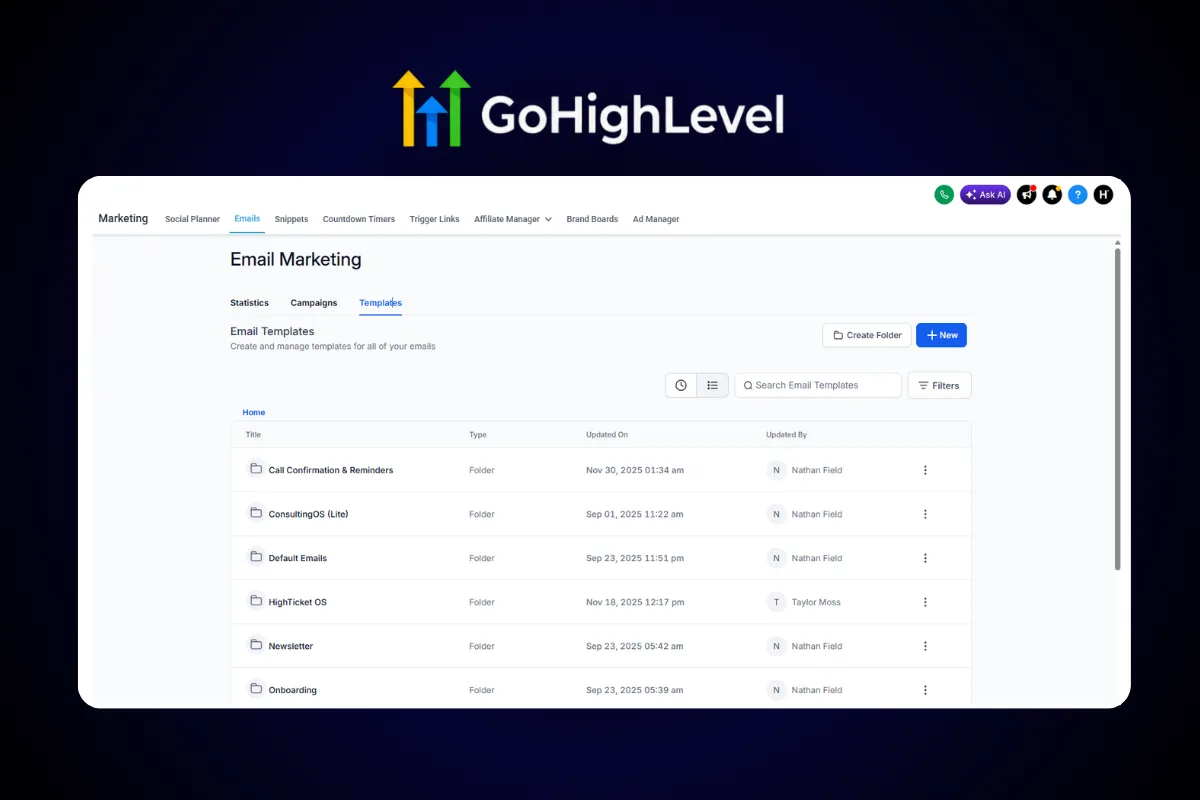
Go to Marketing > Emails in GoHighLevel. Create each email in your sequence as a template.
Formatting tips for higher engagement:
Keep emails between 300-600 words. Long enough to deliver value, short enough to get read.
Use short paragraphs (1-3 sentences max). Wall-of-text emails get skimmed or deleted.
Write like you talk. No corporate jargon. No "I hope this email finds you well."
One CTA per email. Multiple links competing for attention reduces clicks on all of them.
Use the recipient's first name in the subject line and opening. GoHighLevel custom fields make this automatic.
Subject lines that get opened:
The subject line determines whether your email gets read or ignored. Here are patterns that consistently perform:
Curiosity gap: "The mistake that's costing you $10K/month"
Personal: "[First Name], quick question"
Specific benefit: "3 ways to double your show-up rate this week"
Story: "How Sarah went from 2 clients to 14 in 90 days"
Contrarian: "Stop creating content (here's why)"
A/B test subject lines by sending two versions to a small segment, then sending the winner to the rest. GoHighLevel supports this natively.
“Your subject line has one job: get the email opened. Everything else is the body copy's problem.”
Step 3: Build the Workflow
Go to Automation > Workflows and create a new workflow. This is where the magic happens.
Trigger: Choose the entry point for your sequence. Common triggers:
Form submission (lead magnet download)
Tag added (manual or from another workflow)
Pipeline stage change
Calendar event (post-booking nurture)
Build the sequence:
For each email in your 10-email sequence, add these workflow steps:
Wait - Set the delay (e.g., "Wait 1 day")
Send Email - Select the email template
If/Else Branch - Check engagement (optional but powerful)
The If/Else branching is what separates basic email blasts from intelligent nurture sequences. After Email 4, for example, check if the contact opened the previous emails. If they haven't opened any:
Branch A (Engaged): Continue with the normal sequence
Branch B (Disengaged): Send a re-engagement email with a different subject line, then either continue or remove them
This prevents you from wasting emails on dead contacts and keeps your deliverability healthy.
Step 4: Add Behavioral Triggers
GoHighLevel's workflow builder supports triggers beyond simple time delays. Use these to make your sequences responsive:
Link Click Trigger: If someone clicks a specific link in Email 5 (say, a link to your services page), trigger a separate workflow that moves them into a more sales-focused track. They've shown buying intent; don't keep them in the slow nurture.
Tag-Based Branching: Apply tags based on behavior (clicked pricing, watched video, replied to email) and use those tags to customize subsequent emails.
Pipeline Integration: When a contact reaches a certain pipeline stage (like "Booked Discovery Call"), automatically remove them from the nurture sequence. Nothing looks worse than getting a sales email the day after you already signed up.
Goal Completion: Set a workflow "Goal" (like booking a call or making a purchase). If the contact completes the goal mid-sequence, they automatically exit. This prevents awkward "still thinking about it?" emails going to people who already bought.
“Intelligent sequences respond to what people do, not just when they subscribed.”
Step 5: Set Up Your Long-Term Nurture
The 10-email sequence handles the initial nurture period. But what happens to leads who don't convert? You don't just drop them. You move them into a long-term nurture sequence.
Long-term nurture looks different from the initial sequence:
Frequency: Weekly or bi-weekly instead of every 1-2 days
Content: Value-focused newsletter style. Industry insights, tips, case studies.
Occasional offers: Every 4-6 emails, include a soft pitch or invitation
Re-engagement campaigns: Every 60-90 days, run a specific campaign to re-activate dormant leads
In GoHighLevel, build this as a separate workflow triggered by a tag (e.g., "Long-Term Nurture") that gets applied at the end of the initial sequence for non-converters.
Advanced Strategies: Beyond Basic Email Sequences
Multi-Channel Nurture: Email + SMS
Email alone converts well. Email plus SMS converts better. GoHighLevel handles both channels in a single workflow, so you can interleave them naturally.
Use SMS for:
Delivery confirmation ("Just sent you the guide, check your email!")
Quick value bombs (one-line tips that don't need a full email)
Time-sensitive reminders (event starting soon, offer ending)
Personal touch ("Hey [Name], saw your comment on my post. Thanks for engaging!")
Keep SMS short. Under 160 characters when possible. And always offer an opt-out.
Segmented Sequences Based on Lead Score
GoHighLevel lets you build lead scoring models using custom fields. Assign points based on:
Email opens (+1 point)
Link clicks (+3 points)
Page visits (+5 points)
Form submissions (+10 points)
Call booked (+25 points)
When a lead crosses a threshold (say, 30 points), trigger a different workflow that moves them to a high-intent sequence. This could be a more direct pitch, a personal video message, or an invitation to book a call.
Lead scoring turns your nurture sequence from a static conveyor belt into a dynamic system that responds to buying signals in real time.
Personalization Beyond First Name
Most people think email personalization means using {{first_name}} in the subject line. That's the bare minimum. GoHighLevel's custom fields let you go much deeper:
Reference their business type or industry
Mention the specific lead magnet they downloaded
Adjust examples based on their business stage
Change the CTA based on their engagement level
The more relevant each email feels, the higher your engagement and conversion rates.
“True personalization isn't about using someone's name. It's about making them feel like the email was written specifically for their situation.”
The Technical Setup: Deliverability Matters
A beautifully written sequence means nothing if it lands in spam. Here's how to protect your deliverability in GoHighLevel:
Domain Authentication
Set up SPF, DKIM, and DMARC records for your sending domain. GoHighLevel provides the DNS records you need. This tells email providers that you're authorized to send from your domain.
Warm Up Your Domain
If you're sending from a new domain or email address, don't blast your entire list on day one. Start with 50-100 emails per day and gradually increase over 2-4 weeks. GoHighLevel doesn't have built-in warm-up, but you can control this by staggering workflow enrollments.
Clean Your List Regularly
Remove contacts who haven't opened an email in 90 days. Dead contacts hurt your sender reputation. Create a re-engagement workflow first (send 2-3 "Are you still interested?" emails), then remove anyone who doesn't respond.
Monitor Bounce Rates
Keep hard bounces under 2% and soft bounces under 5%. If you're seeing higher numbers, your list needs cleaning. GoHighLevel tracks bounces automatically in the email stats dashboard.
Measuring Sequence Performance
Track these metrics to know if your sequence is working:
Open Rate by Email Position: Are people still opening by Email 7? If open rates drop off after Email 3, your early emails aren't hooking readers well enough.
Click-Through Rate: Which emails drive the most clicks? These are your strongest performers. Study what makes them work and apply those patterns to weaker emails.
Unsubscribe Rate: Some unsubscribes are healthy (wrong-fit leads leaving). But if you see spikes after specific emails, that email needs reworking.
Conversion Rate: What percentage of people who enter the sequence complete your desired action (book a call, buy a product, etc.)? This is the ultimate metric.
Revenue Per Subscriber: Total revenue generated divided by total subscribers who entered the sequence. This tells you the economic value of each lead and helps you determine how much you can afford to spend on acquisition.
Benchmarks for Coaches and Consultants
If your numbers fall below "Good," start optimizing subject lines (for opens), email copy and CTAs (for clicks), and value delivery (for unsubscribes).
Real-World Example: Consultant Nurture Sequence
A marketing consultant uses this exact framework in GoHighLevel:
Entry Point: Lead downloads a "Client Acquisition Checklist" from a Facebook ad
Sequence:
Email 1 (Immediate): Delivers the checklist, introduces herself, sets expectations
Email 2 (Day 2): "The #1 reason coaches struggle to get clients" (problem awareness)
Email 3 (Day 4): Introduces her "Authority Attraction" framework
Email 4 (Day 6): Case study of a client who went from 3 to 18 clients in 6 months
Email 5 (Day 8): "Stop doing this with your Instagram" (common mistake)
Email 6 (Day 10): Quick win: "Send this exact DM to 10 people today"
Email 7 (Day 12): Addresses "I don't have time for marketing" objection
Email 8 (Day 14): Bridges problem to her group coaching program
Email 9 (Day 16): Full offer email with testimonials and pricing
Email 10 (Day 18): Final call with FAQ recap
Results over 6 months:
2,100 leads entered the sequence
38% average open rate
5.2% click-through rate
147 discovery calls booked (7% sequence-to-call rate)
41 clients signed ($5,500 average deal)
$225,500 in revenue from email alone
The entire sequence runs automatically inside GoHighLevel. She spends zero time on manual follow-up.
FAQ
How many emails should be in a nurture sequence?
For an initial nurture sequence, 8-12 emails over 2-3 weeks hits the sweet spot. Fewer than 6 doesn't build enough trust. More than 15 feels drawn out. After the initial sequence, move contacts into a long-term weekly or bi-weekly newsletter.
What's the best time to send nurture emails?
Tuesday through Thursday between 9-11 AM in the recipient's time zone consistently performs best. Avoid Mondays (inbox overload) and Fridays (checked out for the weekend). GoHighLevel lets you schedule sends based on the contact's timezone if you capture that data.
How often should I email my list?
During the initial nurture sequence: every 1-2 days. For long-term nurture: weekly or bi-weekly. The key is consistency. Sporadic emailing trains your audience to forget you, and sudden bursts after silence trigger spam filters.
Can I use GoHighLevel for cold email outreach?
GoHighLevel is designed for permission-based email marketing, not cold outreach. Sending unsolicited emails through GoHighLevel violates their terms of service and will get your account flagged. Use dedicated cold email tools for outreach and GoHighLevel for nurturing warm leads.
How do I re-engage contacts who stopped opening emails?
Create a dedicated re-engagement workflow. Send 2-3 emails with compelling subject lines ("Should I stop emailing you?", "One last thing before I go"). If they don't open any of the re-engagement emails after 7-10 days, remove them from your list. Keeping dead contacts hurts your sender reputation.
Should I include images in my nurture emails?
Plain text emails consistently outperform heavily designed HTML emails for coaches and consultants. They feel personal and authentic, like a real person wrote them. Use minimal formatting: bold for emphasis, bullet points for lists, and maybe your logo in the signature. Skip stock photos and heavy graphics.
How do I track which emails drive the most revenue?
Use GoHighLevel's attribution tracking. Tag contacts when they click specific CTAs, and connect those tags to your pipeline stages. When someone converts, you can trace back which email or sequence pushed them over the edge. For more advanced tracking, use UTM parameters on your email links and monitor them in Google Analytics.
What's the difference between a drip campaign and a nurture sequence?
A drip campaign sends pre-written emails on a fixed schedule regardless of recipient behavior. A nurture sequence adapts based on what the contact does: opens, clicks, visits pages, books calls. GoHighLevel's workflow builder supports both, but behavioral nurture sequences dramatically outperform static drips.
Build Your First Sequence This Week
The gap between businesses that "do email" and businesses that profit from email comes down to structure. Not fancy design. Not clever subject lines. Structure.
A well-built nurture sequence in GoHighLevel takes your leads through a deliberate journey: from stranger to subscriber to prospect to client. It runs 24/7, scales infinitely, and gets better as you optimize based on real data.
Want a head start? The Lead Magnet OS includes pre-built email sequence templates, opt-in funnels, and automation workflows that plug directly into GoHighLevel. Stop building from scratch and start converting.