
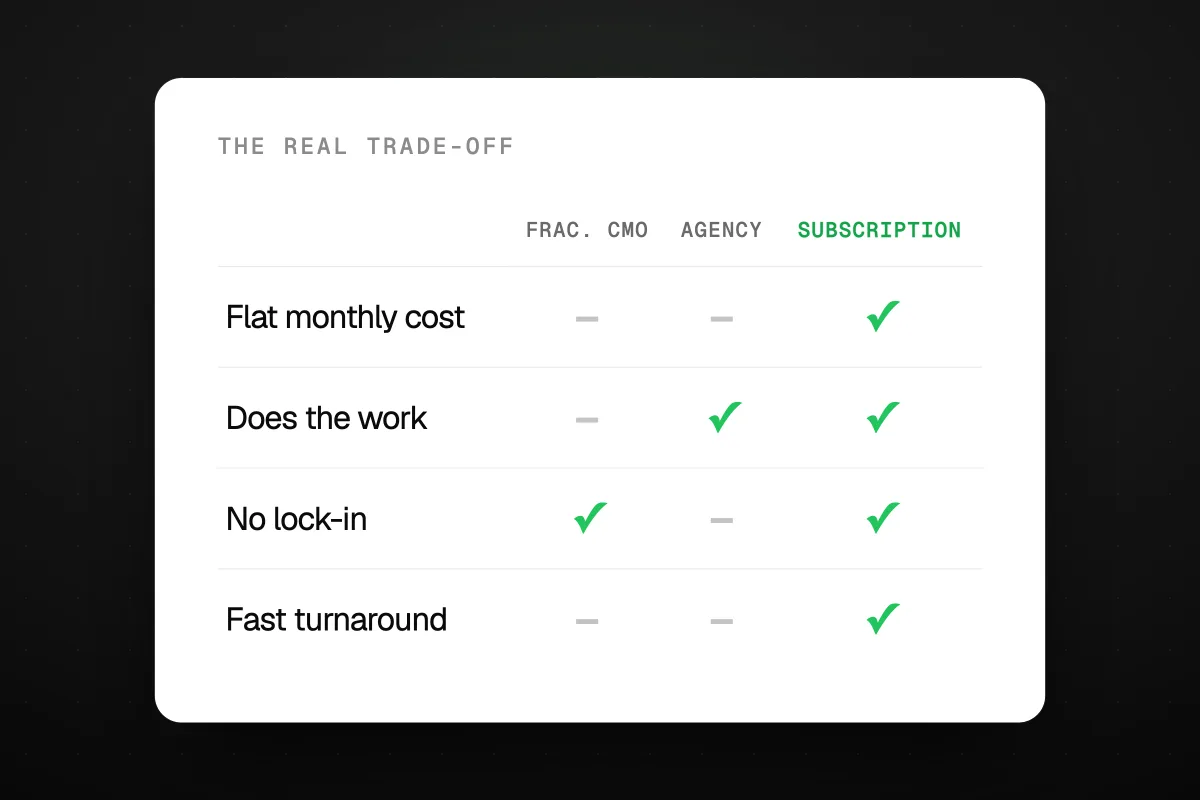
A fractional CMO, a marketing agency and a marketing subscription solve different problems. A fractional CMO gives you a part-time strategy leader. An agency gives you a team to execute a set scope on a contract. A subscription gives you a flat-fee team that runs your marketing on a queue with no lock-in.
Most guides on this compare only two of the three, and most are written by the very firms they recommend. This one puts all three side by side, with real costs, and says plainly when each is the right call.
The short answer
- Fractional CMO when you have people to do the work but no one setting the direction.
- Marketing agency when you know the plan and need a big team to execute a fixed scope.
- Marketing subscription when you need steady work across ads, web, email and CRM, done fast, without a contract or a payroll.
They are not really rivals. A CMO decides what to do. An agency or a subscription does it. Some businesses use a CMO on top of one of the other two.
What each one actually is
Fractional CMO
A fractional CMO is a senior marketing leader who works for you part-time. They own the strategy: the plan, the priorities, the budget and the numbers. They usually do not build the ads or the site themselves. They direct whoever does.
Marketing agency
An agency is an outside team you pay to execute. You sign a retainer for a set scope, often with a setup fee and a contract of several months. Work moves through account managers and specialists, so there is process, and there are handovers.
Marketing subscription
A subscription is a flat-fee team that works a queue. You send requests, they deliver one at a time, usually in about 48 hours, and you can cancel anytime. It is execution like an agency, with the contract and the setup fee removed. We explain the model in full in what is a marketing subscription.
The cost of each
These are industry ranges, not fixed prices. Rates vary by market and scope.
| Option | Typical monthly cost | Contract | What you get |
|---|---|---|---|
| Full-time CMO | Salary of about $166,790 a year at the US median, plus benefits | Employment | One full-time strategy leader |
| Fractional CMO | About $5,000 to $15,000 | Monthly, minimum hours | Part-time strategy, no execution |
| Agency retainer | About $5,000 to $15,000, plus setup and ad spend | Often 6 to 12 months | A team on a fixed scope |
| Marketing subscription | About $3,000 to $8,000 | Cancel anytime | A team on a queue, no scope limit |
The full-time CMO salary is the US median for a marketing manager from the Bureau of Labor Statistics. The fractional CMO and agency ranges are common figures across industry sources such as MarketerHire; treat them as guides, not quotes. A fractional CMO buys strategy, not hands. That is the part people miss when they compare it to an agency on price alone.
The mistake in most comparisons
Nearly every "fractional CMO vs agency" article treats them as an either-or. They are not. A fractional CMO sits above execution. An agency or a subscription is the execution. So the honest framing is a two-part question:
- Do you have a clear plan? If no, you may need strategy: a CMO.
- Do you have hands to run the plan? If no, you need execution: an agency or a subscription.
A common high-performing setup for a growth-stage company is a fractional CMO directing an agency or a subscription. The CMO decides, the team delivers.
A fractional CMO with no one to execute is a plan with no builder. An agency with no strategy is a builder with no plan.
When a fractional CMO is the right pick
- You already have people, in-house or freelance, who can do the work.
- What is missing is direction: nobody owns the plan or the numbers.
- You are making big bets, like a new market or a raise, and need senior judgement.
If that is you, a CMO is worth more than more hands. Do not buy execution when the gap is strategy.
When a marketing agency is the right pick
- You know the plan and need a large team to run a defined scope.
- You want deep specialists in one area, like performance ads at scale.
- You are comfortable with contracts, setup fees and a slower sign-off process.
Agencies are strong when scope is clear and stable. They get expensive and slow when your needs change week to week and every change is a new quote.
When a marketing subscription is the right pick
- You need steady work across several channels, not one project.
- You want it fast, without waiting out a contract.
- You do not want a payroll, a setup fee, or the job of managing a team.
This is the middle ground most small service businesses actually sit in. They have a rough plan. What they lack is a reliable team to run it without hiring one.
How to choose in one pass
- Is your problem strategy or execution? Strategy points to a CMO. Execution points to an agency or a subscription.
- Is your scope fixed or changing? Fixed and large suits an agency. Changing and varied suits a subscription.
- How much lock-in can you accept? Little or none rules out most retainers.
Answer those three and the right option is usually obvious. Many businesses land on a subscription for execution now, and add a fractional CMO later if the strategy gap grows.
A real example
Two of our clients are training organisations. Neither needed a fractional CMO. They had a clear goal: more enrolments. What they lacked was a team to run the ads and funnels. We ran the ads for one and brought leads in at $2 each. We built a quiz funnel for the other and brought leads in at $4 each.
A strategy leader would have been the wrong spend there. They needed execution, fast, without hiring. Results depend on the offer, the market and the budget, so these are examples, not promises.
Frequently asked questions
Is a fractional CMO cheaper than an agency?
Not always, and it is the wrong comparison. A fractional CMO usually runs about $5,000 to $15,000 a month for strategy only. An agency runs a similar range but for execution. They do different jobs, so compare them by what you need, not by price.
Can a fractional CMO also do the work?
Usually not. A fractional CMO leads and directs. They set the plan and manage whoever executes it. If you need the ads built and the site made, you still need an execution team underneath them.
What is the difference between an agency and a subscription?
An agency is a fixed scope on a contract, often with a setup fee. A subscription is a flat fee with a queue of requests you control and no lock-in. The subscription trades a big parallel team for speed and flexibility.
Can I use more than one?
Yes, and many do. A common setup is a fractional CMO on top of an agency or a subscription. The CMO owns the plan, the team delivers it. Start with whichever gap is bigger: direction or hands.
Which is best for a small service business?
Usually a subscription. Most small service businesses have a rough plan already; what they lack is a reliable, affordable team to run it across channels without hiring. A CMO fits better once the business is large enough to need a dedicated strategy seat.
Where Havstock fits
We built Havstock Unlimited as the execution option in this picture. One flat fee of $4,995 USD a month covers ads, websites, funnels, email, CRM, SEO and AI chat, with no contract and no setup fee. If your gap is a team to run your marketing, not a strategy chief, this is the fit.
Not sure yet? Book a 15-minute call and we will tell you honestly whether you need us, an agency, or a CMO first.