 Nathan Field
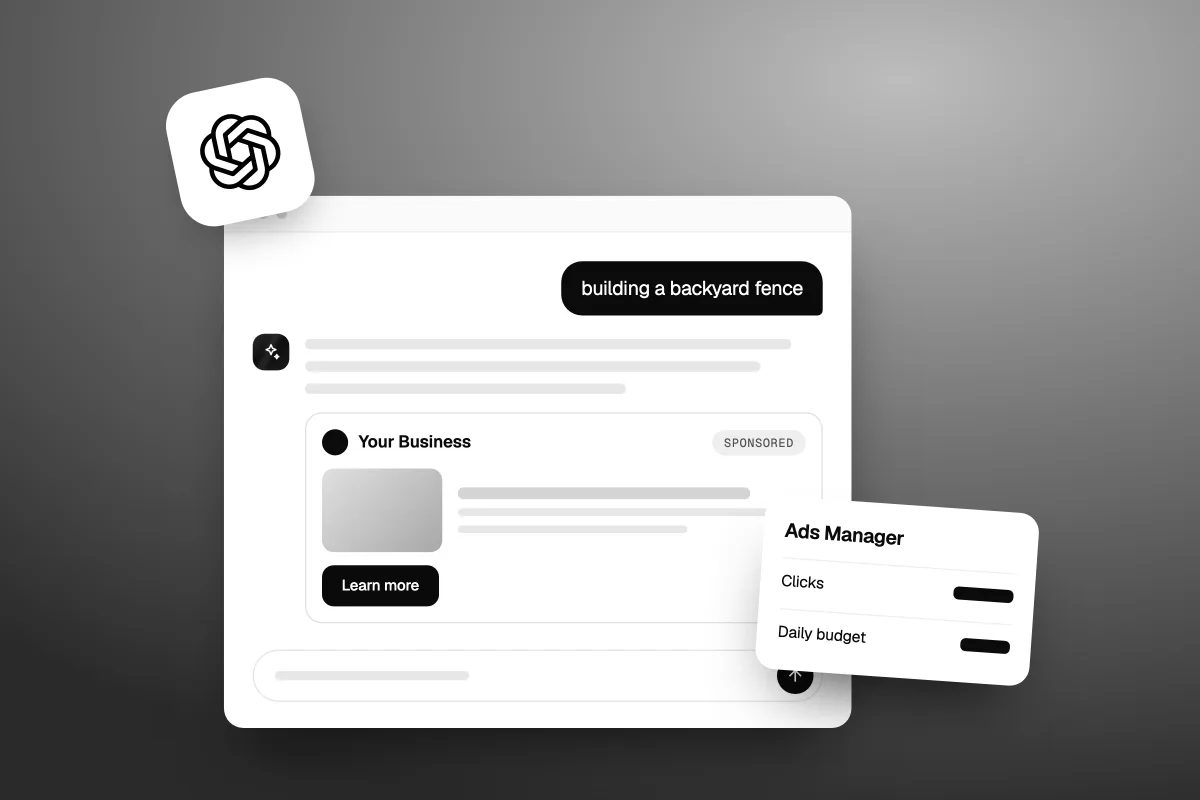
ChatGPT ads are paid ads that show up below ChatGPT's answers, and most businesses in the US can now buy them on their own at ads.openai.com. They are worth a small test if you sell something people research and compare before they buy. If your calls, reviews and Google ads are not working yet, fix those first.
We read OpenAI's own ads pages and help center on 18 October 2026. OpenAI still calls the ad platform a beta, so rules and prices can change. Check the pages again before you spend.
The short answer
- What they are: one ad below a ChatGPT answer, clearly labeled and kept apart from the answer.
- Who sees them: adults on the Free and Go plans. Not Plus, Pro, Business, Enterprise or Edu.
- Who can buy: businesses based in one of the 60 plus countries on OpenAI's list, including the US, UK, Canada and Australia.
- What they cost: you bid. Pay per 1,000 views or per click. OpenAI suggests a top bid of $3 to $5 a click to start. The lowest daily budget in the US is $25.
- Should you run them: test them if one sale is worth a lot and buyers ask questions first. Wait if the basics are not done.
What are ChatGPT ads?
ChatGPT ads are paid spots that appear under a ChatGPT response. OpenAI's Ads in ChatGPT: The Basics page (checked 18 October 2026) says each ad has six parts:
- Your business name
- Your small logo (favicon)
- A headline
- A short description
- An image
- A link to your landing page
People see one ad unit at a time, and it can hold one or more images. OpenAI is also testing a visual ad that shows while ChatGPT is making an image.
OpenAI's own ad page shows what this looks like for a trade. Someone asks ChatGPT about building a backyard fence. Under the answer sits an ad from a supply company for a cedar privacy panel (ads.openai.com, checked 18 October 2026).
The ad does not touch the answer. OpenAI says ads run on separate systems, and advertisers "have no ability to shape, rank, or alter ChatGPT's responses" (OpenAI Help, Ads in ChatGPT).
You cannot pay to be in the answer. You can only pay to sit under it.
Who sees ads in ChatGPT?
Only people on the Free and Go plans see ads. Ad tests started in the US on 9 February 2026, and OpenAI is adding regions over time. Here is who does not see them, per OpenAI's help page:
- People on Plus, Pro, Business, Enterprise and Edu plans.
- Accounts OpenAI thinks belong to someone under 18.
- Temporary Chats.
- Chats about sensitive topics, like personal health, mental health or politics. OpenAI does not allow political ads at all.
That matters for who you reach. A busy business owner who pays for ChatGPT Plus will never see your ad. If your buyer is that person, this channel will miss them.
Can a small business advertise on ChatGPT today?
Yes, in most cases. OpenAI ran a pilot from February to April. It now lets businesses sign up themselves through Ads Manager Beta (OpenAI Ads FAQ). Three things decide if you can run ads.
1. Where your business is based
The business that pays for the ads must be based in a country on OpenAI's Ads Manager availability list. On 18 October 2026 it had more than 60 countries, including the US, Canada, the UK, Australia, New Zealand, the UAE and most of Europe. If your country is missing, you can still make an account and OpenAI says it will tell you when it opens.
One catch. Some new accounts can only advertise in their home country at first. They can add other countries after identity checks pass and the account has spent enough at home.
2. What you sell
Some types of business cannot advertise, or only in the US. OpenAI lists them in its policy eligibility table. A few that matter to the businesses we work with:
| Category in OpenAI's table | US | Other countries |
|---|---|---|
| Legal services | Allowed, if licensed to practice law in the US | Not allowed |
| Minimally invasive cosmetic procedures | Allowed | Not allowed |
| Medical procedures and experimental care | Not allowed | Not allowed |
| Telehealth services | Not allowed | Not allowed |
| Hospitals and urgent care | Select approved advertisers only | Not allowed |
| Insurance (not health insurance) | Allowed | Select approved advertisers only |
Trades and home services were not on the regulated list we read. Their ads still go through the normal review. A med spa or clinic should read the full table before building anything.
3. Passing review
Your business, your ads and your landing pages all get checked. OpenAI says business verification can take up to 7 business days. Each ad must be approved before it serves.
How do you set up ChatGPT ads?
You set them up yourself, then wait for review. These steps come from OpenAI's Ads Manager account setup guide, checked 18 October 2026:
- Sign in. Go to ads.openai.com and log in with the OpenAI account you use for ChatGPT, or make one.
- Enter your website, or skip. Ads Manager can read your site and draft your first ad from it. You review and edit it.
- Enter your business details. Pick your country, currency and time zone with care. OpenAI says these three cannot be changed later.
- Set up billing. Add your business name, address, an email for invoices and a credit card. Your bank may show a short hold on the card while it is checked.
- Check your brand name and logo. Your Brand Name is the name people see on your ads.
- Finish verification if Ads Manager asks for it.
- Build your campaign. Pick a goal, a budget and countries. Then add an ad group with context hints, and your ads.
Watch one thing. If you build an ad during signup, it can go live as soon as it passes review and billing is set. If you are not ready, pause the campaign. OpenAI also says not to publish your first campaign just to reach the start and end date settings.
How much do ChatGPT ads cost?
ChatGPT ads cost whatever budget and bid you set. There is no fixed price list. You choose one of three goals, per OpenAI's campaign guide:
- Views: you pay per 1,000 times your ad is shown (CPM).
- Clicks: you pay for each valid click (CPC).
- Conversions: the system aims for a sale or sign-up, but you still pay per click or per 1,000 views. You do not pay per conversion.
You set a top bid for each ad group. For clicks, OpenAI suggests starting at $3 to $5 a click. Ads then go through an auction that weighs both your bid and how relevant your ad is.
Minimum daily budget
The lowest daily budget depends on your billing currency. A few from OpenAI's table:
| Currency | Lowest daily budget |
|---|---|
| US dollar | $25 |
| Canadian dollar | 25 CAD |
| Australian dollar | 25 AUD |
| British pound | 15 GBP |
| Euro | 15 EUR |
| UAE dirham | 65 AED |
A daily budget is an average
This trips people up. OpenAI's daily budgets page says your daily budget is an average over seven days. On any one day you can be billed up to twice that amount. Over a Sunday to Saturday week, spend will not go past seven times it.
So at the $25 US minimum, one day can cost up to $50, and a week can cost up to $175. That is our maths from OpenAI's rule, not an OpenAI quote.
When you get charged
You pay after the ads run. OpenAI's billing page says your card is charged each time your unpaid spend reaches a set amount, called a payment threshold, and again at the end of the month for anything left. New accounts usually start with a lower threshold. Spend figures can lag 7 to 8 hours, so a zero in your dashboard does not mean nothing is being spent.
What is a good price per click?
Nobody knows yet. OpenAI's FAQ says it "does not yet have performance benchmarks across advertisers, industries, or campaign types." We left out the cost numbers some blogs print, because we could not find a source for them.
If OpenAI has no benchmark yet, a blog post with a "typical" price per click is a guess.
How does ChatGPT decide when to show your ad?
It looks at what the person is talking about right now. It also reads your ad, your landing page, and your context hints. If the person allows it, it can use signals from their wider ChatGPT use, like past chats and memory.
Context hints, not keywords
Context hints are short notes about what you sell, who it helps and when it is useful. You add them to each ad group. OpenAI's guide to context hints gives an example for a local plumber: after-hours home plumbing in their city, with the call-out fee for urgent repairs.
Write each hint as a plain phrase about one idea. Do not paste a list of keywords. And know the limit: OpenAI says hints "are not targeting rules" and do not promise your ad will show in any chat.
Location and device targeting
You can pick countries. For most campaigns you can also pick states, cities, markets and postal codes, where they are offered. You can choose the Android app, iOS app or the web. To target your own customer list, it needs at least 25,000 matched people, so that one is for bigger brands.
Let OpenAI's bots see your page
Your landing page must not block OpenAI's crawlers, called OAI-AdsBot and OAI-SearchBot. If your site blocks bots, ask your web person to check this before you launch.
What can advertisers see about people's chats?
Nothing from the chat itself. OpenAI says advertisers never get people's chats, chat history, memories, names, emails, exact locations or IP addresses. You get totals: views, clicks, spend, click rate, average cost per click and per 1,000 views, and conversions if you set up tracking.
Add UTM tags to your landing page links so your own analytics can see ChatGPT traffic. If someone chooses to message you through your ad, you see only the messages they send you.
Are ChatGPT ads worth it for a small business?
Our view: worth a small test for some businesses, and too early for most local service businesses. It is a beta, with no benchmarks, and OpenAI says delivery and spend can swing while it changes things. The ads show up during a conversation, so they suit buyers who talk a decision through before they act.
Who should test now
- You sell something people research first. A remodel, a course, a high-ticket service, a piece of software. People ask ChatGPT about these.
- You already run Google search ads and know your cost per lead, so you have something to compare against.
- You have a landing page for one offer, with tracking that works.
- You can leave the minimum budget running for a few weeks and judge the result, not the first day.
Who should wait
- Your category is restricted or not allowed in your country. Check the table above.
- Leads already go cold. If calls ring out and forms sit for days, more ads only means more lost leads.
- Your Google profile and reviews are thin. People check you out before they call. Fix that first.
- Your work is mostly urgent call-outs. When a pipe bursts, people search and call. We would spend on search ads before this.
A simple 30-day test
- Make one campaign with the Clicks goal at the minimum daily budget.
- Make one ad group per service, each with three to five context hints.
- Write a few ads per service, each with a different angle. OpenAI says a range of titles and descriptions helps the system find more places to show you.
- Send each ad to the page for that service, with UTM tags and conversion tracking.
- After four weeks, compare cost per lead and cost per sale with your Google ads.
Is paying for ChatGPT ads the same as being recommended by ChatGPT?
No. They are two separate things. Ads sit under the answer. Being named in the answer is free, and you cannot buy it, because OpenAI says ads do not change answers.
Getting named in answers takes slower work: a clear website, real reviews, and other sites that mention you. We wrote that up in how to get your business recommended by ChatGPT. If you only have budget for one, the free side lasts longer. Ads stop the day you stop paying.
Where do ChatGPT ads fit next to your other ads?
Treat them as one more test, not a new plan. Most local businesses we see get more from fixing their Google search ads and Google profile first. After that, smaller local channels can fill gaps. We looked at two of them: whether Yelp advertising is worth it, and what Nextdoor advertising costs.
ChatGPT ads earn a place when your buyers ask questions before they buy, and you can see in your numbers that those clicks turn into sales.
Should you run ChatGPT ads yourself or hire someone?
For a first test, do it yourself. OpenAI's own signup will draft your first ad from your website. For one small test, that beats paying anyone, including us.
Hire help when you want ChatGPT ads run next to Google and Meta, with one report that shows which channel brings jobs. That is what our ad management covers, as part of Havstock Unlimited. It is a flat-fee marketing subscription: ads, landing pages, tracking and follow-up from one team.
This will not suit you if your whole ad budget is a few hundred dollars a month. Our plan costs $4,995 USD a month, so it only makes sense once marketing is a real line in your budget.
FAQ
How much do ChatGPT ads cost?
You set the cost with your bid and budget. You can pay per 1,000 views or per click. OpenAI suggests starting with a top bid of $3 to $5 a click. The lowest daily budget in the US is $25, and OpenAI does not publish benchmark prices yet, so treat any typical figure with care.
Is there a minimum spend for ChatGPT ads?
Yes. The lowest daily budget is $25 in the US, 25 in Canadian or Australian dollars, and 15 in pounds or euros. A daily budget is an average over seven days, so one day can cost up to twice that. Spend over a week will not go past seven times your daily budget.
Can any business advertise on ChatGPT?
Not quite. Your business must be based in a country on OpenAI's availability list, which had more than 60 countries on 18 October 2026. Your category must also be allowed. Telehealth and many medical procedures are not, and legal services are US only. Your account, ads and pages all go through review.
Do ChatGPT ads change ChatGPT's answers?
No. OpenAI says ads run on separate systems and advertisers cannot shape, rank or change ChatGPT's responses. Ads are shown below the answer and clearly labeled. So paying for ads does not get you named in the answer. That part is earned through your website, reviews and mentions elsewhere.
Who sees ads in ChatGPT?
Adults on the Free and Go plans, in regions where ads have launched. People on Plus, Pro, Business, Enterprise and Edu plans do not see ads. Nor do accounts OpenAI thinks belong to under-18s, or Temporary Chats. Ads are also kept away from sensitive topics like health, mental health and politics.
Can I target my city with ChatGPT ads?
In most campaigns, yes. OpenAI says you can target countries, and also states, cities, markets and postal codes where they are offered. Product feed campaigns are country level only. Context hints help with relevance, but OpenAI says they are not targeting rules, so use the location settings to limit where ads show.
Do advertisers see what I type into ChatGPT?
No. OpenAI says advertisers never receive your chats, chat history, memories, name, email, exact location or IP address. They get totals, like views and clicks. If you choose to message a business through its ad, that business sees only the messages you send to it, and nothing else.
ChatGPT ads are open to most businesses now, and setup is quick. The hard part is the same as on any platform: a clear offer, a page that converts, and fast follow-up. Get those right first, then give ChatGPT ads a small, tracked test.