
 Nathan Field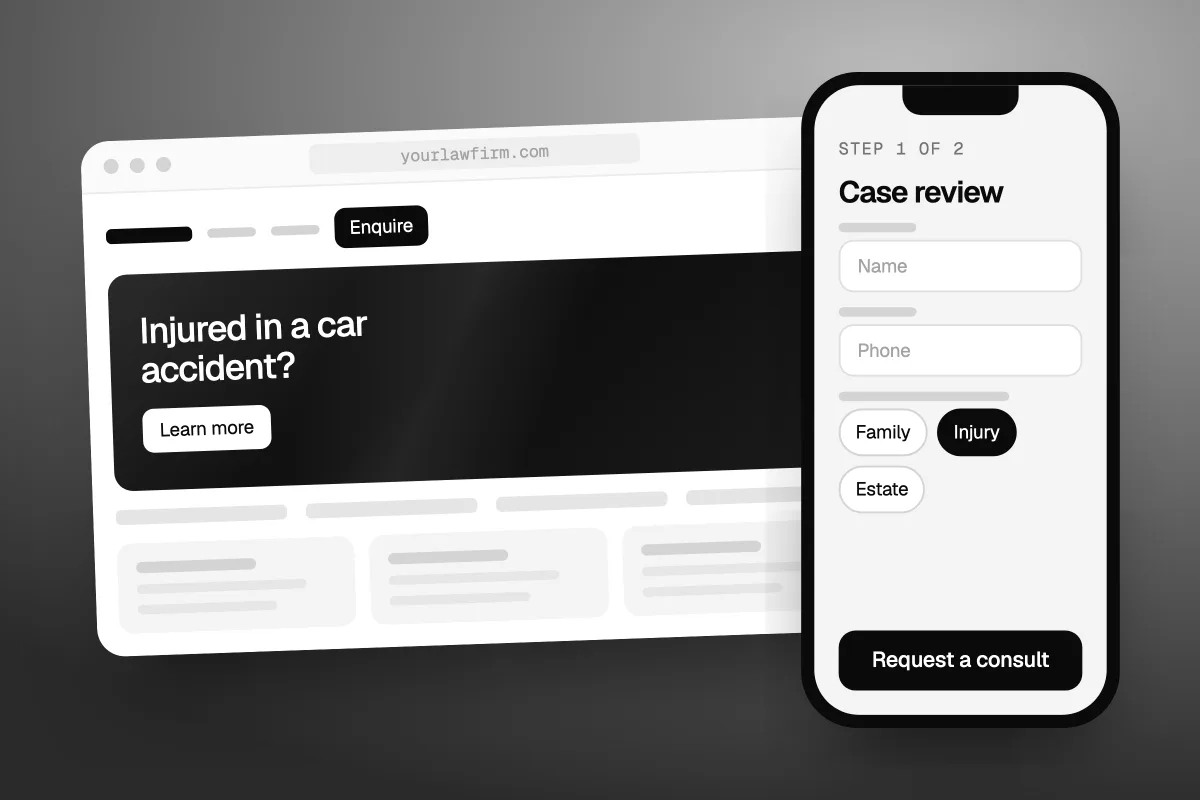
Law firm lead generation comes down to one choice: buy leads from someone else, or own the sources that send clients straight to you. Most firms end up with a mix. The trouble is that most guides list ten tactics and never say which ones you rent and which ones you keep.
This guide sorts them, covers what the ABA's model rules say about paying lead sellers, and shows where most firms lose the client before the first consult: intake.
One note first. We are a marketing team, not lawyers, and this is not legal advice. Ad and referral rules differ by state, so check your state bar's rules before you buy leads or run any ad.
The short answer
Buy leads to fill gaps, and own the sources that last: practice area pages, your Google profile and reviews, referrals and past clients. Use ads that send each enquiry only to you. Fix intake first, so every call and form gets a reply within minutes. Judge every source on cost per signed case.
Buy, rent or own: where law firm leads come from
- Bought leads come from a lead seller or a paid directory. Someone else collects the person's details and sells them to you.
- Rented leads come from ads you run yourself. You pay per lead or click, but the person contacts only your firm.
- Owned leads come from things that belong to you: your website, your Google profile and reviews, your referrers and your list of old enquiries. They are slow to build, and they keep working when you stop spending.
| Lead source | How you pay | Who else gets the lead | Works when you stop paying? |
|---|---|---|---|
| Shared leads from a lead seller | Per lead | Often other firms too | No |
| Exclusive leads from a lead seller | Per lead, usually more | Only you, if the seller keeps its word | No |
| Paid directory listings | A listing or profile fee | Other firms sit on the same page | No |
| Qualified lawyer referral service | The service's usual charges | The service picks the lawyer | No |
| Google Local Services Ads | Per lead, to Google | Other firms' ads sit on the same screen, but the call comes to you | No |
| Google search ads | Per click, to Google | Other ads sit on the page, but the person lands on your site | No |
| Practice area pages on your site | Your time, or a web team | Nobody | Yes |
| Google Business Profile and reviews | Free. Costs your time | Nobody | Yes |
| Referrals from lawyers and past clients | Your time and good work | Nobody | Yes |
| Old enquiries and past clients | An email or a text | Nobody | Yes |
A lead that fills in your form is yours. A lead that fills in a seller's form may be sold to the firm down the street too.
Buying leads: what the ABA model rules say
Lawyers can usually pay for leads, with conditions. The ABA's Model Rule 7.2 lets a lawyer pay for advertising, including online directory listings and internet ads. Its comment then says "a lawyer may pay others for generating client leads, such as Internet-based client leads", on three conditions. The lead seller must not recommend the lawyer. The payment must fit the rules on fee sharing and the lawyer's independence. And the seller's own pages must not be false or misleading (ABA, Comment on Rule 7.2).
So a lawyer must not pay a lead seller that suggests it recommends the lawyer, that the referral is free, or that it looked at the person's legal problem to pick a lawyer. A qualified lawyer referral service is different: a regulator approves it, and a lawyer may pay its usual charges.
The model rules are only a template. Each state adopts its own version, and some bars have written opinions on lead sellers. New York's state bar said in Opinion 1131 (2017) that a lawyer may pay a for-profit service for leads if the lawyer is picked by "transparent and mechanical methods", the service does not recommend any lawyer, and its website follows the state's rule on misleading ads (New York State Bar Association, Ethics Opinion 1131).
Before you buy a single lead, read your own state bar's rules on paying for leads. The model rules are not the law where you practice.
Shared leads vs exclusive leads
A shared lead is sold to more than one firm. It costs less, but the person may get several calls within minutes, and the firm that replies first often wins. An exclusive lead is sold to one firm only. It costs more, and you are trusting the seller's word that nobody else got the same name.
Angi works this way for contractors: each request goes to up to five pros, and every one pays. Our Angi leads review shows how that plays out. Different trade, same math.
Questions to ask a lead seller before you pay
- Do you sell the same lead to other firms? If yes, to how many?
- Where do the leads come from? Ask to see the page the person filled in.
- Does that page say or suggest you recommend a lawyer, or that the referral is free? Under the ABA comment, a lawyer must not pay a seller that does.
- How do you choose which firm gets each lead? New York's opinion turned on this.
- How is your fee worked out? A flat price per lead is common. If any part of it is tied to the fee you earn on a case, check with your bar first.
- Do you give credit for bad leads?
When buying leads makes sense
Buying leads is not a mistake. It is fast. A new firm, or a firm opening a new practice area, can get calls this month while its own sources grow. It also suits firms that reply in minutes, because shared leads reward speed.
It goes wrong when bought leads are your only source. The seller sets the price, and you never build anything you keep.
Ads: leads you rent, but that come only to you
Ads sit between buying and owning. The calls stop when the budget does, but the person contacts only your firm.
What the ad says is a separate question. Model Rule 7.1 bans false or misleading statements about a lawyer's services, and many states add their own rules on top. Check your state bar ad rules before any ad runs, and have a lawyer at your firm approve it. This is the part of our ads service we never skip: nothing goes live until the firm signs off.
Google Local Services Ads
These are the ads at the very top of some Google searches, with a call button. You pay per lead, not per click. For US lawyers, Google lists a state bar license check for each lawyer in the firm and professional liability insurance among the requirements (Google, Business screening and verification requirements). Legal categories include family, immigration, DUI and personal injury.
One thing to watch. Google can now charge for missed calls during your business hours. Here is what changed on 1 October 2026. If nobody answers while you are in court, your ad hours should say so. And check your state bar ad rules before the ads go live.
Google search ads
Search ads let you bid on the searches you want, like a practice area plus a town, and send each click to a page built for that search. Someone searching after a crash should land on a page that asks "Injured in a car accident?", not your home page. You pay per click whether they call or not, so give that page a phone number people can tap and a short case review form. Check your state bar ad rules for the ad and the page.
Social ads on Facebook and Instagram suit matters people plan ahead, like estate planning, more than urgent ones. The same rule applies: check your state bar ad rules first.
Owning leads: the sources that keep working
Practice area pages
One page that lists every service struggles to win any single search. Give each practice area its own page, and each office or town you want work in. Say who you help, what happens in the first consult and how to reach you. Put a phone number people can tap at the top, and a short form under it with a clear button, like "Request a consult".
AI tools like ChatGPT read these pages too when someone asks them to suggest a lawyer. Here is how to get recommended by ChatGPT.
Your Google Business Profile and reviews
When someone searches for a family lawyer near them, the map results come from Google Business Profiles. Yours is free. Fill in every practice area, your real hours and office photos, and ask clients for a review when their matter closes. Bar rules on testimonials and reviews differ by state, so check yours before you quote reviews in ads.
Referrals from lawyers and past clients
Other lawyers send work they do not take. Past clients send friends. Keep in touch, thank them, and answer fast when a referral calls.
Be careful with deals. The ABA model rules allow reciprocal referral agreements only if they are not exclusive and the client is told about them. Paying someone just for a referral is generally not allowed. Check your state's rules before you agree to anything.
Old enquiries and past clients
Every firm has people who called, maybe had a consult, and did not sign. Some still need a lawyer. A short, useful email or text can bring some back, sent only to people who agreed to hear from you.
The cheapest lead your firm will ever get is the one already sitting in your inbox.
Intake: where most law firm leads are lost
Most lead generation guides skip this part. In Clio's 2024 Legal Trends Report, a research firm contacted 500 US law firms as would-be clients. Only 33% of firms replied to the emails, down from 40% in 2019. Only 40% answered the phone calls, down from 56% (2Civility, Illinois Supreme Court Commission on Professionalism, on the 2024 Clio Legal Trends Report).
If half your enquiries never get a reply, more leads just means paying twice to lose the same share.
Replying fast is also allowed. Under the ABA model rules, a reply to someone who asked you for information is not solicitation. Calling people who never asked is different: live calls to strangers for profit are banned in the model rules, with a few exceptions (ABA, Comment on Rule 7.3). Your state's version may differ.
How to fix intake, step by step
- Answer every call in business hours. Ring more than one phone, and decide who covers court days.
- Text back every missed call. Tell the caller when you will call back. Our guide to missed call text back shows how it works.
- Reply to web forms in minutes. Send an instant email or text with a link to book a consult.
- Cover nights and weekends. Use an answering service, or a chat on your site that books consults. In the same Clio study, only 7% of firms had a chatbot on their website.
- Ask the same intake questions every time. Name, phone, type of matter, how urgent it is and how they found you. Then run your conflict check before the consult.
- Send a reminder before every consult.
- Follow up with everyone who had a consult and did not sign. A few messages over two weeks, then stop when they say yes or no. Here is how to automate follow-up without losing the human touch.
Keep every enquiry in one CRM, with its source and next step. That list belongs to you, whichever source sent the lead.
The number that matters: cost per signed case
A cheap lead that never signs is the most expensive lead you can buy.
The sum is simple. Take what you spent on one source in a month, including fees and any agency, and divide it by the cases that source signed. If a source cost you $3,000 and signed 4 cases, that is $750 a signed case. Do the same for every source, then compare.
| Number | Where to find it |
|---|---|
| Money spent | Ad account billing, lead seller invoices, directory and agency bills |
| Leads | Your call log, web form entries, chat transcripts, the seller's dashboard |
| Consults booked and kept | Your calendar or practice management software |
| Signed cases | Your case list, with the source written on each new matter |
| Fees earned | Your billing, matched to the same cases |
Then check what those cases were worth. A source that signs fewer but bigger matters can still win.
Which mix suits your firm
| Your firm | Start with | Add later |
|---|---|---|
| New firm or new practice area, empty calendar | A small test of bought leads or Local Services Ads | Practice area pages and reviews |
| Steady referrals, want more | Practice area pages, Google profile, reviews | Search ads on your best practice area |
| Urgent matters (criminal defense, DUI, injury) | Intake that answers day and night, then ads | Exclusive leads, if your numbers say they pay |
| Matters people plan ahead (estate planning, business) | Pages, emails to past clients, social ads | Search ads |
| Small team, slow replies | Fix intake first | Anything else, once replies take minutes |
What we would do first
Havstock does not run marketing for a law firm today, so this is our method, not a case study. It is the order we use for service businesses.
- Week 1: tracking on every source, missed call text back switched on, and the Google profile cleaned up.
- Weeks 2 to 4: a short intake form with instant replies, consult reminders, follow-up in a CRM, and the first practice area pages.
- Month 2: Local Services Ads, or search ads on the practice area with the best margin, once a lawyer at the firm has checked every ad.
- Every month after: new pages, a note to past clients, and a look at cost per signed case by source.
For two training organizations, our ads and quiz funnel brought in leads at $2 and $4 each. Legal leads cost far more, so do not read those numbers as a promise. What carries over is the setup: every lead went into the client's own CRM, got the same follow-up, and could be traced back to the ad that brought it in.
If you would rather hand that whole system over, it is what Havstock Unlimited does: ads, practice area pages, intake follow-up and a CRM, for one flat fee. It is a marketing subscription, not a lead seller. You own every page, ad account and contact, and your firm approves every word before it goes live. Here is what we do for law firms.
When this will not work
At $4,995 USD a month, Havstock will not suit a solo lawyer with a small budget. If that is you, most of the steps above cost little more than your time. We also do not give legal advice: we write the ads and pages, and your firm checks them against your state's rules.
Owned sources are slow, too. If the calendar is empty this week, buy some leads now and build your own sources alongside them.
FAQ
Can lawyers pay for leads?
Usually, with conditions. The ABA's comment on Model Rule 7.2 lets a lawyer pay for leads if the seller does not recommend the lawyer, the payment fits the fee-sharing rules, and the seller's pages are not misleading. Each state adopts its own version of the rules, so check your state bar's rules before you pay anyone.
What is the difference between a lead seller and a lawyer referral service?
A lead seller sells contact details, and under the ABA model rules it must not suggest it recommends you. A qualified lawyer referral service is approved by a regulator and gives unbiased referrals to lawyers with the right experience. The model rules let lawyers pay a qualified service its usual charges. Your state's rules may differ.
Are exclusive leads better than shared leads?
Not always. Exclusive leads cost more, but you are not racing other firms for the same person. Shared leads cost less, but several firms may call at once, so speed decides most of them. Test both for a few months, then compare cost per signed case, not cost per lead.
How much do law firm leads cost?
It depends on your practice area, your city and the source. Lead sellers set their own prices. Ad costs depend on how many firms compete for the same searches near you. Your own pages and reviews cost your time. Whatever you pay, compare sources on cost per signed case, because a cheap lead that never signs costs the most.
How fast should a law firm reply to a new lead?
Within minutes in business hours, with an instant text or email after hours. In Clio's 2024 study of 500 US firms, only 33% replied to emails and 40% answered the phone. Replying at all puts you ahead of most firms. Replying first and offering a consult time often wins the client.
Do Google Local Services Ads work for lawyers?
They can. You pay per lead, and Google checks each lawyer's state bar license and the firm's professional liability insurance before the ads run. They work best when someone answers every call, since missed calls in business hours can now be charged. Check your state bar ad rules before you start.
Law firm lead generation comes back to one question: who owns the lead? Buy leads when you need speed. Run ads that send people only to you. Keep building the pages, reviews and referrals that work when you stop paying. Start by counting this month's leads and signed cases by source. The numbers will tell you where to spend next.