
 Nathan Field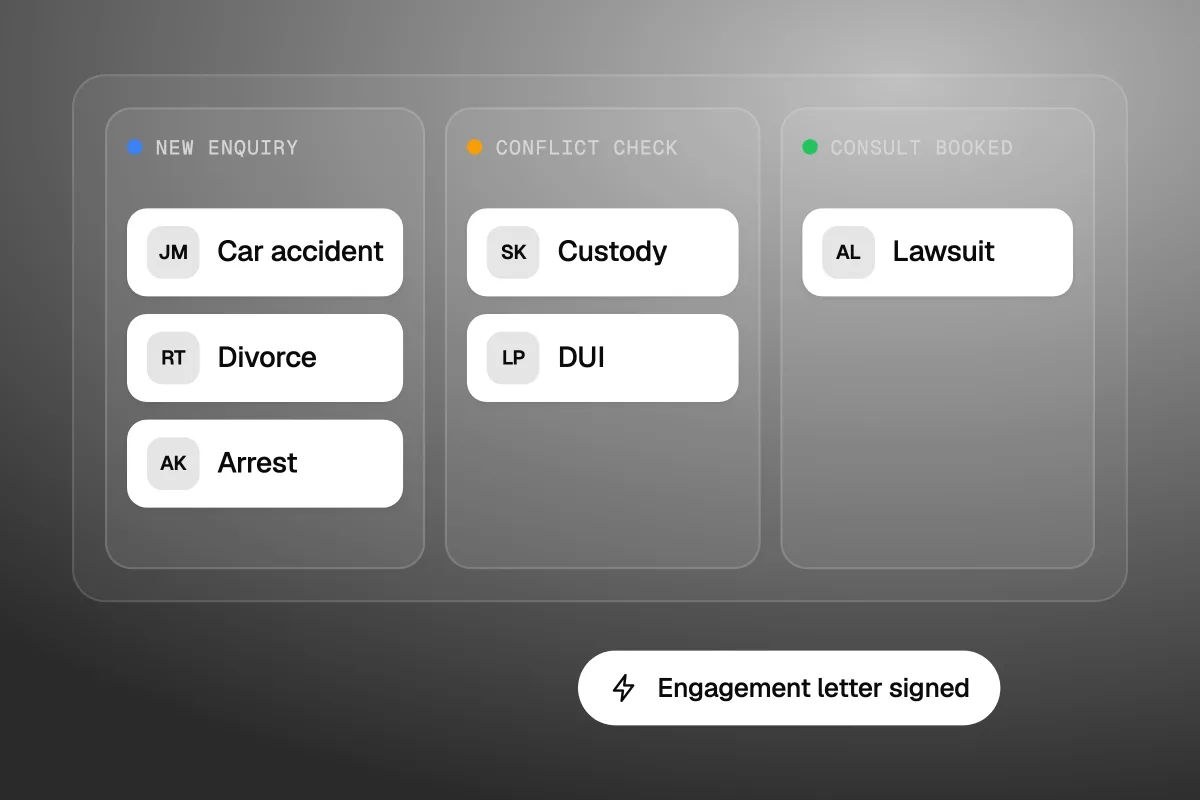
Legal intake is everything your law firm does from the moment a possible client gets in touch to the moment they sign your engagement letter. It covers the first call or form, the screening questions, the conflict check, the consult and the follow-up. Done well, more of the people who contact you become clients. Done badly, you pay for leads and lose them at the door.
Who this is for: law firms taking on new clients. In-house legal teams use the words "legal intake" for the way colleagues send in requests. That is a different job, and this post does not cover it.
We are a marketing team, not lawyers, and this is not legal advice. The rules below are the American Bar Association's model rules. Each state adopts its own version, so check yours.
The short answer
Legal intake has seven stages: first contact, screening, the conflict check, booking the consultation, the consultation, the engagement letter, and follow-up with people who have not decided. Take names before the story, so the conflict check runs first. Reply in minutes. Track every enquiry until it signs or says no.
What is legal intake?
Legal intake is the path a new matter takes into your firm. Someone has a problem. They call, fill in a form, start a chat, or get sent by another lawyer. Intake turns that first contact into a decision: take the case, refer it on, or say no.
It sits between two jobs that often get mixed up with it. Lead generation gets people to contact you, and our guide to law firm lead generation covers where those leads come from. Answering the phone is the first minute of intake, and our law firm answering service guide covers the call itself, with a script that takes names first. This post is the part in between: the full process, from the first hello to a signed engagement letter.
Why it matters: many firms are hard to reach. For Clio's 2024 Legal Trends Report, a research firm contacted 500 US law firms as would-be clients. Only 40% of the firms answered the phone, and only 33% replied to emails (2Civility, Illinois Supreme Court Commission on Professionalism, 1 November 2024).
Most firms do not need more leads first. They need fewer of the ones they already have to slip away.
The legal intake process, step by step
Here are the seven stages, in the order a new client moves through them.
1. First contact
New clients reach you in more ways than the phone. A web form at 11pm, a chat, a text to the number on your ad, a referral. Each one starts intake.
Two habits matter. Put every new enquiry in one place, like a CRM or your practice management software, with its source. And reply fast. A form or chat needs a reply within minutes, even if it only says "Thanks, here is a link to book a time."
2. Screening
Screening answers one question: is this the kind of matter your firm takes? Keep it short:
- The type of matter in a few words: a car accident, a divorce or custody case, an arrest, a DUI, a will, a lawsuit.
- Where it is. A firm licensed in one state may not be able to help with a matter in another.
- Any date coming up: a court date, a hearing, a deadline on a letter.
- The names of the caller and everyone on the other side. Step 3 needs them.
If the matter is not a fit, say so kindly, and point them to a lawyer referral service run by a state or local bar if you can.
3. Conflict check
This is the step that makes legal intake different from intake in any other business. Before your firm takes on a matter, it has to know it is not already working for the other side.
The ABA's comment on Model Rule 1.7 says a firm should have reasonable steps in place, suited to its size and practice, to find out who and what a new matter involves. It is blunt about firms that skip this: "Ignorance caused by a failure to institute such procedures will not excuse" a breach of the rule (ABA, Comment on Rule 1.7).
Check the caller, any other names they have used, everyone on the other side, and others involved like a spouse or business partner. Check them against current clients, former clients and past prospective clients. That last group is easy to miss. The State Bar of Arizona's FAQ on its version of Rule 1.18 gives an example. A husband meets the firm's intake paralegal, gets a fee agreement and never signs. The bar says he is likely still a prospective client and belongs in the conflicts database. When his wife later calls, the firm probably cannot just take her on (State Bar of Arizona, ER 1.18 FAQs).
Why the names have to come before the story
Under ABA Model Rule 1.18, a person who talks to a lawyer about hiring them is a "prospective client", even if they never sign. The firm must not use or reveal what they said. If they shared something that could seriously harm them in the matter, the firm can be blocked from acting against them in it.
The model rule gives two ways out. Both sides can give informed consent in writing. Or the firm can screen off the lawyer who heard it and tell the prospective client in writing. But the second route has a condition: that lawyer must have taken reasonable steps not to hear more than they needed to decide whether to take the case.
A conflict check only protects you if it runs before anyone hears the story.
If the check finds a conflict, an attorney decides what happens next. The ABA's comment on Rule 1.18 says the lawyer should tell the prospective client or decline. Keep that note short. Your other clients' business is private too.
4. Booking the consultation
Book the consult while the person is still with you. "We'll call you back to set a time" is where a lot of good matters go quiet.
- Offer two or three times, or send a booking link that shows only the times an attorney is free.
- Say up front if the consult is free or paid, how long it lasts, and how it happens.
- Confirm straight away with what to bring, then remind them the day before.
In your CRM, the matter now sits in a stage like "Consult booked". If you cannot see every matter in that stage at a glance, you cannot see who is about to slip. And ask for documents only after the conflict check clears. A pile of uploaded records is the story in a different shape.
5. The consultation
Hear what you need, not everything. The ABA's comment on Rule 1.18 says a lawyer deciding whether to take a new matter should keep the first consult to the information that seems needed for that decision. It also lets a lawyer ask the person to agree, with informed consent, that what they share will not stop the firm acting for someone else in the matter (ABA, Comment on Rule 1.18).
End with a clear next step. The person should leave knowing whether you will take the matter, what it will cost, and what happens next. Be careful with advice before they sign. The Arizona bar's FAQ says what matters most is whether the person reasonably believes you are their lawyer, and legal advice at intake is one way to create that belief.
6. The engagement letter
This is where intake ends. Under ABA Model Rule 1.5, the scope of the work and the basis or rate of the fee must be explained to the client, preferably in writing, before or soon after the work starts. A contingent fee agreement must be in writing, signed by the client, and say how the fee is worked out.
The rules set the minimum. Speed and ease decide whether it gets signed:
- Send it the same day as the consult, while the decision is fresh.
- Use e-signature, so it can be signed on a phone in a couple of minutes.
- Put the fee, any retainer and the next step in plain words at the top.
The last stage in your intake pipeline is simple: engagement letter signed. Then send a short welcome that says who their contact is and what happens in the first week.
Some firms also send a short letter to people they decide not to take on, so nobody thinks the firm is looking after their matter. That is our view, not a rule. Ask your bar or malpractice insurer.
7. Follow-up with people who have not decided
Some people have a consult and go quiet. Many firms send one email and stop. A short, kind plan works better:
- Same day: thank them and resend the engagement letter link.
- Two days later: answer the question most people have after a consult in your practice area.
- A week later: a short check-in. "Is anything stopping you from going ahead?"
- Two weeks later: a last note that says you will close the file unless they reply.
Stop as soon as they say yes or no. Under the ABA's comment on Model Rule 7.3, a reply to someone who asked you for information is not solicitation, and texts and emails are not the live, person-to-person contact the rule bans. Your state's rules may differ. Only text people who gave you their number to be contacted. These steps are easy to automate without sounding like a robot: here is how to automate follow-up without losing the human touch.
Who should own legal intake?
Someone has to own it. Not "whoever is free when the phone rings".
| Option | Works well when | Watch out for |
|---|---|---|
| In-house intake person | You have enough new enquiries to keep someone busy | One person cannot take two calls at once, and needs cover for lunch, sick days and nights |
| Answering or intake service | You need nights, weekends and overflow covered | They follow your script, so write it well, and ask how they handle privacy |
| The attorney does it | A very small firm with few, high-value enquiries | Attorneys are in court. Replies get slow, and billable time goes on calls that never sign |
| Chat and text tools on your site | Forms and chats after hours, booking, reminders and follow-up | They must say they are not a lawyer, and must not invite private details |
Most firms end up with a mix: a person in the day, a service at night, and automatic replies and follow-up for written enquiries. What matters is that one named person owns the whole pipeline and looks at it every day. If you are hiring, the job title is usually legal intake specialist. Look for someone calm on the phone who takes good notes and follows up without being told.
On chat: the Arizona bar's FAQ says people who use a law firm chatbot may become prospective clients, and suggests a clear "not a lawyer" label, no requests for confidential details, and a disclaimer.
Legal intake forms: what to ask, and what to leave for later
A legal intake form has two jobs. Get enough to run the conflict check and book the consult. Then stop. Long "tell us everything" forms put people off, and they pull in the story before the check has run.
There is a rule reason too. The ABA's comment on Rule 1.18 says that if your website or ad invites people to send details about a possible case, without clear warnings that limit what you owe them, a consultation has likely happened once they send it. So the form itself can make someone a prospective client.
| Ask on the first form | Leave until after the conflict check |
|---|---|
| Name, and any other names used | The full story of what happened |
| Phone, email and the best time to call | Documents, photos and letters |
| Names of the other side, people or companies | What they have said to the police, an insurer or the other side |
| Type of matter, from a short list | Medical or money records |
| Any court date or deadline | Anything they call private or secret |
Add a short note above the button, such as: "Please do not include private details about your case. Sending this form does not make us your lawyer." Have a lawyer at your firm write the final words to fit your state's rules. Keep it short enough to fill in on a phone.
The first form should open the door. It should not take the whole statement.
Speed: how fast should intake move?
Fast at the start, steady after that. We know of no study that names a perfect reply time, so here is the rule of thumb we would set.
| Moment | Our target |
|---|---|
| New call in office hours | Answered live |
| Missed call | A text back within minutes |
| Web form or chat | A reply within minutes, with a way to book |
| After hours | An instant reply that says when a person will follow up |
| Conflict check, and consult to engagement letter | Same day |
The missed call text is the cheapest fix here. Our guide to missed call text back shows what to send. And remember the Clio figures: answering at all puts you ahead of many firms.
What to measure
Track each matter as it moves through your pipeline: new enquiry, conflict check, consult booked, signed. Then look at these numbers once a month.
| Number | How to work it out | What it tells you |
|---|---|---|
| Time to first reply | Average minutes from first contact to first reply | Whether people are left waiting |
| Screened out, and why | A count by reason: wrong practice area, wrong state, conflict | Whether your marketing brings the right people |
| Consults booked | Consults booked, divided by enquiries that passed screening and the check | Whether staff book while the person is there |
| Consults kept | Consults held, divided by consults booked | Whether reminders work |
| Signed | Engagement letters signed, divided by consults held | Whether the consult and the letter do their job |
| Source of each signed case | The source written on every new matter | Which marketing to keep paying for |
Do not chase a number from someone else's firm. Compare this month with last month, and fix the stage where you lose the most people. For the wider set of numbers, including the money side, see our guide to law firm KPIs.
Where Havstock fits, and where it does not
Havstock does not run marketing for a law firm today, so this is our method, not a case study. The part of intake we would build: short intake forms on your practice area pages, instant replies, missed-call texts, AI chat on your site and by text that answers questions and books consults, consult reminders, a CRM pipeline with every stage above, and follow-up for people who have not decided. Your firm approves every word, and you own the data. That is part of Havstock Unlimited, our flat-fee marketing subscription. Here is how we approach marketing for law firms.
What we do not do: answer your phone. Our AI is chat and text only. It does not take calls. We also do not run conflict checks or give legal advice. If calls are where you lose people, an intake person or an answering service is the better fit.
This will not suit you if you are a solo attorney with a few new enquiries a week. At $4,995 USD a month, we cost more than you need. A booking link, a missed-call text and a written follow-up plan will get you most of the way.
FAQ
What is legal intake?
Legal intake is the process a law firm uses to turn a first contact into a signed client, or a polite no. It covers first contact, screening, the conflict check, booking and holding the consultation, the engagement letter, and follow-up with people who have not decided. In-house legal teams use the same words for internal requests.
What does a legal intake specialist do?
A legal intake specialist handles new client calls, forms and chats for a law firm. They take names for the conflict check, ask screening questions, book consultations, send engagement letters and follow up with people who have not decided. They do not give legal advice. That stays with the attorneys.
What questions should a legal intake form ask?
Keep the first form short: name, phone, email, the names of the other side, the type of matter, any court date or deadline, and how they found you. Leave the full story, documents and private details until the conflict check clears. Add a clear note that sending the form does not make you their lawyer.
Is what someone tells a law firm at intake confidential?
Usually, yes. Under ABA Model Rule 1.18, a person who consults a lawyer about hiring them is a prospective client. The lawyer must not use or reveal what they said, even if they never sign. Each state adopts its own version of the rule, so check your state bar's rules for the details.
Can AI handle legal intake?
Parts of it. AI chat and text can answer common questions, take names for the conflict check, book consults and send reminders. It should say it is not a lawyer, avoid asking for private details, and pass anything urgent to a person. The State Bar of Arizona gives similar advice for law firm chatbots.
Good legal intake comes down to order and ownership. Take names before the story. Reply in minutes. Send the engagement letter the same day. Follow up until you get a yes or a no. Then count what happens at each step, and start with the stage where you lose the most people.