
 Nathan Field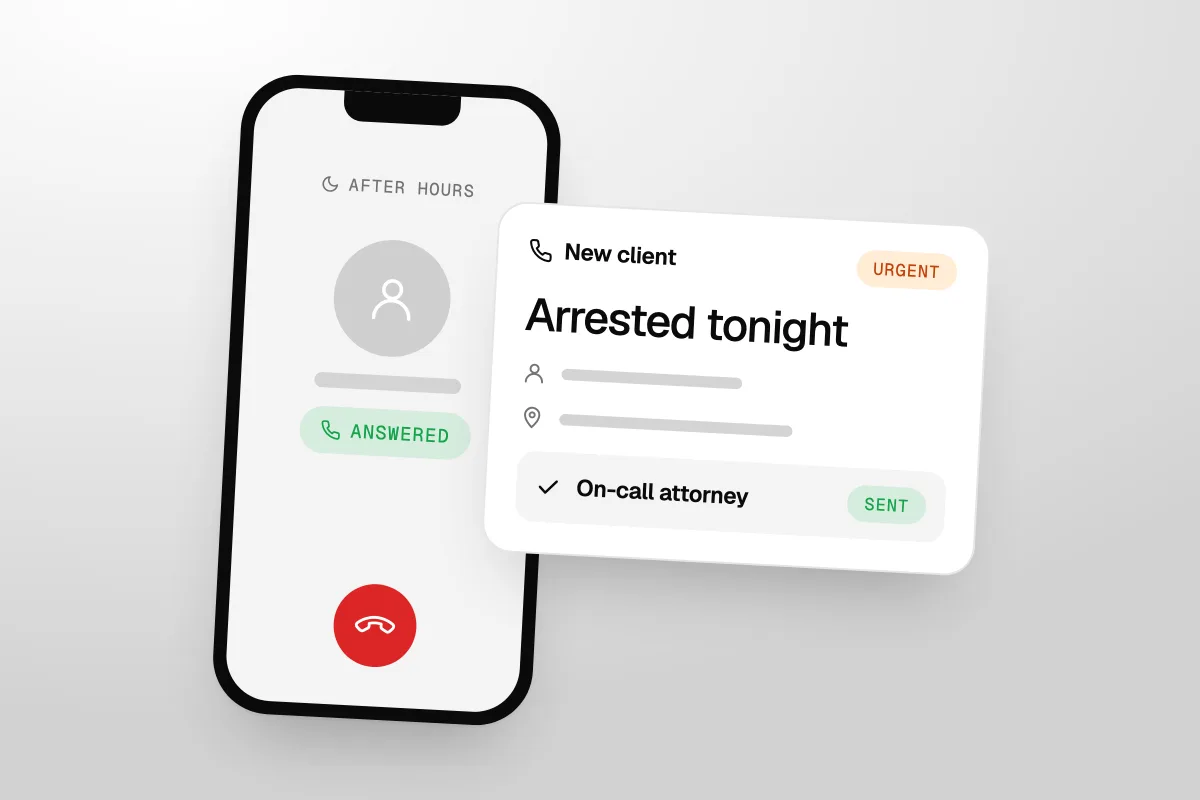
An answering service for a law office picks up your phone when nobody at the firm can, takes the first details from a new client, and gets urgent matters to an attorney fast. It can be people, AI or both. Law adds rules other trades don't have: check for conflicts before you hear the story, never give legal advice, and keep every word private. Below are real prices from each provider's own page.
The short answer
Most firms do best with a human answering service for nights, weekends and overflow. It should follow your script, take names for a conflict check before the caller's story, and ring an on-call attorney for arrests and close deadlines. Add a text for every missed call. Give AI routine calls only after it passes your own test calls.
Why the phone matters more for a law firm
People call a lawyer when something has gone wrong, and a lot of firms don't pick up. For Clio's 2024 Legal Trends Report, a research company contacted 500 US law firms as secret shoppers. Only 40% answered the phone, down from 56% in 2019. And 48% neither answered nor called back, which the summary calls "essentially unreachable by phone". Shoppers who did reach a person were the most likely to recommend the firm, over three times higher than the average. Those figures come from 2Civility's summary of the report, published 1 November 2024 by the Illinois Supreme Court Commission on Professionalism.
Your intake starts the moment the phone rings, not when the office opens.
What a law firm answering service does
The caller hears your firm's name. After hours, every call goes to the service. During the day, calls roll over after a set number of rings, so nobody hits voicemail while your front desk is busy. Here is what you are really paying for.
Takes the first call from a new client
This is the big one. A new client call should end with what your attorneys need to decide whether to call back: who the caller is, who is on the other side, what kind of matter it is, and whether a date is coming up. You write the script. The operator follows it. In law, the order of those questions matters, as you will see below.
Gets urgent matters to an on-call attorney
You decide what counts as urgent and who gets woken up. The service keeps your on-call list and a backup order. If the first attorney doesn't answer within a set time, it tries the next one and logs each try.
Books consultations and takes messages
Some services book straight into your calendar. Others send a message for the morning. Smith.ai, for example, charges $1.50 a call to book. When a current client calls about their case, the operator takes a message for the right attorney and doesn't discuss the case. They don't have the file, and they shouldn't.
Legal intake answering service: names first, story second
Most answering service pages skip this. Callers want to tell the whole story. In a law firm, letting them can cause trouble.
Under the American Bar Association's Model Rule 1.18, someone who talks to a firm about hiring it becomes a "prospective client". What they say is protected even if you never take the case. The ABA's comment says "the duty exists regardless of how brief the initial conference may be." It also says a lawyer should "limit the initial consultation to only such information as reasonably appears necessary for that purpose" (ABA, Comment on Rule 1.18). The ABA's rules are a model. Each state bar writes its own version.
Here is why that matters for your phones. Say a woman calls about a divorce, and her husband is already your client. If the operator takes her full story before anyone runs a conflict check, your firm now holds private details from the other side. Whether that becomes a real problem depends on your state's rules and what she said, which is a question for your bar, not us. The safe habit: take the names before the story.
A script in this order does that:
- Say who they have reached: "You've reached the firm's answering service. I'm not an attorney."
- If anyone is in danger right now, the caller should hang up and call 911.
- Take the caller's name and how to reach them.
- Take the names of everyone else involved, above all the other side. These go to the conflict check.
- Ask what kind of matter it is, in a few words: a car crash, a divorce, an arrest.
- Ask about dates: a court date, a hearing, a deadline on a letter they got.
- Stop there. Tell them when someone from the firm will call back.
Florida shows how far a non-lawyer can go. The Florida Bar's Ethics Opinion 24-1 points back to an older opinion, 88-6: non-lawyers may do the first interview with a prospective client, but they must say they are not lawyers, keep their questions to facts, and send any legal question back to the lawyer (Florida Bar Ethics Opinion 24-1, 19 January 2024). Advisory opinions are not binding, and this one only speaks for Florida. Rules differ by state bar, so read yours before you write the script. We are not lawyers, and this is not legal advice.
Who runs the conflict check?
Usually your own team, against your own client list. Smith.ai sells conflict checks at $0.50 a call. Ask what that buys: do they search your list, or just collect the names? Either way, your firm clears the names before an attorney hears the story.
Take the names before the story. It is the cheapest habit in intake.
The one thing it must never do: give legal advice
Callers will ask. "Do I have a case?" "Should I sign this?" "Should I talk to the police?" Fair questions, but the operator must not answer any of them. Even a right answer is legal advice from someone who is not a lawyer.
Give the operator one line to use every time: "I'm not an attorney, so I can't advise you on that. I'll make sure an attorney gets your question." Then the call goes back to names, facts and dates.
Test it before you sign. Call the service and push. Ask "But what would you do?" twice. A good operator stays polite and still doesn't answer.
The operator takes the facts. The attorney gives the advice. Never the other way round.
Urgent calls: arrests, court dates and deadlines
In a clinic, urgent means a symptom. In a law firm, it usually means a clock. Each practice area has its own:
| Practice area | What the caller says | What your rule might say |
|---|---|---|
| Criminal defense | "My son was arrested tonight." | Ring the on-call attorney now. Take where he is held, if the caller knows. |
| Family law | "I'm scared to go home." | Danger means 911 first, then the on-call attorney. |
| Landlord and tenant | "I've been locked out." | On-call attorney, or first call in the morning, by your rule. |
| Immigration | "They took my husband this morning." | Ring the on-call attorney now. |
| Business and civil | "I've just been served with a lawsuit." | Take the date on the papers. Flag it for first thing. |
The operator should never judge how serious a deadline is. So write rules as facts they can spot: "Any call that mentions an arrest, a detention or a court date this week goes to the on-call attorney now." Callers rarely use your words, so add the plain-speech versions too. "They took my husband" is a detention call, though nobody said the word.
Confidentiality: what to ask before you hand over the phones
Every call to your firm carries private details. The ABA's comment on Model Rule 5.3 says a lawyer using outside services "must make reasonable efforts to ensure that the services are provided in a manner that is compatible with the lawyer's professional obligations", with confidentiality called out in particular (ABA, Comment on Rule 5.3). Ask each service, in writing:
- Who answers our calls: your own staff or contractors? Where are they based?
- Will you sign a confidentiality agreement with us?
- Where are messages and recordings stored, who can see them, and for how long?
- Do you use AI on our calls? Whose, and does it keep or learn from what callers say?
Florida's Opinion 24-1 tells lawyers to research an AI program's policies on keeping data, sharing data and "self-learning", so that last question matters.
Bilingual callers
If your clients speak Spanish, your answering service needs to as well. PATLive answers in Spanish "at no additional cost". Ruby lists "24/7 Spanish and bilingual call handling available". Smith.ai charges $1.00 a call for a dedicated Spanish line. All three checked 1 October 2026.
The step firms miss is the next morning. If nobody at the firm speaks Spanish, the callback falls flat. Decide who makes those calls before you switch it on.
What a law office answering service costs
Here is what five services show on their own pages, checked 1 October 2026:
| Provider | Type | Plans a month | Extra use | Law firm notes |
|---|---|---|---|---|
| PATLive | People | $99 for 50 minutes; $189 for 100; $349 for 200. Or $49 pay as you go | $2.29 / $2.09 / $1.99 a minute; $2.99 on pay as you go | Spanish at no extra cost. 14-day free trial. Taxes and fees extra |
| Ruby | People | $250 for 50 minutes; $395 for 100; $720 for 200; $1,725 for 500 | No rate on the page | Client intake included on every plan. No setup fees |
| Smith.ai | People or AI first | $300 for 30 calls; $810 for 90; $2,100 for 300 | $11.50 / $10.50 / $8.50 a call | Per-call add-ons: conflict checks $0.50, extended intake $1.50. Same price at 2am as 2pm |
| Goodcall | AI | $79 / $129 / $249 per agent, for 100 / 250 / 500 unique customers | $0.50 per extra customer | Unlimited minutes. 15% off if you pay yearly |
| Answering Legal | People, law firms only | No prices on its cost page, just a calculator | By the minute | Average call "less than 3 minutes" |
Check your state bar's member benefits too. The Florida Bar's member page lists deals on three of these: 10% off PATLive's monthly charges, 8% off Ruby, and $100 off the first month at Smith.ai. Other bars may have their own.
Why intake calls cost more on a per-minute plan
A new client call that runs your full script is long. Say 40 calls a month go to the service. As quick messages at 2 minutes each, that is 80 minutes. As full intake calls at 6 minutes each, it is 240. Here is the bill on each provider's cheapest plan that fits, before taxes and fees:
| Provider | 40 message calls (80 minutes) | 40 intake calls (240 minutes) |
|---|---|---|
| PATLive | $189 (100-minute plan) | $428.60 (200-minute plan plus 40 minutes at $1.99) |
| Ruby | $395 (100-minute plan) | $720 (200-minute plan) plus 40 minutes at a rate not on the page |
| Smith.ai | $415 (30 calls plus 10 at $11.50) | $495 (the same, plus conflict checks and extended intake on all 40) |
| Goodcall | $79 | $79 |
The per-minute plans more than double when calls get longer. The per-call plan barely moves, and the AI plan doesn't move at all. A long script is the best case for per-call or AI pricing. Short message calls favour per-minute plans.
Price the service for your real intake script, not for a two-minute message.
Compared with hiring a receptionist
The US Bureau of Labor Statistics puts median pay for receptionists at $38,010 a year in 2025. In professional, scientific and technical services, the industry group law firms belong to, the median was $18.56 an hour (BLS, Receptionists, page updated 27 August 2026). That is before payroll taxes and benefits. A good receptionist knows your clients, and no service matches that. But a 40-hour week leaves 128 hours with nobody at the desk.
Human, AI or in-house: which fits a law office?
| Option | Where it works in a law firm | Where it struggles |
|---|---|---|
| Human answering service | After hours calls, upset callers, arrests at 2am | Per-minute bills climb with long intake calls |
| AI answering service | Routine questions, booking a consult, flat bills | Can miss an urgent call in plain speech. Bar rules on AI apply |
| In-house receptionist | Knowing your clients, a call from a judge's clerk | Office hours only, one call at a time |
| Voicemail and a callback | A last resort | A caller with an arrest tonight will try the next firm. |
Where AI fits, and where it doesn't yet
AI answering has got good fast, and its bill doesn't care how long your script is. Our worry is the caller who doesn't use your words. A person hears "they took my husband" as urgent. A bot may file it as a general question. If you use AI, set it to pass anything near your urgent rules to a person, then test it with messy, real calls.
There are disclosure rules too. Florida's Opinion 24-1 says a lawyer "must inform prospective clients that they are communicating with an AI program and not with a lawyer or law firm employee", and should consider screening questions in case a person already has a lawyer. That opinion is about chatbots. Ask your own bar how its rules apply to an AI voice on your phone line.
What an answering service does not fix
An answering service covers the phone. New clients also fill in forms at midnight, open the chat on your site, or text the number on your ad. And a message taken at 9pm only counts if someone follows it up. Two things help: a text within minutes for every missed call (our missed call text back guide shows what to send), and follow-up that chases every enquiry until it books. We cover where those enquiries come from in law firm lead generation.
The same rules follow you into chat and text. Say it is AI when it is. Never give advice. Take names before the story. Check your state bar's ad rules first.
Our take
Here is what we would do. The front desk answers during the day, with every line set to roll over instead of ringing out. A human answering service covers nights, weekends and overflow, with your script in the order above and a clear on-call list. AI gets routine daytime overflow first, and more only once it passes your test calls.
Then make three test calls after hours: a new client who names one of your clients as the other side, "My son was arrested tonight", and "Do I have a case?". You want names before the story, a call to your on-call attorney, and "I'm not an attorney". Our plumbing, HVAC and medical answering service guides run the same tests for other trades.
Answering is one job. Getting the right people to call, and following up until they book, is another. That one is ours. Havstock Unlimited is a flat-fee marketing subscription: ads, your website, a CRM, missed-call texts, email follow-up, and AI chat on your site and by text that answers questions and books consultations. It does not answer phone calls. We are not an answering service. Here is how we approach marketing for law firms.
At $4,995 USD a month, we will not suit a solo attorney who only needs the phones covered at night. If that is you, a $189 answering plan and a missed-call text will do more for you than we can.
FAQ
What is a legal answering service?
It answers your firm's phone when your staff can't, using your firm's name and a script you write. It takes names for a conflict check, notes the type of matter and any dates, books consultations or takes messages, and sends urgent calls to an on-call attorney. It can be people, AI or both. It never gives legal advice.
How much does an answering service for a law firm cost?
On providers' own pages, checked 1 October 2026: human plans start at $99 for 50 minutes (PATLive), $250 for 50 minutes (Ruby) and $300 for 30 calls (Smith.ai). AI plans start at $79 a month (Goodcall). Long intake calls push per-minute bills up. Some legal-only services only quote on request.
Can an answering service give legal advice?
No. Operators are not lawyers. They should say so, keep to facts, and pass every legal question to an attorney. Florida's Ethics Opinion 24-1, citing an older opinion, says non-lawyers doing a first interview must not offer legal advice. Rules differ by state, so check your own bar's rules before you write the script.
Is it ethical for a law firm to use an AI receptionist?
It can be, but bar rules apply. Florida's Opinion 24-1 says an AI chatbot must tell prospective clients it is an AI program, not a lawyer or staff member, and that lawyers must check how the tool keeps and shares data. Ask your own state bar how its rules apply before you switch one on.
What is the difference between an answering service and a virtual receptionist?
Vendors use both words, and they overlap. A plain answering service takes messages. A virtual receptionist acts more like your front desk: it transfers calls, runs your intake script and books consultations. Ignore the label. Ask what the service does on a call, and what each part costs.
The right answering service for your law office takes names before stories, never gives advice, and gets an arrest at 2am to an attorney in minutes. Write the script with your attorneys, check it against your state bar's rules, and call the answering service yourself before a new client does.