
 Nathan Field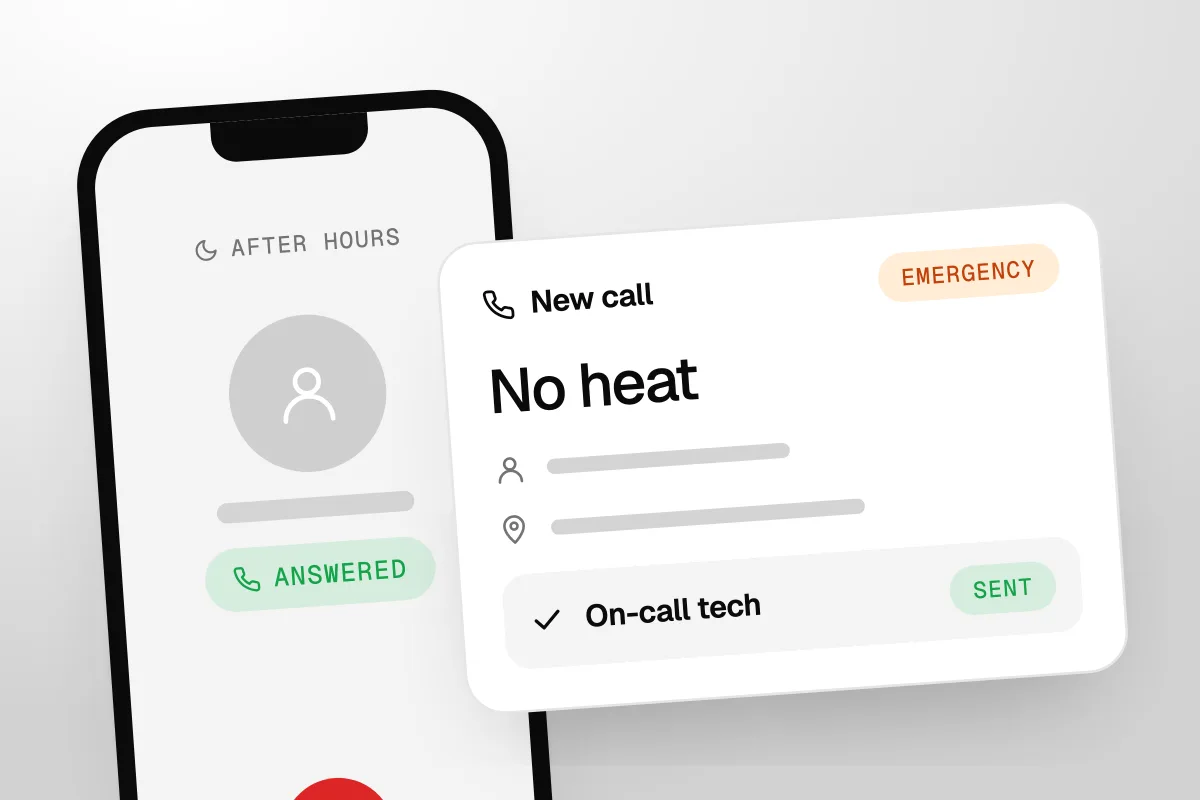
An HVAC answering service picks up your phone when your team can't, sorts no-heat and no-cool emergencies from routine jobs, and gets the urgent ones to your on-call tech. It can be people, AI or both. The HVAC twist: the weather sets your call volume, and most plans charge by the minute or the call. Below are real prices from each provider's own page, and what a heat wave does to the bill.
The short answer
Most HVAC shops do best with a human answering service for nights, weekends and overflow, plus an automatic text for every missed call. Pick a plan that fits your busiest month, not your average one. AI answering stays cheap in a surge, so use it for routine calls once it has passed your own emergency test calls.
What an HVAC answering service should do
Taking a name and number is the easy part. What you pay for is the first two minutes: does the right job reach the right person, fast?
The safety line comes first
A carbon monoxide alarm going off, or a smell of gas, needs one answer in seconds. The CDC's advice is short: "If the detector sounds leave your home immediately and call 911" (CDC, Prevention Guidelines). Put that line at the top of your script. For a gas smell, add your local gas company's emergency number. Then the service tells your on-call tech. Nobody on the phone, person or bot, should try to talk a caller through it.
How urgent is a no heat or no cool call?
Not every no-heat call is the same job. A furnace that quits on a mild October night can wait for the first slot tomorrow. The same fault during a freeze, in a home with a newborn, cannot. A good service asks a few set questions and puts each call in the right lane:
- Is anyone in danger right now? A CO alarm, gas smell, sparks or smoke goes straight to the safety line.
- Is the system fully off, or running but not keeping up?
- Who is in the home? Babies, older people and anyone who is unwell move the call up.
- How hot or cold is it inside right now?
- Is the caller on your maintenance plan?
- Are they happy to pay your after-hours fee? The service should say the fee out loud.
You write the rules. For example: no heat, and the house is below a temperature you pick, means ring the on-call tech now. An AC blowing warm air on a cool night means the first slot tomorrow. The operator follows your rules and never makes up their own.
The call-down list
The service needs tonight's on-call tech and a backup order. If the first tech doesn't pick up within a set time, it tries the next one, then you, and logs each try. After a busy night you want to see which calls reached a tech and which sat waiting. Some providers charge extra for this, as the prices below show.
Tune-ups and maintenance members
Tune-ups, filter changes and quotes for a new system can wait, but they pay the bills. They should land in your calendar or field service software, not in an email someone retypes. Maintenance-plan members should be spotted and put first, because that is what they pay you for.
The service is not there to take messages. It is there to decide, in under two minutes, whether your tech gets out of bed.
Why an answering service for HVAC company calls needs a surge plan
About 88% of US households use air conditioning, according to the US Energy Information Administration (2020 survey, published May 2022). Many of those systems get their first real test on the same hot afternoon. Then it happens again in reverse at the first cold snap, when furnaces that sat idle all summer get switched on. ENERGY STAR tells homeowners to book cooling checks in spring and heating checks in fall because "contractors get busy once summer and winter come" (ENERGY STAR, maintenance checklist, checked 29 September 2026).
So your phone line has three different jobs across the year:
| Season | What callers want | What the service has to do |
|---|---|---|
| First heat wave | No cool, AC blowing warm air, a unit that has iced up | Keep up with the volume, sort real emergencies fast, book the rest in order |
| First cold snap and winter | No heat, a furnace that won't light, a CO alarm, a gas smell | Safety line first, then get no-heat calls that can't wait to the on-call tech |
| Spring and fall | Tune-ups, maintenance visits, quotes for new systems | Book into your schedule and fill the quiet weeks |
An HVAC phone isn't busy all year. It is flat out twice a year and quiet in between.
Every answering service sells "24/7". For HVAC, ask what happens on the worst day of July, when every AC in town seems to quit by lunchtime. Can they keep up, and what will that month cost?
If you run Google Local Services Ads, a missed call can soon cost you more than the job. Read what the new Local Services Ads missed-call charges mean before the busy season.
What an HVAC answering service costs
Here is what five services charge, from their own pricing pages, checked 29 September 2026. Three use people and two use AI. None of them is HVAC-only, but PATLive has a page for home services and trades, and Specialty Answering Service has one for HVAC.
| Provider | Type | Plan | Price a month | Included | Extra use |
|---|---|---|---|---|---|
| PATLive | People | 50 / 100 / 200 minutes | $99 / $189 / $349 | About 20 / 40 / 80 calls, by PATLive's own estimate | $2.29 / $2.09 / $1.99 a minute |
| Specialty Answering Service | People | Economy / 100 Minute / 220 Minute | $44 / $159 / $269 | 0 / 100 / 220 minutes | $1.54 / $1.44 / $1.44 a minute |
| Smith.ai | People | Starter / Basic / Pro | $300 / $810 / $2,100 | 30 / 90 / 300 calls | $11.50 / $10.50 / $8.50 a call |
| Dialzara | AI | Business Lite / Pro / Plus | $29 / $99 / $199 | 60 / 220 / 500 minutes | $0.48 / $0.45 / $0.40 a minute |
| Rosie | AI | Professional / Scale / Growth | $49 / $149 / $299 | 250 / 1,000 / 2,000 minutes | No rate shown on the page |
Read the small print too:
- PATLive also has a $49 pay-as-you-go plan at $2.99 a minute. It answers in English or Spanish at no extra cost and has a 14-day free trial. Taxes and fees are extra.
- Specialty Answering Service bills by the second, with no setup fee and a 14-day free trial.
- Smith.ai bills per call, charges the same at 2am as at 2pm, and doesn't charge for spam. Booking into your calendar adds $1.50 a call. Its AI plans are priced separately.
- Dialzara and Rosie both have 7-day free trials. Rosie takes two months off a yearly plan.
These pages change often, so check them again on the day you sign.
What a heat wave does to the bill
Say a normal month sends 80 calls to the service. PATLive counts 200 minutes as about 80 calls, so call it 200 minutes. A heat wave doubles that to 160 calls and 400 minutes. Here is the bill on each provider's plan that fits a normal month, before extras and taxes:
| Provider and plan | Normal month (80 calls, 200 minutes) | Heat wave month (160 calls, 400 minutes) |
|---|---|---|
| PATLive, 200 minutes | $349 | $747 |
| Specialty Answering Service, 220 Minute | $269 | $528.20 |
| Smith.ai, Basic | $810 | $1,545 |
| Dialzara, Business Pro | $99 | $180 |
| Rosie, Scale | $149 | $149 |
The human plans about double. That is fair, since more calls mean more operator time. Just budget for it before July, so August is not a shock. The AI plans barely move, and that is the strongest case for AI in HVAC.
Moving up a plan before the busy season can also cost less than paying for extra minutes. On PATLive, 400 minutes on the 300-minute plan comes to $668 ($479 plus 100 minutes at $1.89), against $747 on the 200-minute plan. Ask whether you can change plans before summer and winter, and back again after.
Price your answering service for the worst week of July, not the average week of April.
What it costs to reach your on-call tech
Getting a no-heat call to a tech at 11pm is the whole point, and it is the part owners forget to price. Providers handle it differently:
- Specialty Answering Service charges $0.10 a minute for patching, which means connecting a caller to you, from connect until the call ends.
- Smith.ai charges $0.50 for a text or Slack alert when a caller qualifies for a transfer, plus $0.25 for each extra "ping", such as trying a second person after the first.
- PATLive lists emergency dispatch and call transfers among the features included with every plan.
- Rosie offers live and warm transfers from its $149 Scale plan. Its "waterfall transfers", where it keeps trying numbers until someone answers, are on the $299 Growth plan only.
- Dialzara has blind transfers only on its $29 plan. Warm transfers, where your tech hears who is calling before the caller is put through, start on the $99 plan.
For an on-call rota, the backup call matters most. If your first tech sleeps through the ring, the next one has to be tried automatically. Check which plan includes that before you compare headline prices.
Compared with hiring a dispatcher
The US Bureau of Labor Statistics puts median pay for receptionists at $38,010 a year, or $18.27 an hour, in 2025 (BLS, Receptionists, page updated 27 August 2026). That is about $3,170 a month in pay, before payroll taxes and benefits.
A good dispatcher knows your techs, routes jobs by area and sells maintenance plans on the phone. An answering service won't. But a 40-hour week leaves 128 hours with nobody at the desk, and one person takes one call at a time. On the first hot Monday of summer, that is not enough.
HVAC after hours answering service: human, AI or in-house
| Option | Where it works in HVAC | Where it struggles |
|---|---|---|
| Human answering service | Night and weekend emergencies, scared callers, judging a no-heat call from a home with a baby | Bills climb with every surge. Ask how hold times hold up when many of their clients get slammed by the same weather. |
| AI answering service | Surges, routine bookings, tune-up season, a bill that barely moves | Can misread an emergency. Some callers hang up on a bot. Transfer features may sit on a higher plan. |
| In-house dispatcher | Busy shops that want someone who knows the techs and the regular customers | Office hours only. One person can't take ten calls at once in July. |
| A missed-call text on its own | The minimum, and worth having next to anything else you pick | Someone with no heat at 10pm will often ring the next company rather than wait for a reply. |
Where AI fits, and where it doesn't yet
AI answering is good now, and it never puts anyone on hold in a heat wave. Our worry is the caller who doesn't use the words in your script. "It's a bit chilly in here and Mom's not feeling great" is a no-heat call with a vulnerable person in the home. A person on the phone may hear that. A bot may log it as a routine visit. So if you use AI after hours, set it to pass anything near your safety or no-heat rules to a person or your on-call tech. Then test it with the vague, messy calls customers really make.
Callers rarely say "emergency". They say the house is cold and Mom isn't well.
Questions to ask before you sign
- What will my bill be in a month with double my normal calls? Can I change plans for summer and winter?
- When a heat wave hits and many of your clients get busy at once, what happens to hold times?
- How do urgent calls reach my on-call tech? Do you try a second person if the first doesn't answer? Does that cost extra?
- Can I write the safety line and the no-heat rules myself, and change them any time?
- Can you spot my maintenance-plan members and put them first?
- Do you book into my field service software, or send messages only?
- Can callers be answered in Spanish?
Then call the service yourself after hours, three times. First, say your CO alarm is going off. You should hear "leave the house and call 911" within seconds. Second, say you have no heat and a newborn at home. That call should reach your on-call tech. Third, ask for a tune-up next week. That one should land in your calendar, not your voicemail.
If you haven't called your own answering service at night, you don't know what it says.
Our take
Our view: set up your phones by season, not once and forget it.
Before summer, pick the plan for your worst month, test the no-cool rules, and set every office line to roll over to the service after a few rings instead of ringing out. Before the first cold snap, check the safety line and the on-call list, then test again. In spring and fall, when the phone is quiet, use the time to fill the calendar with tune-ups.
Start with a human service after hours. Put AI on daytime overflow and tune-up bookings, and hand it more only as it passes your three test calls. Plumbers face the same choice with burst pipes, and our plumbing answering service guide compares it for them.
Whatever you pick, some calls will still be missed. Every one should trigger an automatic text within minutes, so the caller has a reason to wait for you instead of calling the next company. Our guide to missed call text back shows what to send and how to set it up.
Answering is one job. Getting the phone to ring in the first place, and chasing every lead and quote until it books, is another. That second job is ours. Havstock Unlimited is a flat-fee marketing subscription: ads planned around the seasons, your website, a CRM, missed-call texts, tune-up reminders, and AI chat on your site and by text that answers questions and books jobs. It does not answer phone calls. We are not an answering service. You can see how we run marketing for HVAC companies season by season.
At $4,995 USD a month, we will not suit a two-truck shop. If that is you, a $269 answering plan and a missed-call text are the better spend.
FAQ
What does an HVAC answering service do?
It answers as your company when your team can't, and follows rules you write. It sends CO alarm and gas calls to 911 first, sorts no-heat and no-cool calls by how urgent they are, rings your on-call tech for emergencies, and books tune-ups and routine repairs. It can be people, AI or both.
How much does an HVAC answering service cost?
On providers' own pages, checked 29 September 2026: human services start at $44 to $49 a month plus every minute used (Specialty Answering Service, PATLive), and $300 for 30 calls at Smith.ai. AI services start at $29 to $49 a month (Dialzara, Rosie). Per-minute and per-call plans cost more in a heat wave or a freeze.
Can an answering service dispatch my on-call tech?
Yes, most can, but check the details. The service needs your on-call list and a backup order. Some charge for it: Specialty Answering Service lists patching at $0.10 a minute, and Smith.ai charges for transfer alerts. Some AI plans keep call-down transfers for higher tiers, like Rosie's $299 Growth plan.
Is an AI answering service good enough for HVAC emergencies?
For routine calls, often yes, and its price barely moves in a surge. For emergencies, test it first. Callers rarely say "emergency". They say the house is cold and someone is unwell. Set the AI to hand anything that touches your safety or no-heat rules to a person or your on-call tech.
What should an answering service say if a caller's CO alarm is going off?
It should tell them to leave the house now and call 911, as the CDC advises. For a gas smell, add your gas company's emergency line. Only then should it alert your on-call tech. No operator or AI should try to find the cause or keep the caller inside talking.
Should an HVAC company use an answering service or hire a dispatcher?
Most busy shops end up with both. A receptionist's median pay was $38,010 a year in 2025 (US Bureau of Labor Statistics), and a 40-hour week leaves 128 hours uncovered. A dispatcher runs the day. An answering service covers nights, weekends and the surge days when one person can't keep up.
The right HVAC answering service is the one that still works on the hottest night of July and the first freezing night of winter. Write the safety line and the no-heat rules yourself, price the plan for your busiest month, and test it with your own worst call before a customer makes it.