 Nathan Field
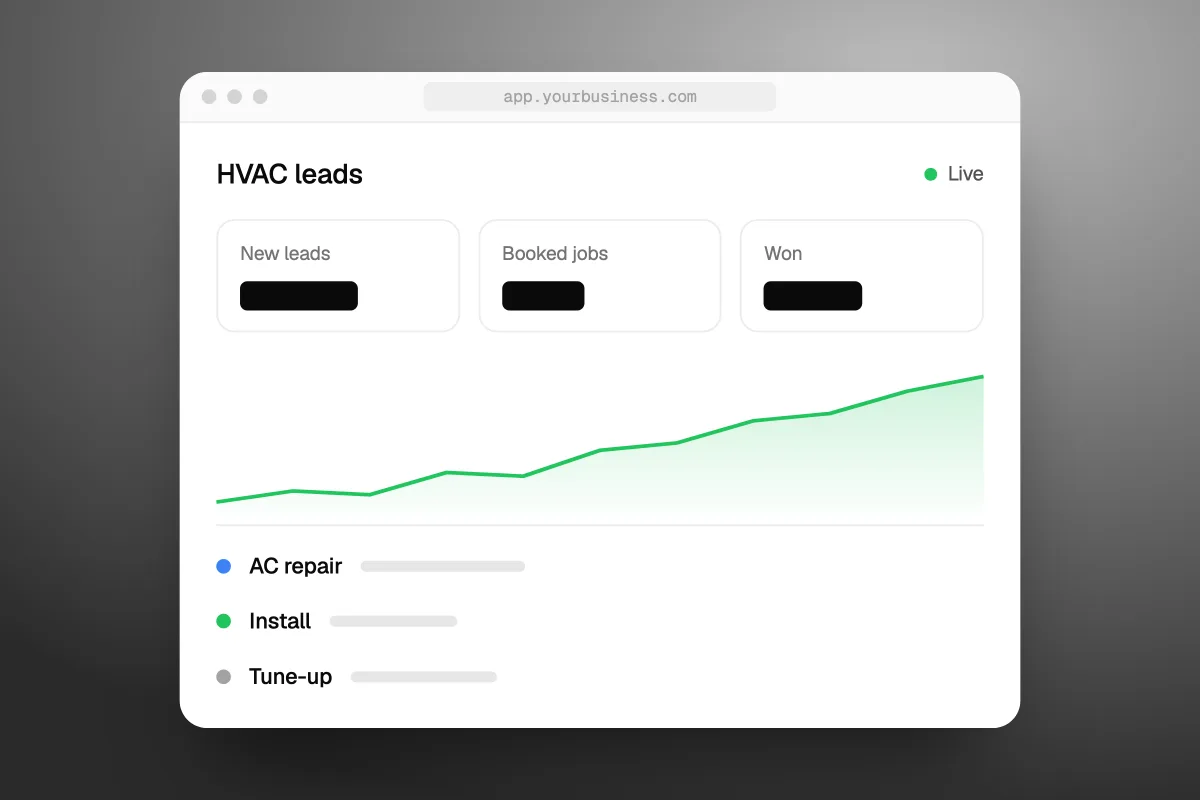
To get more HVAC leads, work in order: catch the leads you already get, win on Google, build service and town pages, then run ads, and smooth out the seasons with maintenance plans. If you have searched how to get more HVAC leads, you have met the long lists that skip two things that decide whether any of it pays: the order you do things in, and how you handle the swings between the cooling season and the heating season. This guide covers both.
The short answer
Answer every call and text back missed ones. Fix your Google Business Profile and gather recent reviews. Build a page per service and town. Run search ads in peak season. Sell maintenance plans to create year-round work. Then judge every lead source on cost per booked job, not cost per lead.
Why do HVAC leads come in waves?
HVAC leads come in waves because demand follows the weather. The first hot week floods you with AC repair calls. The first cold snap brings furnace and heat pump calls. Between those peaks, in spring and autumn, the phone goes quiet. If your lead plan ignores this, you overpay for leads in peak season and starve in the shoulder months.
The swing shapes how you get leads. In peak season, demand is high and so is competition, so speed and ranking decide who wins the AC repair call. In the quiet months, you are not fighting for emergency calls that are not happening. You are creating demand: install quotes, tune-up bookings and maintenance plans that fill the gap. Trying to run the same play all year is why a lot of HVAC marketing feels like feast or famine.
Employment in the trade is projected to grow faster than average over the decade, driven by climate-control demand and equipment that needs skilled service (US Bureau of Labor Statistics). The work is growing. The job is to catch more of it, more evenly.
Demand follows the weather. Your lead plan has to follow the demand, not fight it.
How do you get more HVAC leads, step by step?
You get more HVAC leads by building cheap, owned sources first and paying for leads last. Each step makes the next pay better, so the order is not optional. Here it is.
- Count what you get now. For 30 days, log every call, form and text, where it came from, whether it booked, and what the job was worth. Ask every caller how they found you.
- Answer every call, catch every miss. Set the line to ring more than one phone, cover nights and weekends, and auto-text missed calls. See our guides to an HVAC answering service and to missed call text back.
- Fix your Google Business Profile. It is free and it puts you on the map. Google says there is "no way to request or pay for a better local ranking on Google" (Google Business Profile Help), so you earn it with relevance, reviews and accurate details. List it correctly as a service-area business (Google guidelines for representing your business).
- Ask for a review after every job. Same day, by text, while the house is cool or warm again. Recent reviews carry more weight than old ones.
- Build a page per service and town. AC repair, furnace repair, Install, heat pump, Tune-up, indoor air quality. One page each, per town. That is where your ads should land.
- Run search ads in peak season. Turn them up when demand is high, down when it is not, and send each ad to the matching page.
- Sell maintenance plans. They turn one job into years of work and fill the quiet months. More on this below.
- Buy third-party leads last, only to fill gaps, and only while they pay.
If you want the wider picture beyond leads, pricing, hiring, systems and margins, read our guide on how to grow an HVAC business.
Which HVAC lead sources should you build first?
Build the sources you own before the ones you rent, because owned sources keep working after you stop paying and rented ones stop the day the budget does. This order is what keeps you off the treadmill of paying more every peak season just to stand still.
Owned sources are your Google Business Profile, your reviews, your website and its pages, your maintenance plan members, and your past customers. They cost time to build. Rented sources are search ads, Local Services Ads and third-party lead sites. They cost money per lead or per click, and the lead site kind often sells the same contact to several contractors at once.
| Source | Type | How you pay | Works after you stop paying? |
|---|---|---|---|
| Google Business Profile | Owned | Free, costs time | Yes |
| Reviews | Owned | A text per job | Yes |
| Website and service pages | Owned | Your time or a build team | Yes |
| Maintenance plan list | Owned | Service time | Yes |
| Search ads | Rented | Per click, to Google | No |
| Third-party lead sites | Rented | Per lead, shared | No |
None of the rented sources are wrong. They are fast, and in a peak-season AC repair rush that speed is worth paying for. The trap is leaning on them all year while the owned base stays thin, because then your lead cost only ever goes up. Build owned first, rent to fill the gaps.
How do maintenance plans create leads year round?
Maintenance plans create leads year round by turning one-off customers into repeat work and by giving you a reason to call people in the quiet months. A maintenance plan is a simple agreement: the customer pays a flat yearly or monthly fee, and you service their system on a schedule, usually a cooling Tune-up in spring and a heating check in autumn.
That does three useful things for your lead flow. It books work into the shoulder seasons on purpose, when emergency calls are scarce. It puts a technician in front of the equipment twice a year, where small faults get caught and bigger jobs like an Install get quoted before the system fails on the worst day. And it builds a list of customers who already trust you, the cheapest source of future AC repair and replacement work you will ever have.
Market the plan after every repair and install, while the customer is glad the problem is solved. Then keep a simple reminder system so the spring and autumn visits actually get booked. Most HVAC shops that struggle with quiet months do not have a demand problem. They have a list they never call. A tidy HVAC marketing setup makes those reminders automatic instead of a sticky note on the office wall.
A maintenance plan books your quiet months in advance and hands you the next job before the system dies.
How do you judge an HVAC lead source?
You judge an HVAC lead source on cost per booked job, not cost per lead. A source can look cheap per lead and still be your worst, if those leads rarely book or book only low-value call-outs. Cost per booked job cuts through it.
Keep four numbers per source each month: leads, booked jobs, spend and revenue. Then work out two things.
| Number | How to get it | What it tells you |
|---|---|---|
| Cost per booked job | Spend divided by booked jobs | What a real customer from this source costs you |
| Return | Revenue divided by spend | Whether the source makes or loses money |
Now the calls are easy. Feed the sources with a low cost per booked job and a strong return. Cut the ones where the cost per booked job climbs above what the work is worth. Watch it by season, too: a source that pays in a July AC repair rush may not pay in April, so you turn spend up and down with the weather instead of leaving it running all year.
One more cut worth making: track which sources bring the jobs you want. If plan sign-ups and Install quotes pay better than small call-outs, point your pages, reviews and ads at those searches. Getting more HVAC leads is good. Getting more of the right ones is better.
Do this review monthly, not once. Lead sources drift. A search ad that paid last summer can slip as more contractors bid in your town, and a lead site that worked in a heat wave can go quiet in spring. The shops that stay full are not the ones with a secret source. They are the ones who look at the numbers every month and move the money.
No lead source stays good forever. The monthly habit of checking cost per booked job is the real edge.
FAQ
What is the fastest way to get more HVAC leads?
Answer every call and text back the ones you miss. It needs no ad budget. In peak season, calls ring out while crews are on jobs, and each missed one is a booked job handed to a competitor. Catching those is usually the quickest lead win available.
Do HVAC maintenance plans really bring in leads?
Yes, in two ways. They book work into the quiet shoulder seasons on a schedule, and they put a technician in front of the system twice a year where a Tune-up turns into a repair or an Install quote. They also build a trusted customer list you can call anytime.
Should I use Google ads or lead sites for HVAC?
Use search ads before lead sites. Ads send the click to your own page and the lead is yours. Lead sites sell the same contact to several contractors. Judge both on cost per booked job, and turn ad spend up in peak season and down in the quiet months.
How many reviews does an HVAC business need?
Enough recent ones to look active and trusted in your town, gathered steadily rather than in one burst. Ask after every job, by text, the same day. A flow of fresh reviews from this season carries more weight with buyers and with Google than a pile of old ones.
How do I keep HVAC leads coming in the off-season?
Shift from catching demand to creating it. Sell maintenance plans, book spring and autumn Tune-up visits, and call past customers about aging systems before they fail. The off-season is when install quotes and plan sign-ups are won, not emergency AC repair calls.
Is a website necessary to get HVAC leads?
Yes. A site with a page per service and town ranks in search and gives your ads a place to land that matches what the person clicked. A homepage that lists everything converts worse than a page built for one job, like AC repair in one town.
Getting more HVAC leads is not about one clever trick. It is the owned sources first, ads in season, maintenance plans to smooth the quiet months, and a weekly eye on cost per booked job. That is exactly what Havstock Unlimited runs for HVAC businesses: profile, reviews, site, pages, ads and plan reminders on a flat monthly fee. If you would rather book jobs than manage marketing, see how Havstock Unlimited works.
Running ads? Check the maths first with our free ROAS calculator.