
 Nathan Field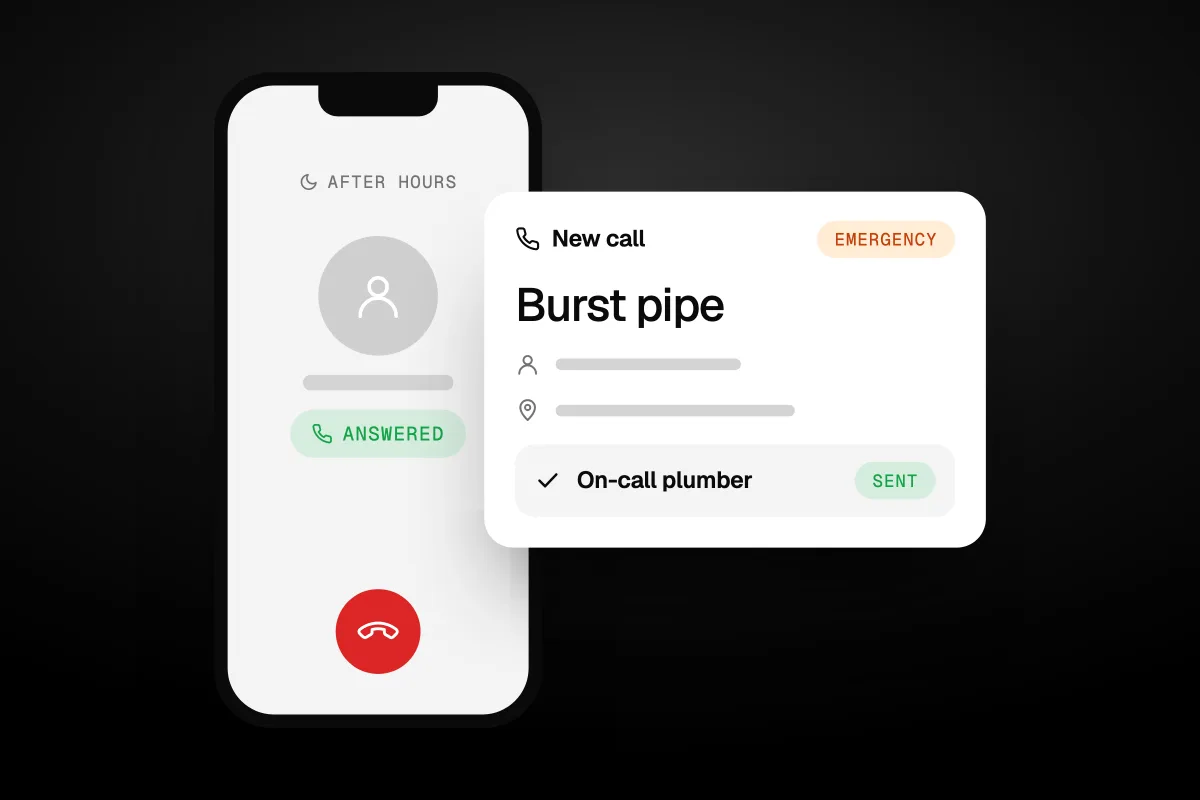
A plumbing answering service picks up your calls when you can't, takes the job details, sorts real emergencies from routine work, and gets the urgent ones to your on-call plumber. You can get one staffed by people, run by AI, or a mix of both. This guide shows what each one costs, using prices we checked on the providers' own pages, and which one fits which kind of plumbing shop.
One thing makes this more urgent than usual. From 1 October 2026, Google can charge Local Services Ads advertisers for missed calls during business hours. If you run those ads, read what the new Local Services Ads missed-call charges mean first.
The short answer
For most plumbing shops the best setup is a mix. Your office answers during the day. A human answering service covers nights, weekends and overflow, because emergencies need judgment. Every missed call gets an automatic text within minutes. AI answering is cheaper and fine for routine bookings, but test it on your own emergency calls before you trust it at 2am.
What is a telephone answering service?
A telephone answering service is a team, or now a piece of software, that answers your business line when you cannot. The caller hears your business name. The service follows a script you agree with them: take the name, address and problem, book a slot, or put an urgent call straight through to whoever is on call.
There are three kinds:
- Live (human). Trained receptionists answer from a call centre, often around the clock.
- AI. A voice agent answers, asks questions, books jobs and sends you a summary.
- Hybrid. AI takes the first pass and hands tricky or urgent calls to a person.
A plumbing answering service is the same thing with a script built for plumbing: emergency questions, service areas, your call-out fee, and the on-call rota.
What a plumbing company answering service should do
Taking messages is the easy part. What you are really paying for is what happens next.
Sort emergencies from routine jobs
A burst pipe, sewage coming back up or no water at all cannot wait until morning. A dripping tap can. A good service asks a few set questions and puts each call in the right lane. For a gas smell, your script should tell the caller to get out of the building and call the gas company or 911 from outside. No answering service should be guessing on that one.
Get urgent calls to a plumber fast
The service should know who is on call tonight, ring them, and try the next person if they do not pick up within a set time. Ask how they log each attempt, so you can see what happened the next day.
Book routine jobs into your system
If you use field service software, the booking should land there, not in an email you retype later. Integrations vary by provider. AnswerForce, for example, lists ServiceTitan, Jobber, Housecall Pro, Workiz and FieldPulse among the integrations on its website (checked 27 September 2026). Check that yours works with the software you actually use.
Tell you what happened
Every call should come back to you as a short record: who called, what they needed, what the service did about it. If you cannot see that, you cannot tell whether the service is winning you jobs or losing them.
Why this matters more from 1 October
Google's page on how Local Services Ads are ranked lists your responsiveness as a factor and says missed calls may hurt it (Google, About ad rankings, checked 27 September 2026). From 1 October 2026, a missed call during your business hours can also be charged as a lead if the caller waits more than 20 seconds (Search Engine Roundtable, 25 August 2026).
So if you run Local Services Ads, a call that rings out can cost you the lead fee, a lower spot in the ads and the job itself. An answering service on overflow turns that ring-out into a booked job or, at worst, a message you can act on.
An unanswered phone used to cost you the job. Now it can cost you the job and the ad fee.
What a plumbing answering service costs
The plumbing-specific pages we looked at, like AnswerForce's, do not show prices on the page. General answering services often do, and plumbers use them too. Here is what four of them charge, from their own pricing pages on 27 September 2026:
| Provider | Type | Plan | Price a month | Included | Extra |
|---|---|---|---|---|---|
| Smith.ai | Live receptionists | Starter / Basic / Pro | $300 / $810 / $2,100 | 30 / 90 / 300 calls | $11.50 / $10.50 / $8.50 per extra call |
| Ruby | Live receptionists | 4 tiers by minutes | $250 to $1,725 | 50 to 500 minutes | No rate published |
| Goodcall | AI | Starter / Growth / Scale | $79 / $129 / $249 per agent | 100 / 250 / 500 unique callers, unlimited minutes | $0.50 per extra caller |
| Rosie | AI | Professional / Scale / Growth | $49 / $149 / $299 | 250 / 1,000 / 2,000 minutes | Moves you up a plan |
A few things the table does not show. The Smith.ai prices are for its human receptionist plans; its AI plans are on a separate page. It bills per call and offers 10% off for a 12-month plan. Ruby bills by the minute, so long calls eat the plan faster. Goodcall counts each phone number as one caller, and its prices above are month-to-month; paying yearly takes 15% off. Rosie has no per-minute overage: go over and it moves you up to the next plan. Prices change, so check the page before you sign.
Compared with hiring someone
The US Bureau of Labor Statistics puts median pay for a receptionist at $38,010 a year, or $18.27 an hour (BLS, 2025 median pay, page updated 27 August 2026). That is about $3,170 a month in pay alone, before payroll taxes, benefits, holidays and sick days.
And one full-time person covers about 40 of the 168 hours in a week. Burst pipes do not keep office hours. That is why most shops that hire a dispatcher still need something for nights and weekends.
A quick way to price it
Count your calls first. Pull last month's call log from your phone provider and count the calls that came in after hours or while every line was busy. Say it was 90. On Smith.ai's Basic plan that is $810 a month. On Goodcall's Growth plan, 90 callers sits inside the $129 plan. Then ask yourself how many of those calls were jobs, and what one job is worth to you. Most owners find the answer quickly.
Human, AI or in-house: which one fits
| Option | Best for | Watch out for |
|---|---|---|
| Human answering service | Nights, weekends and emergencies where judgment matters | Per-call or per-minute bills climb in busy months. Quality depends on the script you give them. |
| AI answering service | High call volume and routine bookings, at a low monthly price | Can misread an emergency or a stressed caller. Some people hang up on a bot. |
| In-house receptionist or dispatcher | Busy shops that want someone who knows the techs and the customers | Covers business hours only. Sick days and lunch breaks still leave gaps. |
| Voicemail plus a missed-call text | The floor every shop should have, whatever else you pick | On its own, many callers will ring the next plumber instead of waiting. |
Plumber call answering service with real people
People are still better at the hard calls: the panicking homeowner, the landlord with a flooded unit, the caller who is not sure if it is an emergency. A human can hear that and act on it. The trade-off is cost. You pay per call or per minute, and a bad week of storms can double your bill.
AI answering service for a plumbing company
AI answering has got good fast. It does not get busy, take lunch or call in sick, and it costs a fraction of a person, as the table shows. For booking a water heater quote on a Tuesday, it is hard to beat.
Our worry is the 2am call. An AI that books a dripping tap for Thursday is fine. An AI that books a burst pipe for Thursday is a disaster. If you go with AI, make sure it hands off to a person, or rings your on-call plumber, for anything your script calls an emergency. Then test it yourself.
In-house
If you already have a busy office, a good dispatcher who knows your techs and your regulars is worth a lot. They can also sell: move a job up, offer a maintenance plan, calm down an unhappy customer. But they go home, and the phone does not.
24/7 plumbing answering service: what "24/7" should really mean
Lots of services say 24/7. Ask what it covers:
- Nights, weekends and public holidays, with the same script as daytime.
- Overflow in business hours. When your office is on another call, does the next call roll to the service, or ring out? After 1 October, a ring-out can be billed by Google.
- A call-down list. If your on-call plumber does not answer, who do they try next, and how quickly?
- Storm days. When a freeze hits and every plumber in town is flooded with calls, can they keep up, and what does it cost?
- Your after-hours fee. The service should tell callers your emergency call-out charge up front, so the plumber is not arguing about it on the doorstep.
Questions to ask before you sign
- Do you charge per call or per minute? What counts as a call: spam, wrong numbers, hang-ups?
- Can I write the emergency script myself, and change it whenever I want?
- Does it book straight into my field service software?
- How do urgent calls reach my on-call plumber, and what happens if they do not answer?
- Can I hear call recordings?
- Is there a trial, and what is the notice period to cancel?
- Can you tell callers our after-hours fee?
Then do the test that matters most. Call the service yourself at 2am, pretend your kitchen is flooding, and see what happens.
Our take
If we were setting up a busy plumbing shop with an office and an on-call rota, here is what we would do. The office answers during the day, with every line set to roll over rather than ring out. A human answering service covers nights, weekends and overflow. And every missed call, whatever the time, gets an automatic text within minutes ("Sorry we missed you. What do you need help with?"), so the customer has a reason to wait for you instead of ringing the next number.
We would try AI on overflow for routine calls and grow it as it proves itself on real calls. We would not make it the only thing between a flooded basement and your on-call plumber until you have tested it on your own worst calls.
The answering service is only half the job. The other half is what happens to the lead afterwards: into a CRM, followed up until it books, and tracked back to the ad that brought it in. We covered that in how to automate lead follow-up without losing the human touch.
That second half is what we do. Havstock Unlimited is a flat-fee marketing subscription for service businesses: Google and Meta ads, your website, a CRM, missed-call texts, and AI chat on your site that answers questions and books jobs. We are not an answering service and we do not pick up your phone. At $4,995 USD a month it will not suit a one-van shop. If that is you, a $300 answering plan and a missed-call text will do more for you than we can.
FAQ
What is a plumbing answering service?
It is a service that answers your plumbing company's phone when you cannot, using your business name and a script you agree. It takes job details, books routine work and sends urgent calls, like burst pipes, to your on-call plumber. It can be staffed by people, run by AI, or a mix of both.
How much does a plumbing answering service cost?
From the providers' own pages on 27 September 2026: live services start around $250 to $300 a month for 50 minutes or 30 calls (Ruby, Smith.ai). AI services start at $49 to $79 a month (Rosie, Goodcall). Busy months cost more on per-call and per-minute plans.
Is an AI answering service good enough for plumbers?
For routine calls, often yes. It does not get busy or take breaks, and it books jobs cheaply. For emergencies, test it first. Make sure it hands off to a person, or rings your on-call plumber, for anything your script calls urgent. Call it yourself at night and check what happens.
Should a plumber use an answering service or hire a receptionist?
Often both. A receptionist costs about $38,010 a year in median pay alone (US Bureau of Labor Statistics, 2025) and covers roughly 40 of the week's 168 hours. An answering service covers the rest. Smaller shops usually start with a service only and hire once daytime calls keep the office busy.
Can an answering service book jobs into ServiceTitan or Jobber?
Many can. AnswerForce, for example, lists ServiceTitan, Jobber and Housecall Pro among its integrations. It varies by provider and sometimes by plan, so ask before you sign. If the booking arrives as an email you have to retype, you will lose time and, sooner or later, a job.
Do answering services charge per call or per minute?
Both exist. Smith.ai charges per call. Ruby charges per minute. Goodcall charges per unique caller, with unlimited minutes. Per-minute plans cost more when calls run long, and per-call plans cost more when you get lots of short ones. Ask what counts as a billable call: spam, wrong numbers and hang-ups.
What should happen to an emergency call at 2am?
The service should ask a few set questions, decide it is urgent, and ring your on-call plumber straight away. If they do not answer, it should try the next person on your list and keep a record. The caller should hear what happens next and what your after-hours fee is.
The right plumbing answering service is the one that still works at 2am on a Sunday in a freeze. Pick one, write the emergency script yourself, and call it before your customers do.