 Nathan Field
Plumbing marketing works when you stop treating it as a pile of tactics and start treating it as a strategy: decide what kind of work you want, pick the lead sources that bring it, and measure each one on the money it earns. Tactics like ads and reviews matter, but they only pay once the strategy behind them is clear. This guide stays at the strategy level. For the hands-on steps, we link the tactical companion below.
The short answer
Pick your mix of emergency and planned work. Build owned lead sources you keep, your profile, reviews, site and past customers, before rented ones like ads and lead sites. Position each page around the job it serves. Then measure every source on cost per booked job and the lifetime value of the customer.
What is a plumbing marketing strategy, and how is it different from tactics?
A plumbing marketing strategy is the set of decisions that sit above the tactics. Tactics are the things you do: run an ad, post a review link, build a page. Strategy is the thinking that tells you which tactics to run, for which work, in which towns, and how you will know they worked. Without it, you are busy, not effective.
Three decisions make up most of a plumbing marketing strategy. What work you want more of, so you can point everything at it. Which lead sources bring that work and belong to you versus which you rent. And how you will measure each source, so you feed what pays and cut what does not. Get those right and the day-to-day tactics almost pick themselves.
If you want the step-by-step tactics instead, read our companion guide on how to get more plumbing leads. This page is the layer above it: the plan those steps serve.
Tactics are what you do. Strategy is deciding what is worth doing, and how you will know.
Should you market for emergency work or planned work?
You should market for both, but you position them differently, because the buyer behaves differently. Emergency work and planned work are two different sales, and treating them the same is where a lot of plumbing marketing money leaks away.
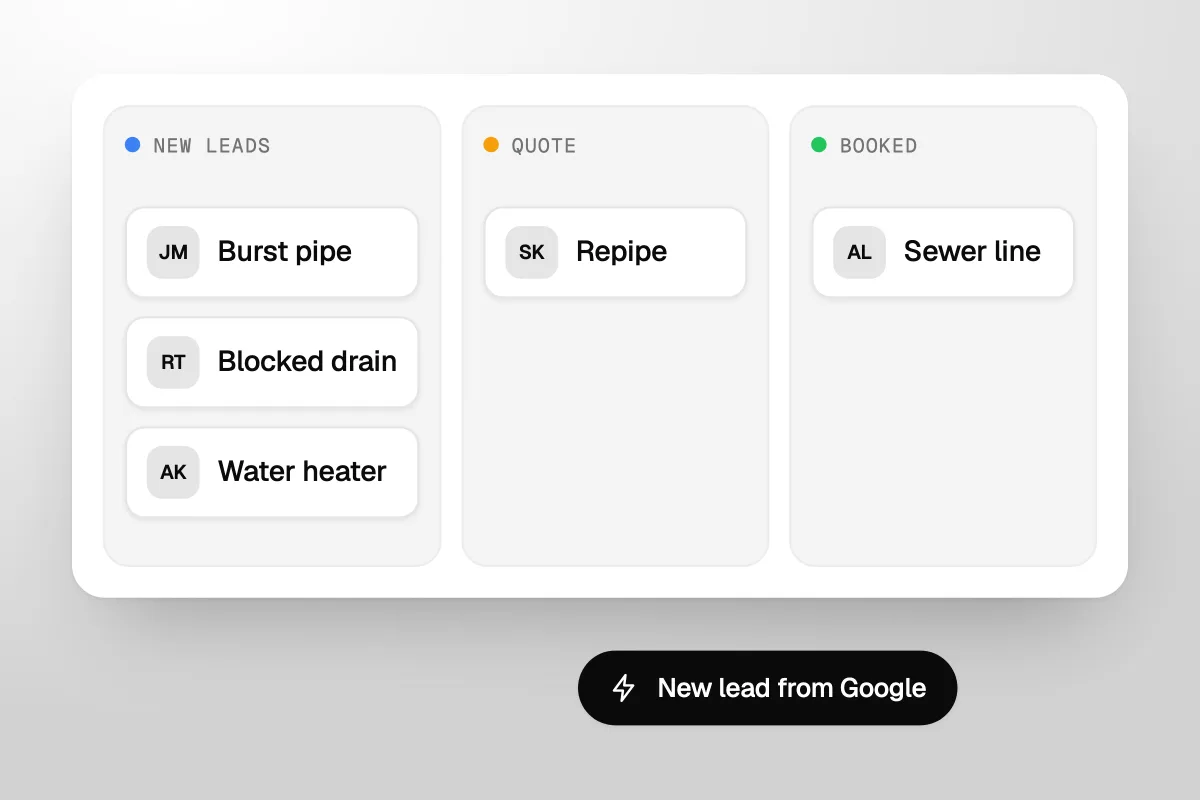
Emergency work is a Burst pipe at 11pm, a Blocked drain backing up into a shower, a failed Water heater on a cold morning. The buyer is stressed and fast. They search on a phone, call the first plumber who answers, and barely compare price. For this work, your strategy is to be found and to answer. Map ranking, a profile with recent reviews, a clear phone number, and a real person or system picking up. Speed wins it.
Planned work is a Repipe, a bathroom renovation, a Sewer line replacement, a hot water system upgrade. The buyer has time. They get two or three quotes, read reviews, look at photos of past jobs, and weigh trust against price. For this work, your strategy is to look credible and follow up. Detailed service pages, strong reviews, clear pricing guidance, and a quote process that chases the customer rather than waiting.
| Emergency work | Planned work | |
|---|---|---|
| Example jobs | Burst pipe, Blocked drain, failed Water heater | Repipe, Sewer line, bathroom renovation |
| Buyer mindset | Stressed, fast, picks first to answer | Patient, compares quotes and reviews |
| What wins it | Being found, answering fast | Trust, proof, follow-up |
| Marketing focus | Map, reviews, answering, ads | Service pages, photos, quotes, nurture |
Most plumbing shops want a mix: emergency work fills the day and plural reviews, planned work pays the bigger tickets. Decide your mix on purpose, then point each page and each ad at one or the other, not both at once.
Which plumbing lead sources actually pay?
The lead sources that pay off most over time are the ones you own, not the ones you rent. Owned sources cost time to build and keep working after you stop. Rented sources are fast but stop the day the budget stops, and often sell the same lead to your competitors.
Owned sources are your Google Business Profile, your reviews, your website and its service pages, your past customers, and the trades who refer you. Rented sources are search ads, Local Services Ads, and third-party lead sites like Angi and Thumbtack. None of the rented ones are wrong. The mistake is making them your only source, because then someone else sets your price and holds your customer list.
A sound strategy builds the owned base first, then rents to fill the gaps. Your past-customer list is the most ignored owned source of all. A plumber who texts last year's customers about a Water heater check or a drain clean before winter turns a cost already paid into new work. Your plumbing marketing only compounds when the sources you own keep growing underneath the ones you rent.
Rent leads for speed. Own the sources that still ring your phone when the budget is off.
Does a plumbing business need both SEO and paid ads?
Most do, because they solve different problems and work on different clocks. SEO, the work of ranking your site and profile in the normal search results, is slow to build and cheap to keep. Paid ads are instant to switch on and cost money every click. One is a pipe you lay once. The other is a tap you open when you need flow now.
The strategy question is not which to pick. It is which to lead with for your goal. If you want planned work like a Repipe or a bathroom renovation, SEO and strong service pages do the heavy lifting, because those buyers research before they call. If you want to catch emergency work like a Burst pipe this week, paid ads put you at the top of the page today while your SEO is still maturing underneath.
A common sequence works like this: build the owned SEO base over months, run ads to cover demand while it grows, then ease ad spend back as rankings and reviews start carrying the load. You keep ads for peak demand and for towns where you are not ranking yet. SEO and ads are not rivals in a plumbing marketing plan. They are the long game and the short game, run together.
How do you measure plumbing marketing?
You measure plumbing marketing on cost per booked job and on what a customer is worth over time, not on clicks, likes or leads. A source that brings cheap leads that never book is expensive. A source that brings fewer leads that turn into Repipe jobs can be your most valuable one.
Keep four numbers per source, every month:
- Leads: how many calls, forms and texts it brought.
- Booked jobs: how many became paid work.
- Spend: what you paid that source, including your time where you can.
- Revenue: what those jobs earned.
From those, two numbers decide everything. Cost per booked job is spend divided by booked jobs. Return is revenue divided by spend. Track them per source and the picture clears fast: feed what pays, cut what does not, and stop guessing which half of your marketing works.
You cannot manage what you do not measure. Cost per booked job turns a hunch into a decision.
Add one more lens for planned work: lifetime value. A customer who calls you for a Blocked drain this year, a Water heater next year and a bathroom the year after is worth far more than one call. Knowing that lets you spend more to win the first job, because you know what the relationship is worth. You cannot measure any of this without catching the leads in the first place, which is why answering matters as much as marketing. Our guides to a plumbing answering service and to missed call text back cover how to stop losing the leads you already pay for.
How much should a plumber spend on marketing?
A plumber should set the marketing budget from measured results, not a fixed percentage copied off a forum. The honest answer is that there is no single right number, and anyone who quotes you one without seeing your cost per booked job is guessing.
Work it the other way around. Start by spending on the sources that cost time, not money: your profile, your reviews, answering your calls, and texting past customers. Those set a floor of work at almost no cost. Then add paid spend one source at a time, track cost per booked job for 30 to 60 days, and keep raising the budget while that number stays comfortably below what the work earns. The day a source stops paying, you will see it in the numbers before it hurts.
Demand gives you room to grow into. The US Bureau of Labor Statistics projects steady employment growth for plumbers, pipefitters and steamfitters over the decade, with thousands of openings each year as the trade grows and workers retire (US Bureau of Labor Statistics). The work is there. Strategy decides how much of it comes to you.
FAQ
What is the difference between plumbing marketing and plumbing lead generation?
Lead generation is one part of marketing: the tactics that bring calls and forms. Marketing is wider. It includes your positioning, your reputation, your pricing and how you keep past customers. Lead generation fills the top. Marketing strategy decides where the leads come from and whether they pay.
Should a plumber focus on emergency or planned jobs?
Most do both, and position them apart. Emergency jobs like a Burst pipe come from being found fast and answering. Planned jobs like a Repipe come from trust, proof and follow-up. Decide your mix on purpose, then build pages and ads aimed at one or the other, not a blur of both.
Is a website worth it for a plumbing business?
Yes, because it is an owned source that works while you sleep and gives your ads somewhere to land. A site with a page per service and town ranks and converts far better than a one-page listing. It also carries the reviews and photos that win planned work like a Sewer line replacement.
How do I know if my plumbing marketing is working?
Track cost per booked job and return for each source every month. If you cannot say what a booked job costs from Google versus a lead site, you cannot tell which to feed. Clicks and impressions are not results. Booked, paid jobs are.
Are lead sites like Angi worth it for plumbers?
They can fill slow weeks, but they sell the same lead to several plumbers and own the customer. Use them as a top-up on owned sources, never as your base, and drop any that run a higher cost per booked job than the work is worth.
How long does plumbing marketing take to work?
Answering leads and asking for reviews pay within days. A Google Business Profile builds over weeks. Service and town pages take months to rank. Paid ads bring calls quickly once live. A real strategy runs all of these at once so results arrive in layers, not one burst.
A strong plumbing marketing strategy is not more tools or a bigger ad budget. It is clear decisions about your work, your sources and your numbers, run by someone who watches them every month. That is what Havstock Unlimited handles: your profile, reviews, site, pages and ads on a flat monthly fee, measured on cost per booked job. If you would rather run the strategy than build it, see how Havstock Unlimited works.
Running ads? Check the maths first with our free ROAS calculator.