
 Nathan Field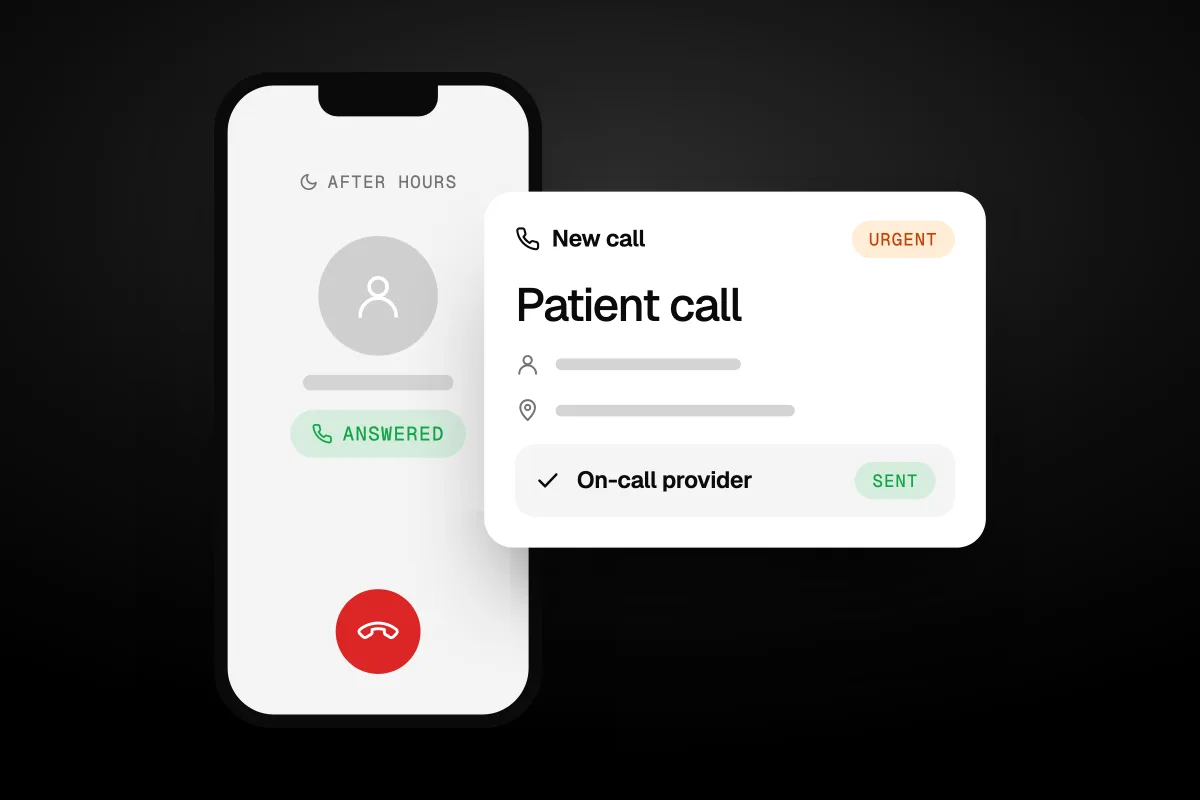
A medical answering service picks up your practice's phone when your front desk can't: at night, on weekends, at lunch, and when every line is busy. It takes messages and appointment requests, and it sends urgent calls to your on-call provider. It never gives medical advice. Emergencies go to 911.
This guide covers what the service does, what it costs (using prices we checked on the vendors' own pages), and how to choose between people, AI and your own staff.
The short answer
For most practices, start with a human answering service for nights, weekends and overflow. It should reach your on-call provider fast when a call is urgent and take clear messages for everything else. AI answering costs less and handles routine calls well. Test it on urgent calls before you trust it alone. Sort out the privacy paperwork before the first patient call goes through.
Looking for MAS, the company that books Medicaid rides in New York State? That is a different business with a similar name. You can find it at medanswering.com.
What does a medical answering service do?
It stands in for your front desk when nobody there can pick up. The caller hears your practice name. The operator follows a script that you write with the service. Most operators are not clinicians. TriageLogic, a company that sells nurse triage, describes answering services as using "nonclinical operators who document patient concerns and forward them to providers" (TriageLogic, checked 28 September 2026).
After hours medical answering service
This is the main reason to buy one. Patients call at 9pm about a fever, a refill that has run out, or a question after a procedure. The service answers every call and writes down the details. Your script then says which calls go to the on-call provider now and which wait for the morning. Your providers write those rules. The operator does not make them up.
Overflow during the day
When your front desk is on another line, checking someone in, or at lunch, the call rolls over to the service instead of ringing out. You set this up in your phone system: after a set number of rings, forward the call. The patient gets a person, not voicemail.
Urgent calls to your on-call provider
This is the part you are really paying for. The service keeps your on-call list, rings or pages tonight's provider, and tries the backup if nobody answers within a set time. Ask how it logs each try, so you can check what happened the next day.
Some services charge extra to connect a caller to your provider live. Doctors Answering Service, for example, lists call patching at $1.00 a minute on its pricing page (checked 28 September 2026). Ask about this before you sign.
Appointment requests and messages
Routine calls turn into messages: a new patient wants a slot, someone needs to move an appointment, a patient has a billing question. Some services book straight into your scheduling system. Many just send a message that your staff act on in the morning. Both are fine. Just know which one you are buying.
What an answering service must never do
It must never give medical advice. The operator is not your nurse. They should not tell a caller whether a symptom is serious, suggest a medicine, or say it is fine to wait.
Your greeting should deal with emergencies first: "If this is a medical emergency, hang up and call 911." If a caller describes an emergency partway through the call, the operator tells them to call 911 now, then lets your on-call provider know. Everything clinical goes to a clinician.
The operator takes the message. Your clinician makes the call.
Answering service or nurse triage?
Some companies sell nurse triage. There, a nurse talks to the patient and follows set clinical steps to judge how urgent it is. That is a clinical service, and a different product from a plain answering service. If your providers keep getting woken for things that could have waited until morning, ask about nurse triage. Either way, know which one you are paying for.
How much does a medical answering service cost?
The human services we checked bill by the minute. The AI services charge a flat monthly fee with a set number of calls or callers. Here is what six services charge, from their own pricing pages on 28 September 2026:
| Provider | Type | Plans a month | Extra use | What the page says on HIPAA |
|---|---|---|---|---|
| Specialty Answering Service | People | $44 with no minutes included; $159 for 100 minutes; $649 for 500 minutes | $1.34 to $1.54 a minute | "HIPAA Compliant" listed on every plan |
| MAP Communications | People | $49 with no minutes included; $179 for 125 minutes; $649 for 500 minutes | $1.28 to $1.37 a minute | "Fully HIPAA Compliant" listed on every plan |
| Doctors Answering Service | People | $99 for 100 minutes; $243 for 250; $475 for 500 (billed every 28 days) | $0.97 to $0.99 a minute on these plans, plus $1.00 a minute for call patching | Says it is HIPAA compliant and mentions a business associate agreement |
| Ruby | People | $250 for 50 minutes up to $1,725 for 500 minutes | No rate on the page | "HIPAA-compliant services available" |
| Goodcall | AI | $79 / $129 / $249 per agent, for 100 / 250 / 500 unique customers | $0.50 per extra caller | Nothing on the pricing page (see below) |
| Upfirst | AI | $24.95 for 30 calls; $59.95 for 90; $159.95 for 300; $299 for 600 | $0.70 to $1.50 per extra call | Business associate agreements listed on the Custom plan only |
A few things the table does not show:
- Cheap entry plans bill every minute. The $44 plan at Specialty Answering Service and the $49 plan at MAP Communications include no minutes at all, so every minute is charged at the overage rate.
- 28 days is not a month. Doctors Answering Service bills every 28 days, so you get 13 bills a year, not 12.
- AI privacy terms can depend on the plan. Goodcall's pricing page says nothing about HIPAA, but its page for physicians says it is HIPAA compliant with a signed business associate agreement. Ask which plans that covers. Upfirst's pricing page lists business associate agreements only under its Custom plan, so the cheap plans may not come with one.
- Yearly billing costs less. Goodcall takes 15% off if you pay yearly, and Upfirst's yearly prices are lower too.
Some well-known medical services do not show prices at all. PatientCalls' pricing page says "Contact for Pricing" and only names a one-time $75 setup fee. TeleMed asks you to get a quote. That does not make them worse. It just means you need a written quote before you can compare.
Compared with hiring more front desk staff
The US Bureau of Labor Statistics puts median pay for receptionists at $38,010 a year in 2025, and $19.00 an hour for receptionists in healthcare and social assistance in May 2025 (BLS, Receptionists, page updated 27 August 2026). That is pay alone, before payroll taxes and benefits. Healthcare and social assistance employs 42% of all receptionists, more than any other industry, according to the same BLS page.
A hire covers your office hours. Nights, weekends, holidays and sick days still need cover. That is why a practice with a full front desk may still need an answering service after hours.
How to price it for your own practice
- Pull last month's call log from your phone system.
- Count the calls that came in after hours or rang out while the desk was busy.
- Note how long those calls lasted on average.
- Pick a plan where last month fits with some room to spare. Per-minute plans charge for the operator's time. Per-call plans charge per call.
- Add the extras: call patching, setup fees, holiday fees. Then ask for the total in writing.
Then ask yourself one question. How many of those calls were new patients who never called back?
Human, AI or in-house: which fits a medical office?
| Option | Good for | Watch out for |
|---|---|---|
| Human answering service | Nights, weekends, worried callers, and getting urgent calls to your on-call provider | Per-minute bills climb in busy months. The quality depends on the script you give them. |
| AI answering service | Routine calls: opening hours, directions, moving an appointment, taking a message | Can miss a caller who is scared or unsure. Check what privacy paperwork comes with your plan. |
| In-house front desk | Knowing your patients, fitting people in, insurance and billing questions | Office hours only. Lunch breaks and sick days leave gaps. |
| Voicemail and a callback | A last resort when nothing else is set up | A new patient may call the next practice instead. Urgent messages can sit unheard. |
Physician answering service with real people
People are still better at the hard calls. The worried parent. The caller who says they are fine but does not sound fine. A trained operator can hear that and follow your urgent steps. The trade-off is cost: you pay by the minute, and a busy month costs more.
AI answering service for a medical office
AI answering has got good quickly. It does not get busy, it can take many calls at once, and the table shows it costs less than a human service. For "what time do you open?" or "I need to move my appointment", it works well.
Our worry is the call that is not routine. A caller who describes something your script lists as an emergency needs to hear "call 911" straight away, not be offered a slot on Thursday. If you use AI, make sure it hands every call your script calls urgent to a person or to your on-call provider. Then test it yourself, many times, using different words. Patients do not use the words in your script.
Keeping it in-house
Staff who know your patients by name are worth a lot. They can answer insurance questions, fit in a sick child, and calm down an upset caller. But they go home at the end of the day, and patients still call at night.
HIPAA compliant medical answering service: privacy questions to ask
Every patient call carries private details: a name, a date of birth, the reason for calling. Any service that hears those details has to look after them. Lots of services put "HIPAA compliant" on their website. A line on a website is not proof. It is also not something we can judge for you. We are not lawyers or compliance advisers, and nothing here is legal advice.
Here is what to ask each service, in writing:
- Will you sign a business associate agreement (BAA) with us, and on which plan?
- Where are messages and call recordings stored, and who can see them?
- How do you send messages to us and to the on-call provider: a plain text message or a secure app?
- How long do you keep recordings and messages, and can we ask you to delete them?
- What privacy training do your operators get?
- If there is a data breach, how and when will you tell us?
Take their answers, and any agreement they send, to your own compliance adviser before you sign. They know your practice and your state rules. We do not.
Questions to ask before you sign
- Do you charge per minute or per call? What counts: hang-ups, wrong numbers, spam, time on hold?
- How do urgent calls reach our on-call provider, and who do you try next if they do not answer?
- Do you charge extra to connect a caller to our provider live?
- Can we write the script ourselves, including the 911 line, and change it any time?
- Do you book into our scheduling system, or send messages only?
- Can we listen to call recordings?
- Are there setup fees, holiday fees or a contract? How much notice do we give to cancel?
- Is there a free trial?
Then do the test that matters most. Call the service yourself after hours, twice. First, be a patient who needs a refill. That call should end as a clear message on your desk in the morning. Second, describe an emergency. That call should end with "call 911" within the first few seconds.
Don't judge an answering service by its website. Judge it by what happens when you call at 11pm.
What an answering service does not fix
An answering service covers the phone. But patients reach you in other ways too. They text back, or open the chat on your website at midnight. And a message taken at 9pm is only worth something if someone follows it up the next morning.
Two things help most practices here:
- A text when a call is missed. When a call rings out, the caller gets a short text within minutes, so they have a reason to wait for you instead of calling the next practice. Our guide to missed call text back shows what to write and how to set it up.
- Follow-up that does not depend on memory. Every request lands in one place and gets chased until it is booked. We covered how in how to automate lead follow-up without losing the human touch.
The same privacy rule applies here. If patient details go into a text, a chat or a CRM, check with your compliance adviser first. That goes for any tool, including the ones we use.
Our take
If we were setting up a busy clinic, this is what we would do. The front desk answers during the day, with every line set to roll over instead of ringing out. A human answering service covers nights, weekends and overflow, using a script your providers wrote and a clear on-call list. The greeting starts with the 911 line. We would try AI on routine overflow, and only give it more once it has passed your own test calls.
The same checks work outside medicine. Our plumbing answering service guide applies them to a trade. A dental office has its own mix of calls, but the same tests apply.
The answering service is only half the job. The other half is getting new patients to call in the first place, and following up every enquiry until it books. That is what we do. Havstock Unlimited is a flat-fee marketing subscription: ads, your website, a CRM, missed-call texts, email follow-up, and AI chat on your site that answers questions and books appointments by chat and text. It does not answer phone calls. We are not an answering service. If you run a clinic that sells treatments, like a med spa, that is the kind of work we take on.
At $4,995 USD a month, Havstock Unlimited will not suit a small practice that only needs its phones covered at night. If that is you, a $159 plan from Specialty Answering Service will do more for you than we can.
FAQ
What is a medical answering service?
It is a service that answers your practice's phone when your staff cannot, using your practice name and a script you agree. It takes messages and appointment requests and sends urgent calls to your on-call provider. It can be staffed by people, run by AI, or both. It does not give medical advice.
How much does a medical answering service cost?
On vendors' own pages (28 September 2026), human services start at $44 to $49 a month plus every minute used (Specialty Answering Service, MAP Communications). AI plans start at $24.95 to $79 a month (Upfirst, Goodcall). Some medical services only give prices on request.
Can a medical answering service give medical advice?
No. Operators take messages and pass them on. They should not judge symptoms, suggest medicine, or tell a caller it is safe to wait. Your greeting should tell callers with an emergency to hang up and call 911. Everything clinical goes to your on-call provider or, if you use one, a nurse triage line.
Is an AI answering service safe for a medical office?
For routine calls like opening hours and moving appointments, it can work well. The risk is an urgent call it treats as routine. Make sure it hands urgent calls to a person or your on-call provider, check what privacy paperwork comes with your plan, and test it yourself before patients rely on it.
How do I know if an answering service is HIPAA compliant?
Don't rely on a badge on their website. Ask, in writing, whether they will sign a business associate agreement, how messages are stored and sent, and who can see them. Then take their answers to your own compliance adviser. Some vendors only offer the agreement on certain plans, so check before you pick one.
What is the difference between an answering service and nurse triage?
An answering service uses operators who are usually not clinicians. They take the message and pass it on. Nurse triage uses nurses who talk to the patient and follow set clinical steps to judge how urgent the problem is. It is a separate service. Ask which one a vendor is selling.
Should a practice use an answering service or hire a receptionist?
Often both. Receptionists in healthcare and social assistance earned a median $19.00 an hour in May 2025 (BLS), before taxes and benefits, and they cover office hours only. An answering service covers nights, weekends and overflow. A smaller practice may start with the service alone.
The right medical answering service gets an emergency to 911 in seconds and every other patient call to your team by morning. Write the script with your providers, get the privacy paperwork checked, and call the medical answering service yourself before your patients do.