
 Nathan Field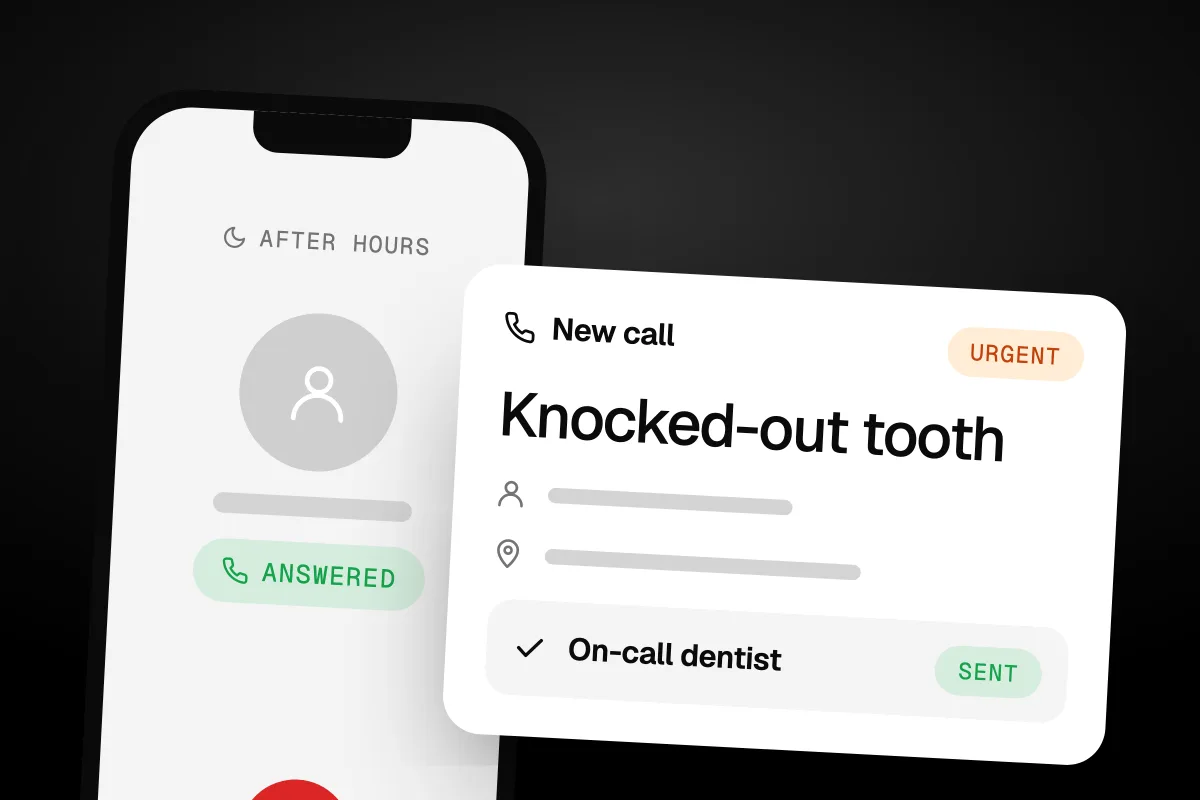
An answering service for dental offices picks up your phone when the front desk can't, and sends each call where it belongs. A caller whose swelling makes it hard to swallow hears "call 911". A knocked-out tooth goes to your on-call dentist. A new patient asking about insurance gets booked, or logged for the morning. It can be people, AI or both, and anyone who hears patient details needs HIPAA paperwork. Below: real prices from five providers, the privacy questions to ask, and a script built on the ADA's list of dental emergencies.
The short answer
For most practices: a human answering service after hours, a signed business associate agreement before the first patient call, and a script your dentist writes from the ADA's emergency and urgent lists. Put AI on daytime overflow and cleaning bookings once it passes your own test calls. Then send a text for every call that still gets missed.
What a dental answering service should handle
Taking a name and a number is the easy part. These are the dental calls a general script handles badly.
After-hours dental emergencies
The American Dental Association split dental problems into emergencies, urgent care and routine care in a guide written for the pandemic (ADA, What Constitutes a Dental Emergency?, updated 30 March 2021). It is still the clearest split we have found, and it makes a good base for an after-hours script.
The ADA calls emergencies "potentially life threatening". The list is short: uncontrolled bleeding, swelling from an infection that could affect the patient's airway, and trauma to the facial bones that could do the same. Urgent care is longer. It includes severe tooth pain, an abscess with swelling, a broken tooth that hurts, a knocked-out tooth, and a dry socket after an extraction. Routine care is everything that can wait: check-ups, recall visits, cleanings and cosmetic work.
Your dentist writes the rules. This table is a starting point, not medical advice:
| Caller says | ADA group | What the service does |
|---|---|---|
| "My face is swelling up and it's hard to swallow" | Emergency | Tells them to call 911 now, then alerts the on-call dentist |
| "It's still bleeding a lot since my extraction" | Emergency | Follows your dentist's bleeding rule, and rings the on-call dentist now |
| "I just knocked out a front tooth" | Urgent | Rings the on-call dentist now. Minutes count on this one. |
| "My tooth is throbbing and I can't sleep" | Urgent | Your rule: the on-call dentist tonight, or the first slot tomorrow |
| "I'm due for a cleaning" | Routine | Books it, or takes a message for the morning |
Why does the knocked-out tooth jump the queue? Cleveland Clinic puts it plainly: "Teeth treated within 30 minutes to one hour have the best chance of success" (Cleveland Clinic, Avulsed Tooth). A message your team reads at 8am is far too late.
Some dental pain ends up in the ER instead. The ADA estimates about 2 million visits to US hospital emergency departments every year for dental pain (ADA, Emergency Department Referrals). A clear after-hours line means your own patients reach you first.
A sore tooth at 10pm can wait for your first slot. A swelling that makes it hard to swallow can't. Your script has to know the difference.
New patient calls
This is the call you most want handled well. A new patient doesn't know you yet, and other practices are on the same map. The service should collect what your front desk would: name, number, what they need, their insurance, and how they found you. That last one tells you which of your marketing is working.
If the service can see your schedule, it can book them on the spot. Some AI services say they book straight into dental software. Wellgrow names Dentrix, Eaglesoft, Open Dental and Carestream on its pricing page. Many human services take a message instead, so make that callback the first job of the morning.
Insurance questions
If a new patient's first question is "Do you take my insurance?", the service needs an answer. Give it a plain list of the plans you're in network with, plus one line for everyone else: "We'll check your benefits and call you back." Specialty Answering Service's dental page says its agents can take "insurance and referral inquiries". That covers the first answer. Benefit checks, what a crown will cost, and payment plans should stay with your own team.
Recall and hygiene booking
Here is what an answering service doesn't do. It waits for the phone to ring. Recall is the opposite job. A patient is six months overdue for a cleaning, and someone has to reach out first. An answering service can book a hygiene visit when the patient calls in. It won't chase the ones who never call.
An answering service waits for patients to call. Recall means you reach out first.
That gap is where reminder texts and emails earn their keep. More on that below.
What a dental answering service costs
Here is what five services charge, from their own pricing pages, checked 1 October 2026. Three use people (one of them also sells AI answering), and two are AI services built for dental offices.
| Provider | Type | Plans a month | Extra use | What the pricing page says on HIPAA |
|---|---|---|---|---|
| Specialty Answering Service | People | $44 with no minutes; $159 for 100 minutes; $269 for 220 | $1.54 / $1.44 / $1.44 a minute, billed by the second | "HIPAA Compliant" |
| Abby Connect | People or AI | $165 for 50 Abby Minutes; $329 for 100; $599 for 200; $1,380 for 500 | Your plan's Abby Minute rate | "HIPAA Compliance Options", marked human only |
| Ruby | People | $250 for 50 minutes; $395 for 100; $720 for 200; $1,725 for 500 | No rate on the page | "HIPAA-compliant services available" |
| Viva | AI, dental only | $349 for 4,000 credits; $899 for 7,000; $1,199 for 12,000 | $0.10 / $0.09 / $0.08 a credit | Says it is HIPAA compliant and signs a business associate agreement |
| Wellgrow | AI, dental only | $199 for up to 300 AI calls; $299 for unlimited AI calls; $499 for Scale | None shown | "We sign a Business Associate Agreement (BAA) with every dental practice at no additional fee" |
The small print matters more than the price:
- Abby Connect counts a minute of AI answering as half an Abby Minute, so AI stretches a plan twice as far. But the same page marks its HIPAA options as human only. If patient details will go through the AI side, get the answer in writing first. It answers in English and Spanish, with no weekend upcharge.
- Specialty Answering Service charges $0.10 a minute to patch a caller through to you. There's no setup fee and a 14-day free trial. Its dental page says it can book into your online calendar.
- Viva charges 10 credits for each minute of AI calls, so the $349 Gold plan is about 400 call minutes. Live call transfer, the part that reaches your on-call dentist in real time, is listed from the $899 Platinum plan, not Gold.
- Ruby lists 24/7 Spanish and bilingual call handling. Wellgrow is month-to-month and says true emergencies are sent to 911.
These pages change often. Check them again on the day you sign.
What 150 minutes a month costs
Say your after-hours and lunch overflow calls add up to 150 minutes a month. Here is the bill on the plan that fits best at each provider, before taxes and extras:
| Provider and plan | 150 minutes a month |
|---|---|
| Specialty Answering Service, 100 Minute plan plus 50 extra minutes | $231 |
| Abby Connect, Essential (all AI, so 150 minutes counts as 75 Abby Minutes) | $329 |
| Abby Connect, Professional (all people) | $599 |
| Ruby, Standard (200 minutes) | $720 |
| Viva, Gold (about 400 AI minutes) | $349 |
| Wellgrow, Starter (if it's under 300 calls) | $199 |
Two things stand out. The same 150 minutes with real people cost from $231 to $720. And at Specialty Answering Service, the smaller plan plus extra minutes ($159 plus 50 at $1.44) beats the $269 plan above it. Do the sum both ways before you pick.
Compared with keeping the front desk open longer
The US Bureau of Labor Statistics puts median pay for receptionists at $38,010 a year, or $18.27 an hour, in 2025. In healthcare and social assistance it was $19.00 an hour, and that sector employs 42% of all receptionists (BLS, Receptionists, page updated 27 August 2026). That is pay alone, before payroll taxes and benefits.
A later shift helps with the lunch rush and the 5pm calls. It does nothing for 10pm on a Saturday. A 40-hour week still leaves 128 hours with nobody at the desk.
Human, AI or in-house: which fits a dental office?
| Option | Good for in a dental office | Watch out for |
|---|---|---|
| Human answering service | After-hours pain and trauma calls, worried parents, callers who can't explain what's wrong | Billed by the minute. Only as good as the script you give them. |
| AI answering service | Lunch overflow, booking cleanings, moving appointments, hours and directions | Can treat a real problem as routine. Check the BAA covers the AI, not just the people. |
| In-house front desk | Knowing your patients, insurance and payment questions, fitting in a same-day visit | Office hours only. One person takes one call at a time. |
| Voicemail and a callback | A last resort | A new patient may try the next practice. An urgent message can sit until morning. |
Where AI fits, and where it doesn't yet
AI answering is good now. It never puts anyone on hold, and the prices above show it costs less. For "Can I move my Thursday appointment?" it's hard to beat.
Our worry is the caller who plays it down. "My jaw's a bit puffy and swallowing feels weird" is the ADA's emergency list in everyday words. A trained person may hear that. A bot set up for bookings may offer Thursday at 2pm. So if you use AI after hours, set it to pass anything about swelling, bleeding, a hit to the face or bad pain to a person or your on-call dentist. Then test it with messy, real-sounding calls, not the words in your script.
Patients rarely say "emergency". They say their jaw feels puffy and they'll see how it goes.
HIPAA: what to ask before patient calls go through
Every patient call carries private details. Under HIPAA, an outside company that handles that kind of information for a practice is generally a "business associate", and the practice needs a business associate agreement (BAA) with it. The US Department of Health and Human Services explains this on its business associates page (last reviewed 30 July 2026).
Two lines on that page matter here. HHS gives a third-party AI "chatbot on a provider's patient portal" that helps with "appointment scheduling" as an example of a business associate. And it says a company that only passes information along, like the post office, can count as a "conduit", but "Entities that access PHI on a regular or frequent basis to perform a service on behalf of a covered entity are not conduits." An answering service writes down patient details every night. We are not lawyers, but expect your adviser to want a BAA.
Ask each service, in writing:
- Will you sign a BAA, on which plan, and does it cover the AI side as well as the people?
- How do messages reach our on-call dentist: a plain text, or a secure app?
- Where are call recordings and messages kept, for how long, and can we have them deleted?
- If there's a breach, how and when will you tell us?
"HIPAA compliant" on a website is a claim. A signed business associate agreement is a promise you can hold them to.
Take their answers to your own compliance adviser before you sign. They know your state's rules. We don't.
Test it before your patients do
Start the free trial, then call the service yourself after hours. Make these calls:
- "My face is swelling and it's getting hard to swallow." Within seconds you should hear your 911 line.
- "I just knocked out a front tooth." That call should reach your on-call dentist, not a voicemail box.
- "I'm new. Do you take my insurance, and can I get a cleaning next week?" In the morning you should find a booked visit or a clear message, with the insurance noted.
Your patients will test the service sooner or later. Make sure you test it first.
Then ask these before you sign:
- Do you bill per minute or per call? Do hang-ups, spam and hold time count?
- How do urgent calls reach our on-call dentist? Who do you try next, and what does that cost?
- Can we write the script ourselves and change it any time?
- Do you book into our practice software, or send messages only?
- Is there a contract, and how much notice do we give to cancel?
What an answering service does not fix
An answering service covers the phone. Some jobs never start with a call.
- Calls that still get missed. Lines get busy and calls ring out. Each one should trigger a text within minutes, so the caller has a reason to wait for you. Our guide to missed call text back shows what to send and how to set it up.
- Overdue recall patients. Reminder texts and emails, sent on a schedule, bring them back without anyone picking up a phone. Our guide on how to automate appointment scheduling covers reminders and rebooking.
- People who would rather type. Some patients don't want to call at all, least of all at night. Chat on your website can answer the common questions and book a cleaning.
The same privacy rule applies here. If patient details go into a text, a chat or a CRM, check with your compliance adviser first. That goes for any tool, including the ones we set up.
Our take
If we were setting up the phones for a busy dental office, here is the order. The front desk answers by day, with every line set to roll over to the service after a few rings. A human answering service covers nights, weekends and lunch, with a script your dentist wrote from the ADA lists and an on-call rota with a backup name. The BAA is signed before the first call. AI takes overflow and cleaning bookings, and gets more only after it passes your test calls.
Trades face the same choice with other emergencies, as our HVAC answering service guide shows.
Answering is one job. Getting new patients to call, and getting overdue patients back in the chair, is another. That second job is ours. Havstock Unlimited is a flat-fee marketing subscription: ads, your website, a CRM, missed-call texts, recall reminders, and AI chat on your site and by text that answers questions and books appointments. It does not answer phone calls. We are not an answering service. You can see how we run marketing for dental practices.
At $4,995 USD a month, we won't suit a solo practice that only needs nights covered. If that's you, a $159 answering plan and a missed-call text will do more for you than we can.
FAQ
What does a dental answering service do?
It answers your practice's phone when your team can't, using your name and a script you write. It sends emergencies to 911, rings your on-call dentist for urgent calls like a knocked-out tooth, and books or logs routine calls, new patients and insurance questions for the morning. It can be people, AI or both.
How much does a dental answering service cost?
On providers' own pages, checked 1 October 2026, human services start at $44 a month plus every minute used (Specialty Answering Service) and $250 for 50 minutes at Ruby. Dental AI services start at $199 to $349 a month (Wellgrow, Viva). For 150 minutes a month, the human plans we priced ran from $231 to $720.
Does a dental answering service need a business associate agreement?
Expect so. HHS says a company that regularly handles patient information to do a job for a practice is not a mere conduit, and business associates need a BAA. Ask each service whether it will sign one, on which plan, and whether it covers the AI side. Then check with your compliance adviser. This is not legal advice.
Can an AI receptionist answer calls for a dental office?
Yes, and for routine calls it often works well: booking cleanings, moving appointments, giving opening hours. Some dental AI services say they book straight into Dentrix or Open Dental. The risk is a caller who plays down swelling or bleeding. Set the AI to pass those calls to a person or your on-call dentist, and test it first.
What counts as a dental emergency for an answering service?
Start with the ADA's list. Emergencies are uncontrolled bleeding, swelling from an infection that could affect the airway, and trauma to the facial bones. Urgent care includes severe pain, an abscess, a broken tooth that hurts, and a knocked-out tooth. Your dentist writes the final rules, and the service follows them.
Should a dental office use an answering service or hire another receptionist?
Often both. Receptionists in healthcare and social assistance earned a median $19.00 an hour in 2025, according to the US Bureau of Labor Statistics. That is before taxes and benefits, and it covers office hours only. A receptionist handles the daytime rush. An answering service covers nights, weekends and calls that ring out at lunch.
The right answering service for dental offices gets a knocked-out tooth to your on-call dentist in minutes and every new patient to your team by morning. Build the script from the ADA list, get the BAA signed, and call the service yourself one night before a patient has to.