 Nathan Field
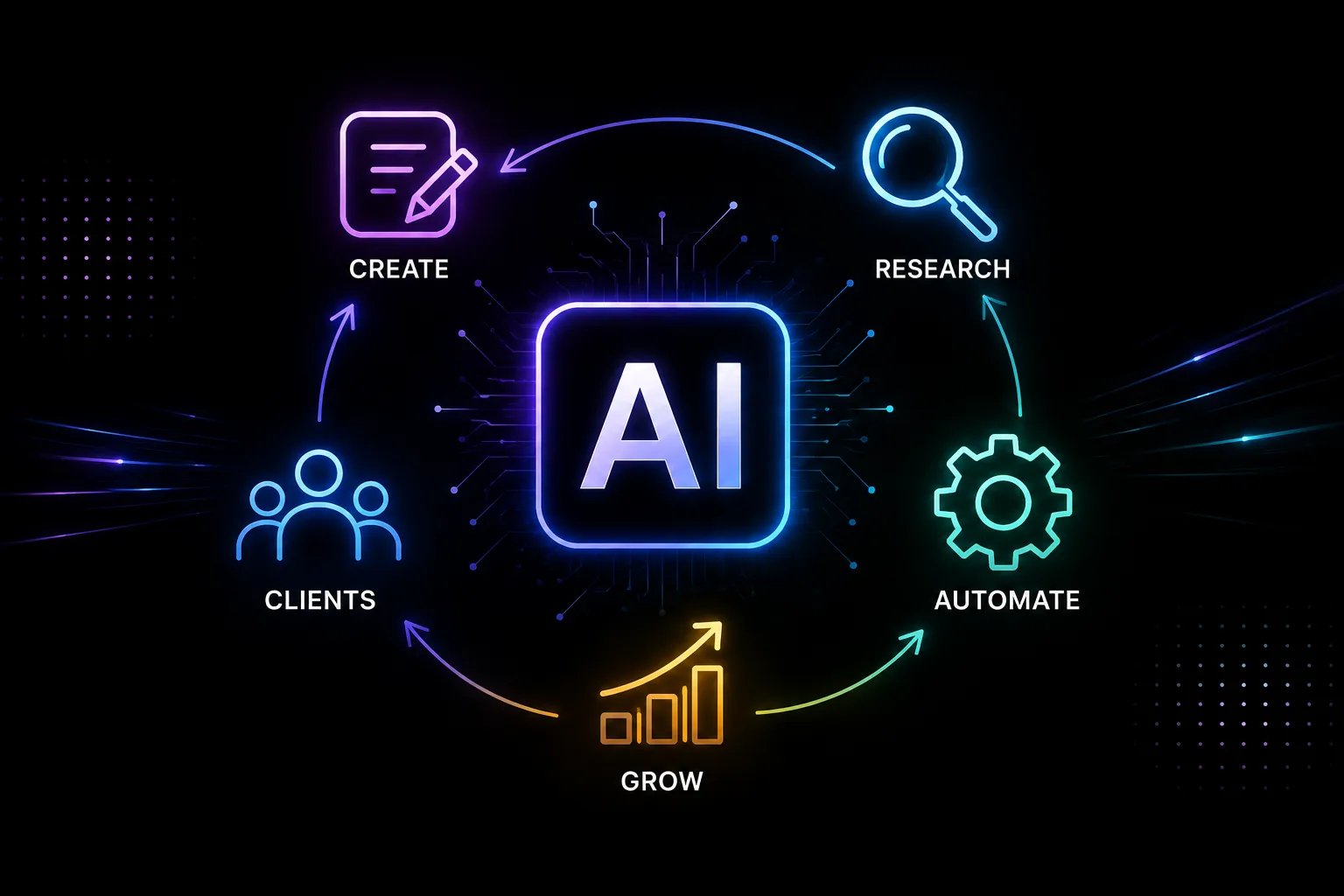
Marketing agencies are entering a completely different era.
Tasks that once required hours of manual work can now be accelerated with artificial intelligence.
Research can happen faster.
Content drafts can be created in minutes.
Client documentation can be organized automatically.
Lead follow-up can happen without someone manually sending every message.
But building an AI-powered agency doesn't mean handing the entire business over to robots.
It means creating systems where AI handles repetitive work while people focus on strategy, creativity, relationships, and results.
In this guide, we'll explore how to build an AI-powered marketing agency in 2026.
What Is an AI-Powered Agency?
An AI-powered agency uses artificial intelligence throughout its operations to improve productivity and delivery.
AI can support:
Marketing research
Content creation
Lead generation
Sales
Client onboarding
Reporting
Internal documentation
Customer communication
The technology doesn't have to run everything.
Instead, it becomes another layer inside the agency's operating system.
Start with Your Existing Workflow
Before adding AI, document how your agency currently works.
Look at the entire client journey:
- Lead Generation
- Sales
- Onboarding
- Strategy
- Content Creation
- Campaign Execution
- Reporting
- Retention
For every stage, identify repetitive tasks.
Those are usually the best candidates for automation and AI assistance.
Use AI for Research
Research is an excellent starting point.
AI can help marketers organize information about:
Target audiences
Competitors
Industry trends
Customer pain points
Content topics
Campaign ideas
This gives strategists a faster starting point.
However, research still needs human validation.
AI should accelerate the process, not become the final authority.
Build an AI Content Engine
Content production is one of the easiest areas to improve.
An AI content workflow can look like:
- Research
- Content Brief
- AI Draft
- Human Editing
- SEO Optimization
- Publishing
- Repurposing
One piece of long-form content can then become multiple social posts, emails, videos, and community resources.
This allows a small team to maintain a consistent publishing schedule without constantly starting from zero.
Automate Lead Management
AI becomes even more powerful when combined with CRM automation.
A new lead can enter your system and automatically trigger:
Lead assignment
Qualification
Email follow-up
SMS communication
Appointment reminders
Pipeline updates
GoHighLevel (we may earn a commission from this link) can be used as the central system for managing these workflows.
Instead of manually tracking every lead, your CRM handles much of the process.
Build AI-Assisted Sales Processes
AI can also support sales teams.
It can help create:
Discovery call questions
Proposal drafts
Follow-up messages
Objection responses
Sales scripts
Client summaries
The salesperson still owns the relationship.
AI simply helps them prepare faster.
Improve Client Onboarding
Onboarding is another area where automation can dramatically improve efficiency.
After a client signs, your system can automatically send:
Welcome emails
Intake forms
Scheduling instructions
Client questionnaires
Project expectations
Next steps
This reduces the administrative burden while creating a more professional experience.
Create Better SOPs
An AI-powered agency needs strong documentation.
AI can turn rough notes, recordings, or existing processes into structured SOPs.
Document:
How clients are onboarded
How content is created
How campaigns are launched
How reports are prepared
How approvals work
How problems are escalated
Good SOPs make it easier to delegate work and scale the agency.
Use AI for Client Reporting
Reporting shouldn't simply be a monthly data dump.
AI can help identify patterns and summarize performance.
For example:
- Data
- Traffic Increased
- Lead Volume Increased
- Appointment Rate Declined
- AI-Assisted Analysis
- Identify Possible Bottleneck
- Human Strategist Recommends Action
This turns reporting into a strategic conversation rather than a spreadsheet review.
Keep Humans in the Loop
An AI-powered agency still needs people.
Humans should remain responsible for:
Strategy
Brand positioning
Creative direction
Client relationships
Quality control
Ethical decisions
Final approvals
AI should make your team more capable - not less involved.
Build Your Agency's AI Stack
Your technology stack should be based on business needs.
You may need:
AI writing tools
Research tools
CRM
Automation platform
Project management
Analytics
Design tools
Communication tools
Don't start with software.
Start with the problem.
Then select technology that solves it.
Common Mistakes
Agencies often make the same mistakes when adopting AI.
These include:
Automating broken processes
Using AI without brand guidelines
Eliminating human review
Buying too many tools
Creating low-quality content at high volume
Failing to train employees
Ignoring data security
AI amplifies your systems.
If your process is messy, AI can help you create messy work faster.
Building an AI-powered marketing agency isn't about replacing your team.
It's about giving your team better leverage.
AI can handle research, drafting, documentation, analysis, and repetitive tasks.
Automation can manage communication and workflows.
Your people can focus on strategy, creativity, relationships, and results.
That combination creates an agency that's faster, more efficient, and better positioned for the future.
Frequently Asked Questions
What is an AI-powered marketing agency?
An AI-powered marketing agency uses artificial intelligence throughout its workflows to improve research, content creation, client delivery, sales, reporting, and operations.
Can a small agency use AI?
Absolutely. Smaller agencies may benefit significantly because AI allows a small team to accomplish work that previously required much more manual effort.
What should agencies automate first?
Start with repetitive, predictable tasks such as lead follow-up, appointment reminders, client onboarding, reporting preparation, and content repurposing.
Does AI eliminate the need for marketers?
No. AI can automate tasks, but marketers are still needed for strategy, creativity, positioning, decision-making, and client relationships.
Build Your AI-Powered Agency with Havstock
AI is most powerful when it's connected to a real business system.
At Havstock, we help agencies and business owners explore practical ways to combine AI, automation, CRM systems, and repeatable workflows.
From content creation and lead management to client onboarding and reporting, our resources can help you build an agency that works smarter without sacrificing the human expertise your clients value.
Explore Havstock's guides, templates, and automation strategies to start building a more efficient AI-powered business.