
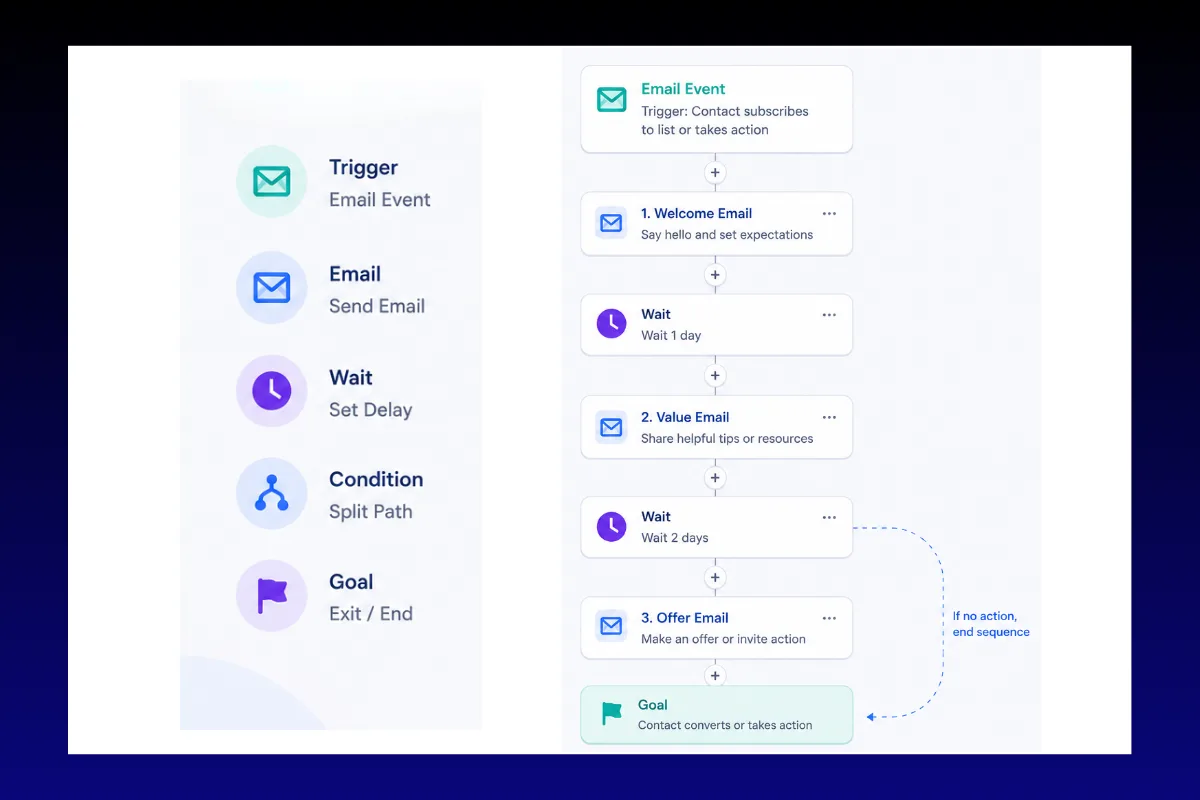
If you are manually following up with every lead that comes through your funnel, you are leaving money on the table and burning hours you will never get back. The coaches and consultants who scale past six figures all have one thing in common: their follow-up runs itself. Not with a VA checking a spreadsheet. Not with sticky notes on a monitor. With automated sequences that send the right message at the right time, every single time.
The problem is not that you need more leads. The problem is that 30 to 50 percent of the leads you already have are slipping through the cracks because nobody followed up fast enough, often enough, or with enough relevance.
GoHighLevel solves this with its Workflow builder, a visual automation engine that lets you build multi-step follow-up sequences across email, SMS, voicemail drops, and even AI-powered conversations. No code. No third-party tools. Everything lives inside the same platform where your leads, calendar, and pipeline already exist.
This guide breaks down exactly how to build automated follow-up sequences in GoHighLevel that convert cold leads into booked calls, and booked calls into paying clients. Step by step, with the logic behind each decision.
Why Automated Follow-Up Is the Highest-ROI Activity in Your Business
Most coaches spend their marketing budget on ads and funnels. That is the visible part of the machine. But the invisible part, what happens after someone opts in, is where the real revenue lives.
Here is what the data consistently shows:
- 80 percent of sales require at least five follow-up touches after the initial contact
- The average response time for a lead inquiry is 47 hours, but leads contacted within five minutes are 21 times more likely to convert
- Only 2 percent of sales happen on the first touchpoint
If your current system is "I'll follow up when I get a chance," you are competing against businesses that respond in under 60 seconds with a personalized SMS, followed by an email sequence, followed by a voicemail drop, all triggered automatically.
“The businesses that win are not the ones with the best offer. They are the ones that follow up fastest and most consistently.”
The good news: building this system in GoHighLevel takes a few hours, not a few months. And once it is running, it works 24/7 without you touching it.
The Anatomy of a High-Converting Follow-Up Sequence
Before you start dragging and dropping actions in the Workflow builder, you need to understand the structure of a follow-up sequence that actually converts.
A high-converting sequence has four phases:
Phase 1: Immediate Response (0 to 5 Minutes)
Speed is everything. When someone fills out your form or books a call, the first message needs to arrive before they close the browser tab.
This is typically an SMS that confirms the action they just took and sets the next expectation. Something like: "Hey [First Name], got your application. I'm reviewing it now and will reach out shortly."
Simple. Personal. Fast.
Phase 2: Value and Credibility (Hours 1 to 24)
Once the initial confirmation is sent, the next few messages need to build trust. This is where you send a case study, a short video, a testimonial, or a piece of content that positions you as the obvious choice.
The goal here is not to sell. It is to make the lead feel confident that they made the right decision reaching out.
Phase 3: Engagement and Qualification (Days 2 to 5)
This is where most coaches drop off. The lead did not book a call on day one, so they assume the lead is dead. Wrong. Days two through five are prime territory for re-engagement.
Ask a question. Share a relevant resource. Reference something specific to their situation. The key is to feel like a real person, not a drip campaign.
Phase 4: Long-Term Nurture (Days 7 to 30+)
Not everyone is ready to buy right now. But they might be ready in three weeks, three months, or three quarters. A long-term nurture sequence keeps you top of mind with lower-frequency, higher-value touches.
“The fortune is not in the follow-up. The fortune is in the follow-up that does not feel like follow-up.”
Step-by-Step: Building Your First Follow-Up Workflow in GoHighLevel
Now let's get into the actual build. Open your GoHighLevel account and navigate to Automation, then Workflows.
Step 1: Create a New Workflow
Click "Create Workflow" in the top right. You will see options to start from scratch or use a recipe. For this guide, start from scratch so you understand every piece.
Name your workflow something clear, like "New Lead Follow-Up Sequence" or "Discovery Call Application Nurture." You will thank yourself later when you have 20 workflows running.
Step 2: Set Your Trigger
The trigger is the event that starts the sequence. Common triggers for coaches include:
- Form Submitted: Someone fills out your application or opt-in form
- Opportunity Created: A new deal enters your pipeline
- Tag Added: A specific tag is applied to a contact (useful for segmentation)
- Calendar Booking: Someone books a discovery call
Choose the trigger that matches your funnel. If you are running a discovery call funnel, "Form Submitted" with a filter for your specific form is the most common starting point.
Add a filter to narrow the trigger. You do not want every form submission triggering this sequence. Filter by the specific form name, tag, or pipeline stage.
Step 3: Add Your Immediate Response (SMS)
Drag an "SMS" action onto the canvas and connect it to your trigger. No wait time. This fires instantly.
Write your message. Keep it short, personal, and conversational:
"Hey {{contact.first_name}}, just received your application. I'm looking through it now. Quick question: what's the biggest challenge you're facing with [your niche topic] right now?"
Two things are happening here. First, you are confirming receipt so the lead knows the form worked. Second, you are asking a question that opens a conversation, which makes the lead far more likely to respond.
Step 4: Add a Wait Step and Email Follow-Up
After the SMS, add a "Wait" action. Set it to 30 minutes. This gives the lead time to see your text before the next touchpoint.
Then add an "Email" action. This email should deliver value and build credibility. Subject line ideas:
- "Here's what to expect next"
- "Quick story about a client who was in your exact position"
- "[First Name], one thing before our call"
The body should include a case study, testimonial, or short video. Something that shows results. Not a pitch. Proof.
Step 5: Build the Day 2 to 5 Re-Engagement Sequence
Add more wait steps and messages to cover days two through five. Here is a solid framework:
Day 2 (SMS): Share a quick win or tip related to their pain point. Keep it to two or three sentences.
Day 3 (Email): Send a longer piece of value content. A blog post, a video training, a case study breakdown. Position it as "I thought this might help while you're thinking things through."
Day 4 (SMS): Direct follow-up. "Hey {{contact.first_name}}, just checking in. Did you get a chance to look at [thing you sent on Day 3]? Happy to answer any questions."
Day 5 (Voicemail Drop): Use GoHighLevel's voicemail drop feature to leave a personal-sounding voicemail without the phone actually ringing. This is massively underused and incredibly effective.
“A voicemail drop on Day 5 outperforms another email by 3x because it feels personal in a world of automated everything.”
Step 6: Add Conditional Logic
This is where GoHighLevel's workflow builder gets powerful. Use "If/Else" conditions to branch the sequence based on lead behavior.
Common conditions:
- If the contact replies to any message: Remove them from the automated sequence and notify you (or your closer) to take over the conversation manually
- If the contact books a call: Stop the follow-up sequence and trigger a pre-call nurture sequence instead
- If the contact does not open any emails after 5 days: Switch to SMS-only communication
This conditional logic is what separates a follow-up sequence from a drip campaign. A drip campaign sends the same messages to everyone regardless of behavior. A follow-up sequence adapts.
Step 7: Set Up the Long-Term Nurture
For leads that do not convert in the first week, add a "Wait" of 7 days, then continue with weekly or bi-weekly touches:
- Valuable content (blog posts, videos, podcast episodes)
- Social proof (client wins, testimonials, case studies)
- Soft CTAs ("If now's not the right time, no pressure. But if anything changes, you can book a call here: [link]")
Run this nurture for 30 to 90 days. You will be surprised how many leads come back in weeks three, four, or eight.
Advanced Follow-Up Strategies in GoHighLevel
Once your basic sequence is running, these advanced tactics will squeeze more conversions out of the same lead flow.
Speed-to-Lead with Workflow Triggers
The fastest way to respond to a new lead is to combine a form submission trigger with an instant SMS and a simultaneous internal notification.
Set up a parallel path in your workflow: one branch sends the automated SMS to the lead, and the other branch sends an internal notification (SMS or email) to you or your sales team. This way, a real person can jump into the conversation within minutes while the automated sequence handles the first touch.
Multi-Channel Sequencing
Do not limit your follow-up to just email. GoHighLevel supports SMS, email, voicemail drops, Facebook Messenger, Instagram DMs, and WhatsApp. Use a mix.
The research is clear: multi-channel sequences outperform single-channel sequences by 300 percent or more. Why? Because some people check email religiously. Others live on text messages. A few prefer social media DMs. By showing up across multiple channels, you meet the lead where they already are.
A strong multi-channel sequence might look like:
- SMS (instant)
- Email (30 minutes)
- SMS (Day 2)
- Email (Day 3)
- Voicemail drop (Day 5)
- SMS (Day 7)
- Email (Day 10)
Pipeline-Based Follow-Up
Instead of running one generic sequence for all leads, create different workflows for different pipeline stages.
For example:
- New Lead stage: Education and trust-building content
- Application Submitted stage: Social proof and urgency
- Call Booked stage: Pre-call prep and expectation setting
- Call Completed (No Sale) stage: Objection handling and re-engagement
- Call No-Show stage: Reschedule sequence
Each stage has different psychology. A new lead needs education. A no-show needs a low-pressure reschedule option. Tailoring your follow-up to the pipeline stage dramatically increases conversion rates.
“Generic follow-up gets generic results. Stage-specific follow-up closes deals.”
AI-Powered Conversations
GoHighLevel now includes AI conversation capabilities that can handle two-way conversations with leads. The AI can qualify leads, answer common questions, and book calls directly.
This is particularly useful for after-hours leads. Instead of making someone wait until morning for a response, the AI can engage them immediately, qualify them, and book them onto your calendar. All while you sleep.
Set this up by enabling the AI Bot in your workflow and training it with your common Q&A, qualifying questions, and booking link.
Common Follow-Up Mistakes That Kill Conversions
Knowing what to build is half the equation. Knowing what to avoid is the other half.
Mistake 1: Too Many Messages Too Fast
Sending five messages in the first 24 hours does not show enthusiasm. It shows desperation. Space your messages with intentional wait times. Give people room to breathe and respond.
Mistake 2: All Selling, No Value
If every message in your sequence is "Book a call" with a different subject line, your leads will tune out by message three. Lead with value. Teach something. Share a win. Answer a question they did not ask yet.
Mistake 3: No Personalization
"Hi there" is not personalization. Use merge fields ({{contact.first_name}}) at minimum. Better yet, reference specific information from their form submission or application.
Mistake 4: Not Testing
Build your sequence, then test it. Send yourself through the workflow. Read every message on your phone, not your desktop, because that is how most people will see them. Check timing, formatting, links, and tone.
Mistake 5: Set It and Forget It
An automated sequence is not a "build once, run forever" asset. Review your metrics monthly. Which messages get the highest reply rates? Where do people drop off? Which channel converts best? Iterate based on data.
“Automation does not mean abandonment. The best sequences are built once and optimized forever.”
Measuring Follow-Up Performance
GoHighLevel gives you the data you need to optimize your sequences. Here are the key metrics to track:
Response Rate: What percentage of leads reply to at least one message? If this is below 10 percent, your messaging needs work.
Speed to First Response: How quickly does a lead hear from you after opting in? Aim for under 60 seconds.
Booking Rate: What percentage of leads in the follow-up sequence end up booking a call? This is your north star metric.
Drop-Off Point: Where in the sequence do most leads stop engaging? This tells you where your messaging is weakest.
Channel Performance: Which channel (email, SMS, voicemail) drives the most replies and bookings? Double down on what works.
Track these monthly. Small improvements compound. A 2 percent increase in booking rate across 100 leads per month is 24 extra calls per year, which could be 6 to 12 additional clients depending on your close rate.
Template: The 14-Day Discovery Call Follow-Up Sequence
Here is a ready-to-implement sequence you can build in GoHighLevel today. Adjust the messaging to match your niche and voice.
Day 0 (Instant, SMS): Confirmation + open-ended question
Day 0 (30 min, Email): Welcome email with case study or video
Day 1 (AM, SMS): Quick tip related to their pain point
Day 2 (PM, Email): Deeper value content (blog post or training)
Day 3 (AM, SMS): Check-in referencing Day 2 content
Day 5 (AM, Voicemail Drop): Personal voicemail with soft CTA
Day 7 (AM, Email): Client success story with booking link
Day 7 (PM, SMS): "Saw you opened my email, any questions?"
Day 10 (AM, Email): FAQ email addressing common objections
Day 14 (AM, SMS): Final direct follow-up with low-pressure close
Use GoHighLevel's "If/Else" conditions to exit contacts from the sequence when they reply, book a call, or request removal.
This template alone, properly implemented, can recover 15 to 25 percent of leads that would have otherwise gone cold.
How Havstock Makes This Even Easier
Building a follow-up sequence from scratch works, but it takes time to get the messaging, timing, and logic right. The High Ticket OS comes with pre-built follow-up workflows designed specifically for coaches and consultants running discovery call funnels. The sequences are already mapped to pipeline stages, with multi-channel messaging, conditional logic, and proven copy templates.
Instead of spending a week building and testing, you can import the snapshot into your GoHighLevel account and have a complete follow-up system running in under an hour.
FAQ
How many follow-up messages should I send before giving up on a lead?
There is no universal number, but 7 to 12 touchpoints over 14 to 30 days is a solid starting range. Some leads will convert on message two. Others will come back on message ten. The key is to keep providing value without being aggressive. If someone explicitly asks to stop, remove them immediately.
Can I use the same follow-up sequence for different services?
You can, but you should not. Different services attract different types of leads with different pain points and buying timelines. Build separate sequences for each offer, or at minimum use conditional logic to personalize the messaging based on which form they filled out or which tag they have.
What is the best time of day to send automated follow-up messages?
For SMS, mid-morning (9 to 11 AM) and early evening (5 to 7 PM) in the lead's local time zone tend to perform best. For email, Tuesday through Thursday mornings see the highest open rates. GoHighLevel lets you set "Send During Business Hours" on your wait steps to avoid messaging people at 3 AM.
How do I stop the automated sequence when a lead replies?
Use the "Customer Replied" trigger in a separate workflow that removes the contact from your follow-up workflow, or add "If/Else" conditions at each step that check whether the contact has replied. You can also use GoHighLevel's "Stop on Reply" setting within certain workflow actions.
Should I use email or SMS for follow-up?
Both. Multi-channel follow-up consistently outperforms single-channel. SMS has higher open and response rates (98 percent open rate vs. 20 percent for email), but email lets you send longer, more detailed content. Use SMS for short, conversational touches and email for value-heavy content like case studies and trainings.
What metrics should I track to know if my follow-up sequence is working?
Focus on four metrics: response rate (percentage of leads who reply), booking rate (percentage who book a call), speed to first contact (time between opt-in and first message), and drop-off point (where leads stop engaging). Review these monthly and optimize the weakest points.
Can GoHighLevel's AI handle follow-up conversations automatically?
Yes. GoHighLevel's AI Bot can manage two-way conversations, qualify leads, answer FAQs, and book appointments directly into your calendar. It works especially well for after-hours leads who would otherwise wait until morning for a response. You train the AI with your qualifying criteria and common questions.
How do I personalize follow-up messages beyond just using their first name?
Use custom fields from your forms. If your application asks about their business type, revenue level, or biggest challenge, reference those answers in your follow-up using merge fields like {{contact.custom_field}}. GoHighLevel also supports conditional logic to send entirely different messages based on form responses.
Start Building Your Follow-Up Machine Today
Every day you operate without automated follow-up is a day you lose leads that were ready to buy. The system is not complicated. The tools are already inside GoHighLevel. The only thing missing is the implementation.
Want a follow-up system that is already built, tested, and ready to deploy? The High Ticket OS gives you pre-built workflows, pipeline automation, and proven follow-up sequences designed for coaches selling high-ticket offers. Import the snapshot and start closing more leads today.