
Most RTOs do not have a traffic problem. They have a system problem. The ads get clicks. The page gets visits. But the enquiries are thin, the follow-up is slow, and very few of those clicks turn into enrolments.
On top of that, RTOs have to market inside rules most businesses never think about. A claim that would be normal for a gym or a café can put an RTO's registration or funding contract at risk.
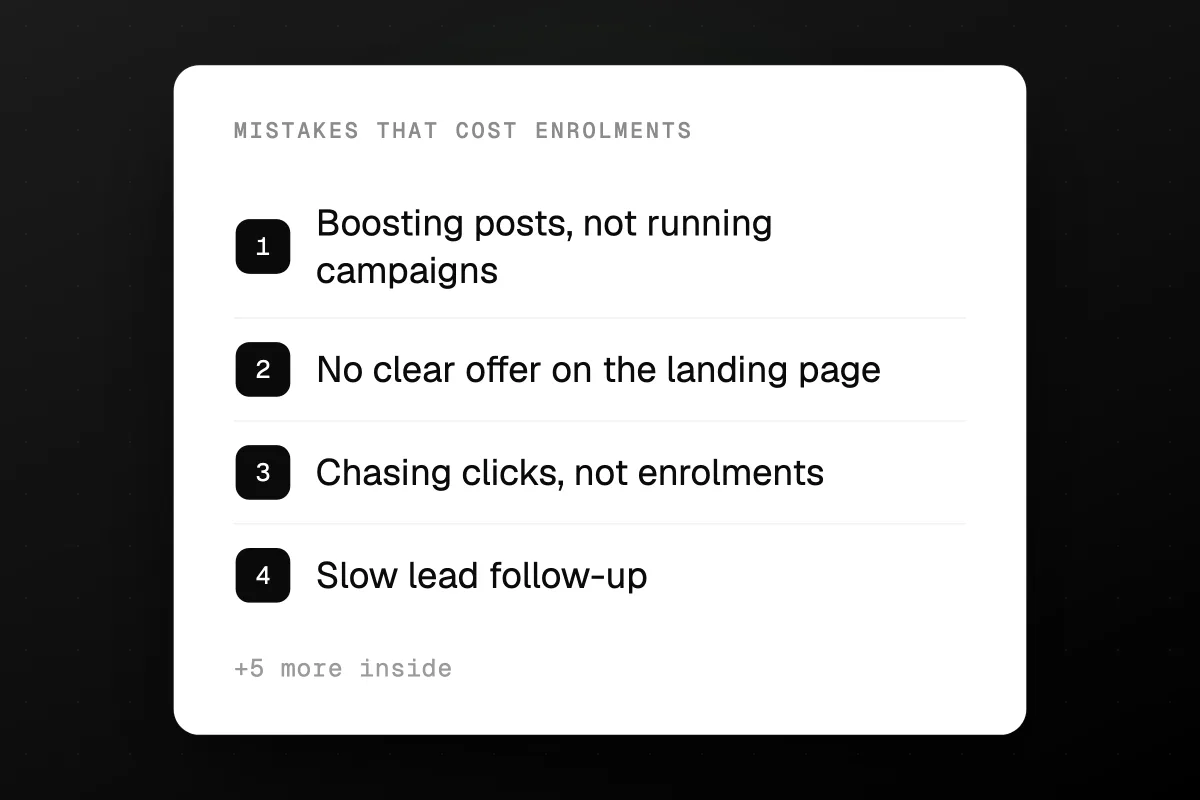
This guide covers the nine marketing mistakes we see RTOs make most often, and what to do instead. It is written for RTO owners, CEOs and marketing leads who want enrolments, not just views.
This is general marketing guidance, not legal or compliance advice. Always check your own obligations with your compliance adviser, your state funding contract and ASQA.
1. Sending ad traffic to the homepage
An RTO homepage has to serve everyone: current students, employers, staff and new enquiries. That makes it a poor place to send someone who just clicked an ad for one course.
When people land on a page that does not match the ad they clicked, many leave. Every click you paid for is gone.
Do this instead: send each campaign to its own page. One course, one message, one action. The page should repeat the promise in the ad, show the exact course title, and make the next step obvious.
2. Asking for contact details too late
Many RTOs use a course quiz or an eligibility check. That is a good idea. The large course sites do it too. Courses.com.au, for example, asks about residency and postcode before it shows courses.
The common mistake is asking for a name, email and phone at the very end. Anyone who stops halfway is lost for good, and you have no way to follow up.
Do this instead: capture contact details early, just before the result, then ask the rest of the questions. Someone who drops off after that point is still a lead you can follow up with.
3. Slow or no follow-up
Choosing a course is a big decision. People compare providers, talk to family and think about cost. Very few enrol on the first visit.
Yet many RTOs treat an enquiry as the finish line. One email goes out, maybe a call a few days later, and then nothing.
Do this instead: build a follow-up system that runs every time, without relying on someone remembering:
- A fast first reply, by SMS or email, while the person is still thinking about it.
- A call from a real person for anyone who asks for one.
- A short series of emails that answer the common questions: cost, time, study mode and what the course leads to.
- Live chat on the site for people who will not fill in a form. Large providers like Upskilled and TAFE Queensland offer webchat as a main contact option.
Only send marketing emails and SMS to people who have given consent, and always include a working unsubscribe. The Spam Act applies.
4. Hiding who you are
People are careful about who they study with. The most trusted education sites in Australia show their regulator details clearly. TAFE NSW, TAFE Queensland and Upskilled all list their RTO number on the site.
For course marketing, this is not only about trust. The RTO's name and national provider code should appear on every ad, landing page, post and email that markets a training product. A funnel that only reveals the RTO a few clicks later is a compliance risk.
Do this instead: show your RTO name and code on every page and ad. Use the phrase "nationally recognised" where it is true. It is the language students look for.
5. Using the wrong course names
"Cert 4 Building" is how people talk. It is not how you can advertise. Course codes and titles in your marketing should match training.gov.au exactly, for example "CPC40120 Certificate IV in Building and Construction". And you can only market courses that are currently on your scope.
Do this instead: keep one approved list of course titles and codes, and use it everywhere. Your designer, your ad person and your website should all pull from the same list.
6. Saying "free" or "fully funded"
Funding is one of the strongest hooks in RTO marketing. It is also where the biggest penalties have come from.
During the VET FEE-HELP era, providers and brokers marketed courses as "free" and used gifts like laptops to push people to sign up. The fallout was huge. The ACCC case against the Phoenix Institute led to a record $438 million in penalties, and an education broker, Acquire Learning, was ordered to pay $4.5 million.
Regulators still watch funding claims closely because of it.
Do this instead: say funding "may be available for eligible students" and show the conditions. Name the correct state program where it applies. The credible players do exactly this, and being upfront about limits reads as more trustworthy, not less.
7. Offering gifts to enrol
Free tablets, vouchers, or "enrol before 30 June" bonuses can feel like normal sales tactics. Under state funding rules they are often banned. NSW, for example, bans inducements such as iPads and tablets for Smart and Skilled training, as well as deals to enrol by a set date (NSW Government guidance).
Do this instead: sell the outcome, not a gift. Check your funding contract before you run any offer.
8. Using marketers without the paperwork
Many RTOs use agencies, lead generators or brokers. That is allowed, but the RTO stays responsible for everything they publish.
Under the Standards for RTOs 2025, anyone marketing or recruiting on your behalf is a third party. That generally means a written agreement, telling ASQA about the arrangement, approving what they publish, and monitoring it. If a marketer gets it wrong, the finding lands on the RTO, not on them.
Do this instead: before any campaign starts, have a signed agreement, confirm the ASQA notification, and approve every ad, page and script in writing. Keep a log. Work only with marketers who expect this and make it easy.
9. Measuring clicks instead of enrolments
Views, likes and clicks are easy to report. They do not pay for trainers.
A campaign with cheap clicks and no enrolments is worse than one with expensive clicks that fill a class. Many RTOs cannot tell the difference, because their ads, their forms and their student system do not talk to each other.
Do this instead: track every lead from the ad it came from to the enrolment it became. Then judge campaigns on cost per enrolment, not cost per click. That is the number that tells you where to spend.
What good RTO marketing looks like
Put the fixes together and you get a simple system:
- Ads for one course or goal at a time, with compliant, approved wording.
- A dedicated page or quiz for each campaign, with the RTO name, code and exact course title.
- Early lead capture, so no one who starts is lost.
- Fast, automated follow-up by SMS, email, phone and chat.
- Tracking from click to enrolment, so you spend more on what works.
Here is what that looks like in practice. For one training organisation, we ran their ads and brought in leads at $2 each. For another, we built a quiz funnel and ran the ads behind it, and brought in leads at $4 each. Results depend on the course, the market and the budget, so treat these as examples, not promises.
Frequently asked questions
Can an RTO use a marketing agency?
Yes. But the agency counts as a third party, so the RTO stays responsible for what it publishes. Put a written agreement in place, tell ASQA about the arrangement, and approve all marketing before it goes live.
Can we advertise a course as free?
Be very careful. If any fee can apply, or funding depends on eligibility, "free" is likely to mislead. Say funding may be available for eligible students, and show the conditions.
What should be on every RTO ad and landing page?
At minimum: the RTO's name and national provider code, the exact course title and code from training.gov.au, and accurate, conditional funding wording where funding is mentioned.
What is a good cost per lead for an RTO?
It depends on the course, the location and how well the page converts. A better number to watch is cost per enrolment, because a cheap lead that never enrols is not cheap.
How Havstock helps RTOs
Most RTOs do not need a full in-house marketing team to fix this. They need the right skills on the right job: ads, landing pages and quizzes, follow-up, CRM and tracking, all joined up.
Havstock Unlimited is a marketing subscription that covers all of it for one flat monthly fee. You add requests to your board, we deliver them one at a time, and you approve everything before it goes live. No setup fee and no contract.
If you want your marketing to fill classes, not just get views, book a 15-minute call and we will show you your quickest wins.