 Nathan Field
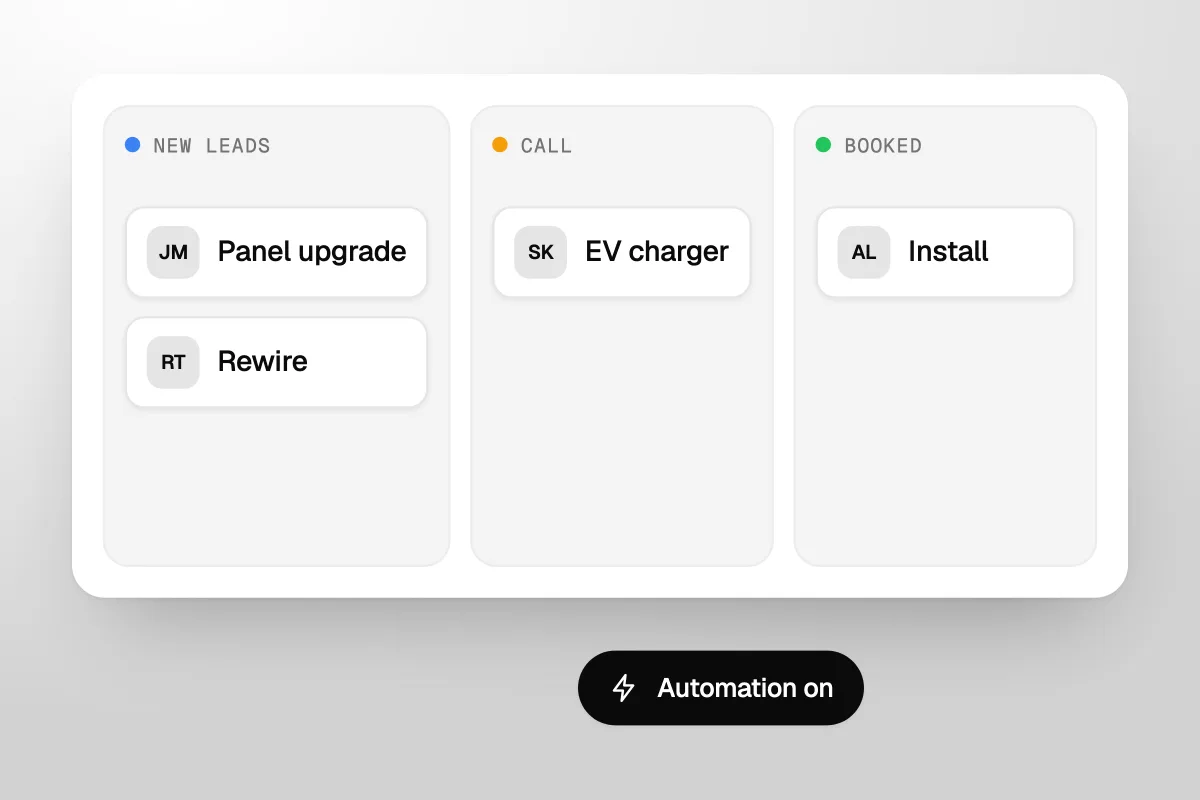
Good electrician marketing is not one big campaign. It is a short list of jobs done in the right order: answer leads fast, win on Google, build a site with a page for each service and town, then pay for ads, and buy leads last. Most lists you find online skip the order, and the order is what decides whether any of it pays. This guide gives you the plan, top to bottom.
The short answer
Answer every call and text back the ones you miss. Fix your Google Business Profile and ask for a review after every job. Build a site with a page per service and town. Then run search ads. Buy leads from third-party sites only to fill gaps. Judge every source on cost per booked job.
What should an electrician's marketing plan look like?
An electrician's marketing plan should move from cheap and owned to costly and rented, in that order. The jobs at the top cost time, not money, and they keep working after you stop. The jobs at the bottom cost money every month and stop the day you stop paying.
Here is the order most electricians get the most out of:
- Answer leads fast, and catch the ones you miss.
- Set up and clean your Google Business Profile.
- Ask every customer for a review, the same day.
- Build a website with a page for each service and each town.
- Run search ads once the first four are in place.
- Buy leads from third-party sites, last, to fill slow weeks.
Each step makes the next one pay better. There is no point paying for clicks that land on a weak site, or running ads that ring a phone nobody answers. Skipping steps is the most common way electrician marketing money gets wasted.
Build the cheap, owned sources first. Rent leads only to fill the gaps they leave.
Why does answering leads fast come first?
Because the lead you already have is cheaper than any new one. A homeowner with a dead circuit or a tripping board calls two or three electricians and books the first one who picks up. If your phone rings out, you paid for that lead and handed it to the next guy.
Start by counting what you lose. For 30 days, log every call, form and text: where it came from, whether you booked it, and what the job was worth. Ask every new caller how they found you. Most electricians are shocked by how many calls ring out during a job, on a ladder, or under a house.
Then plug the leak. Set the office line to ring more than one phone. Decide who covers nights and weekends. Send an automatic text to every missed call so the caller waits for you instead of dialling on. We cover the wording in our guide to missed call text back, and the full build vs hire decision in our guide to an answering service for contractors.
How do electricians win on Google Business Profile and reviews?
Your Google Business Profile is the free listing that puts you on the map when someone searches "electrician near me". It is the single highest-value thing most electricians can fix this week. You cannot buy your way up it. Google says plainly that "there's no way to request or pay for a better local ranking on Google" (Google Business Profile Help).
Google says local ranking comes down mainly to relevance, distance and how well known you are, which includes reviews. You cannot move your office, so work on the rest.
- Set up as a service-area business. If you drive to customers, Google's rules say you list your main location with a service area, not a fake address (Google guidelines for representing your business).
- Use your real business name. Stuffing it with "cheap emergency electrician" breaks the rules and can get you suspended.
- Pick the fewest categories that fit. Electrician as the main one, then only real extras.
- List your services by name. Panel upgrade, rewire, EV charger install, switchboard upgrade, safety inspection, fault finding.
- Add real photos. Your vans, your team, a finished panel upgrade. Not stock images.
Then reviews. Ask every customer the same day the work is done, while they are happy the lights are back on. A short link texted from the van gets far more reviews than a card left on the bench. Reply to each one. A steady drip of recent reviews beats a pile of old ones.
The map runs on your profile and your reviews. Both are free, and both are earned.
What should an electrician's website have?
An electrician's website needs one clear page for each service and each town you work, not a single page that lists everything. Search engines rank a page about "EV charger installation in [town]" above a homepage that mentions it in a sentence. People booking a specific job trust a page that is about that job.
Think in a grid. Down one side, your services: panel upgrade, rewire, EV charger install, ceiling fan and lighting, switchboard replacement, generator hookup, safety inspection. Across the top, your towns. Each box is a page. You do not need all of them at once. Build the ones for the work you want more of first.
Every one of those pages is a landing page: a page built to turn a visitor into a call. A good landing page says what the job is, what it costs to find out, what you will do, why people trust you, and how to book, with your phone number held in view as they scroll. A phone number buried in the footer loses jobs.
Keep it fast and readable on a phone, because most of these searches happen on one. Any site we build for an electrician gets checked on real screens from a small phone up to a wide desktop before it goes live. A slow or broken page quietly costs you the clicks you worked to earn.
When do paid ads make sense for electricians?
Paid ads make sense once the first four steps are done, not before. Ads buy attention. If that attention lands on a phone nobody answers or a weak page, you are paying to lose. With the basics in place, ads become a tap you can turn up in a slow week and down when you are booked.
The most direct option for an electrician is a search ad: the paid listing at the top of Google when someone types "electrician near me" or "panel upgrade cost". You bid to show for those searches, and you pay when someone clicks. Google explains the format in its own help on how to create a Search campaign. Point each ad at the matching landing page, not your homepage, so the person who clicked "EV charger install" lands on the EV charger page.
Two rules keep ad money honest. First, send each search ad to the page about that job. Second, track which clicks became booked jobs, not just calls, so you can see what a paid customer really costs. Demand for electrical work is steady and rising, with the US Bureau of Labor Statistics projecting faster-than-average job growth for the trade, partly on the back of EV chargers and new wiring work (US Bureau of Labor Statistics). Steady demand means ads can pay, if the jobs behind them are tracked.
Are bought leads worth it for electricians?
Bought leads are worth using last, and only to fill gaps. Lead sites like Angi and Thumbtack sell you a contact, often the same contact they sold to three other electricians. You race the others to call first, and you pay whether or not you win the job. That is fine as a top-up. It is a trap as your main source, because the site sets the price and owns the customer.
Compare the sources plainly:
| Source | How you pay | Who owns the lead | Works after you stop paying? |
|---|---|---|---|
| Google Business Profile | Free, costs time | You | Yes |
| Reviews | Free, a text per job | You | Yes |
| Website and service pages | Your time or a build team | You | Yes |
| Past customers and referrals | A message, good work | You | Yes |
| Search ads | Per click, to Google | You get the call | No |
| Third-party lead sites | Per lead, to the site | Shared with other electricians | No |
If you do buy leads, treat them like ads: track which ones booked, and drop any source where the cost per booked job is higher than the work is worth. The method is the same one plumbers use, which we lay out in our guide to getting more plumbing leads.
How do you know your electrician marketing is working?
You know it is working when you can name your cost per booked job for each source, not your cost per click or your cost per call. A source that brings cheap calls that never book is costing you money. A source that brings fewer, better calls can be the one to feed.
Keep four numbers for every source, every month: leads, booked jobs, money spent, money earned. Divide spend by booked jobs and you have cost per booked job. Divide earned by spent and you have your return. Now the decisions make themselves. Feed what pays. Cut what does not.
Also watch the jobs you want more of. If panel upgrades and EV charger installs pay better than call-outs, point your pages, reviews and ads at those. Marketing is not only about more leads. It is about more of the right leads. A tidy marketing system that tracks all of this in one place beats a drawer of notebooks and a memory of "that job came from Google, I think".
Count cost per booked job, not clicks. It is the one number that tells you where to put your money.
FAQ
How much should an electrician spend on marketing?
Start with what you can measure, not a fixed percentage. Spend first on the free jobs: profile, reviews, answering calls. Add paid spend only when you can track cost per booked job, and raise it while that number stays below the value of the work it brings.
Do electricians need a website if they have a Google profile?
Yes. Your Google Business Profile gets you on the map, but a website with a page per service and town is where people compare you and where your search ads should land. The two work together. The profile brings the click, the site books the job.
What is the fastest electrician marketing fix?
Answering every call and texting back the ones you miss. It needs no ad budget and no new website. Most electricians lose bookable jobs to calls that ring out mid-job, so catching those is usually the quickest win available.
Are search ads or lead sites better for electricians?
Search ads give you a lead that is yours and sends the click to your own page. Lead sites sell the same contact to several electricians. Use ads before lead sites, and judge both on cost per booked job rather than on which one feels cheaper per lead.
How do I get more high-value jobs like panel upgrades and rewires?
Point your marketing at them. Give a panel upgrade and a rewire their own pages, ask for reviews that mention those jobs, and run search ads for those exact searches. If you market only "electrician near me", you get mostly small call-outs.
How long before electrician marketing works?
Answering leads and asking for reviews pay off in days. A Google Business Profile builds over weeks. Service and town pages take months to rank in search. Paid ads can bring calls within days once set up. Expect a mix, not one switch.
You do not need every one of these at once. You need them in the right order, run by someone who tracks what pays. That is what Havstock Unlimited is for: one team that handles your profile, reviews, site, pages and ads on a flat monthly fee, and reports back on cost per booked job. If you want your electrician marketing handled without hiring staff or juggling five tools, see how Havstock Unlimited works.
Running ads? Check the maths first with our free ROAS calculator.