 Nathan Field
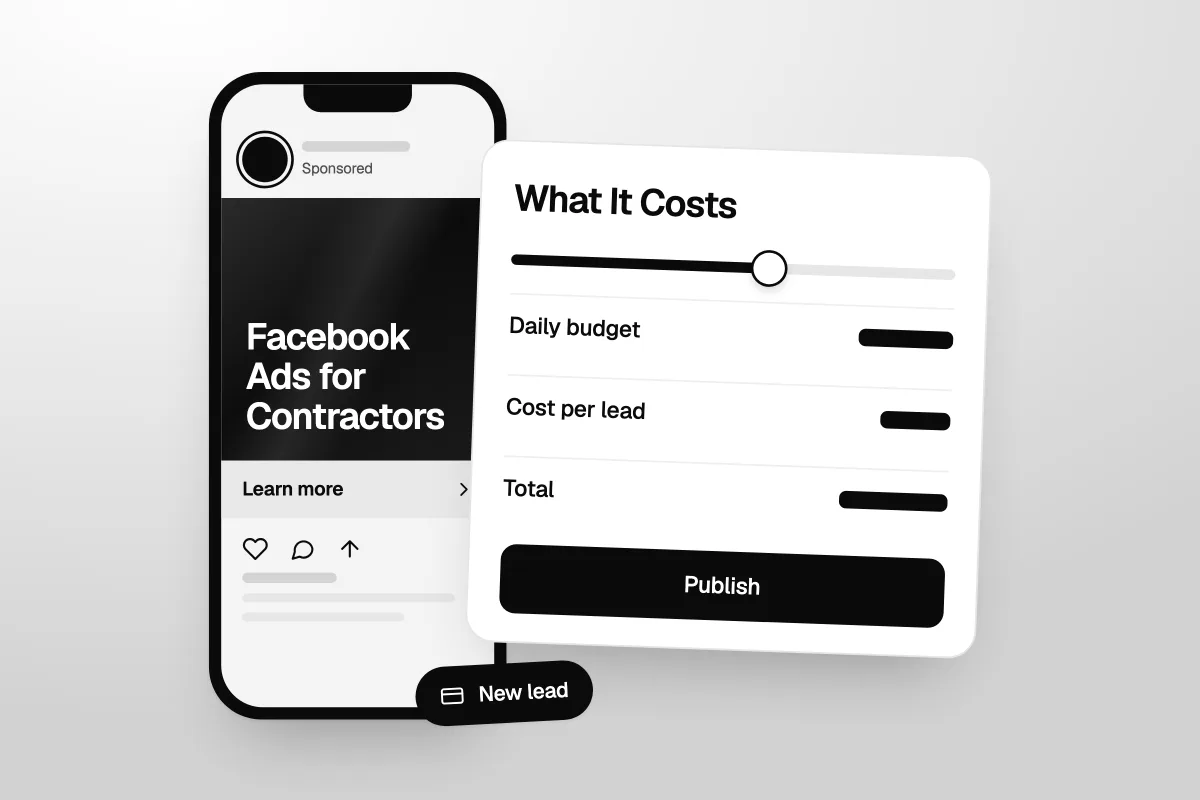
Facebook ads for contractors work when they show real local jobs to homeowners near you, ask for one clear next step, and every lead gets a call back within minutes. They work best for planned jobs people can picture, like a new roof, a deck or a system replacement. They work worst for emergencies, where people search Google instead. This guide covers what to run, how to work out your real cost per lead, and when Google should come first.
The short answer
Facebook ads can bring a contractor steady leads for planned, visual work. Meta does not publish a cost per lead for trades, so you find yours by testing a set budget and dividing spend by leads, then by booked jobs. Use lead forms or call buttons, target your service area, and reply fast.
Do Facebook ads work for contractors?
Yes, for the right jobs. Facebook ads work for contractors when the job is planned, visual and big enough to be worth a homeowner's time. A kitchen remodel, a roof replacement, a new deck, a fence, a heat pump swap. People do not wake up searching for these. They see a finished job from a contractor down the road and think "we should do that before winter."
That is the key difference from Google. On Google, the person is already looking. On Facebook, you are interrupting someone scrolling past their cousin's holiday photos. So the ad has to make them want the job, then make it easy to ask for a quote.
Facebook ads tend to struggle in three spots:
- Emergencies. A burst pipe or a dead furnace at 2am sends people to Google and the phone, not to their feed.
- Slow follow-up. Facebook leads are cooler than search leads. If nobody calls them back the same hour, they forget they asked.
- Weak landing spots. Sending people to a homepage that lists twelve services loses most of them.
Get those three right and Facebook becomes a solid second channel for most trades. For some visual trades, like remodeling and outdoor work, it can be the first.
Google catches people who already want the job. Facebook makes people want the job. Plan your ads around which one you are doing.
What do Facebook ads cost a contractor per lead?
There is no fixed price. Meta sells ads in an auction, and your cost per lead depends on your town, your offer, your ad and how many other businesses want the same homeowners. We found no cost per lead figure for trades on Meta's own help pages, and we will not quote another blog's guess.
Here is what Meta does say. Each time there is a chance to show an ad, an auction runs. The winner is the ad with the highest "total value", which mixes your bid, Meta's estimate of whether this person will act on your ad, and the quality of the ad, subject to a price floor (Meta, about ad auctions, checked 10 November 2026). So a better ad can cost less per result than a worse one with the same budget.
Budgets also work differently from what most owners expect. A daily budget is an average, not a hard cap. Meta says it may spend up to 75% over your daily budget on some days and less on others, but never more than seven times your daily budget in a calendar week, Sunday to Saturday (Meta, about budgets, checked 10 November 2026). A lifetime budget is a hard cap.
How to work out your own cost per lead
Run a test with a budget you can afford to lose, for at least a few weeks. Then track four numbers, not one. The table uses made-up numbers to show the maths. They are not a benchmark.
| Step | Example number | Sum | Result |
|---|---|---|---|
| Ad spend for the month | $1,500 | - | - |
| Leads (forms and calls) | 30 | $1,500 / 30 | $50 per lead |
| Estimates booked | 12 | $1,500 / 12 | $125 per estimate |
| Jobs won | 4 | $1,500 / 4 | $375 per job |
The number that matters is the last one: cost per job won. A $50 lead is cheap if one in eight turns into a $15,000 roof. It is expensive if nobody calls it back. Compare cost per job with the profit on a typical job. If you want to check whether your ad spend pays for itself, put the numbers into our free ROAS calculator.
The same maths works on Instagram, since both run on Meta's ad system. Our guide to what Instagram ads cost goes deeper on budgets and bidding.
Which Facebook ad types get contractors calls?
The ones that show real work and ask for one simple thing. A contractor does not need fancy formats. You need proof that you do good work near the viewer, and a short path to a quote.
| Ad type | What it shows | Good for | Watch out for |
|---|---|---|---|
| Before and after photo | One job, two photos, the town named | Roofing, painting, decks, driveways, remodels | Stock photos. People can tell, and it kills trust |
| Short job video | A 20 to 40 second walk round a finished job | Remodels, outdoor living, HVAC installs | Long intros. Show the result in the first seconds |
| Carousel | Several recent jobs in one ad | Contractors with a range of services | Too many services in one ad. Keep each ad to one job type |
| Owner to camera | You, explaining one offer in plain words | Inspections, seasonal tune-ups, financing questions | Scripts that sound read out. Talk like you do on site |
| Lead form ad | A short form that opens inside Facebook | Quote requests, inspection bookings | Junk leads if the form is too easy. Add one real question |
Lead forms are the most common choice for trades because the homeowner never leaves Facebook. That convenience cuts both ways. Easy forms bring more leads, and more of them are tyre kickers. Adding one question that matters, such as the job type, the town or when they want the work done, filters out a lot of noise.
The offer matters as much as the format. "Free roof inspection this month in [town]" gives people a reason to act now. "Quality roofing since 1998" does not.
Show one real job, in one real town, with one thing to do next. That beats any clever ad format.
How do you target homeowners with Facebook ads?
Start with your service area and let the ad do the filtering. Set the location to the towns or radius you actually drive to. Then keep the rest of the targeting fairly open. Meta's auction already weighs how likely each person is to act on your ad, so a clear ad about "roof replacement in [town]" mostly finds homeowners on its own.
Three audiences are worth adding once you have the basics running:
- Past customers. Upload your customer list to remind them about the next job, such as gutters after a roof or a service plan after an install.
- Website visitors. People who looked at your site but did not call. A second ad with a review or a recent job brings some back.
- People who engaged with your ads. Those who watched most of a video or opened a form and left.
Do contractor ads fall under Meta's Special Ad Categories?
Most do not, but check your offer. Meta has Special Ad Categories for housing, employment, financial products and services, and social issues, elections or politics. In the US, ads in the housing, employment and financial categories lose some targeting options, including age, gender and postal code (Meta, how to choose a Special Ad Category, checked 10 November 2026).
Meta's own examples of housing ads are home listings, homeowners and renters insurance, mortgage insurance, financing options including mortgage loans, home equity or appraisal services, and house hunting services (Meta, about ads for housing, employment or financial products, checked 10 November 2026). Repairs and remodeling are not on that list. Two things to watch: an ad that leads with financing may be treated differently, and a hiring ad for your crew counts as employment. Meta says its examples are not complete and are not legal advice, so if an ad gets rejected, read the help page and pick the category it asks for.
Do Facebook ads work for roofers, plumbers and HVAC companies?
They work for all three, but each trade should run Facebook for different jobs. The rule of thumb: Facebook for work people plan, Google for work people need right now.
| Trade | Run on Facebook | Leave mostly to Google |
|---|---|---|
| Roofers | Replacements, inspections, storm follow-ups, gutters | Active leaks |
| Plumbers | Water heater replacement, repipes, bathroom remodels | Burst pipes, blocked drains, no hot water |
| HVAC companies | Seasonal tune-ups, system replacements, maintenance plans | No heat or no cooling calls |
| Remodelers and outdoor trades | Kitchens, baths, decks, fences, patios | Small repair jobs |
Roofers are the strongest fit. A roof is expensive, visible and planned, and a before and after photo of a house on a nearby street does a lot of work. Facebook roofing ads built around a free inspection give people a low-risk first step. We cover the rest of the roofing plan in how to get more roofing leads.
Plumbers should keep emergency work on Google and use Facebook ads for plumbers on the bigger planned jobs. Nobody scrolls Facebook while their kitchen floods.
HVAC companies can use HVAC Facebook ads to fill the quiet shoulder seasons. A tune-up offer in early autumn or spring books work in weeks that would otherwise be slow, and some of those visits turn into replacement quotes.
Facebook ads or Google ads: which should a contractor run first?
For most contractors, Google search ads come first. They show up when someone types "roofer near me" or "AC repair [town]", so the person already wants the job. Facebook comes first only when your work is planned and visual, and your area does not have many people searching for it yet.
| Question | Google search ads | Facebook ads |
|---|---|---|
| Is the person looking already? | Yes, they typed the search | No, you are interrupting their feed |
| Best jobs | Urgent and high intent | Planned, visual, big ticket |
| How you pay | Mostly per click | Usually by impressions, priced by the auction |
| What it needs to work | A page for each service and town | Good photos or video of real jobs |
| Lead quality | Usually warmer | Usually cooler, needs fast follow-up |
Our advice: if your phone mostly rings for urgent work, start with Google and add Facebook later for the planned jobs. If you sell remodels, roofs or outdoor projects, run both, with Facebook showing your work and Google catching the searches it creates. Our list of construction marketing ideas covers the free channels to set up alongside both.
The ad platform matters less than what happens in the ten minutes after a homeowner asks for a quote.
What should happen after a Facebook lead comes in?
Call it within minutes. A Facebook lead filled in a form while doing something else. If you call the next day, many will not remember asking. If you call within five minutes, you may be the first contractor they hear from.
Set up three things before you spend a dollar on ads:
- Instant alerts. Every new lead pings a phone that someone actually watches.
- An automatic text. "Thanks, this is [name] from [business]. I will call you shortly about your roof." It buys you time and shows you are real.
- A simple pipeline. New lead, contacted, estimate booked, won, lost. Without it, you cannot work out the cost per job in the table above.
We wrote a full guide on speed to lead, with the scripts and the follow-up schedule.
Where does Havstock fit, and when is it the wrong choice?
Havstock runs ads on Meta, Google and LinkedIn, plus the website pages, CRM and follow-up that make those ads pay. It is part of Havstock Unlimited, which was $4,995 USD a month on our pricing page when we checked on 10 November 2026, with ad spend paid separately to the platforms. You can see how it works for trades on our contractor marketing page, and the detail of the ad side on our ads management page.
It is the wrong choice if you want to spend a few hundred dollars a month testing one Facebook ad. At that size, running it yourself or hiring a freelancer costs far less. If you want an agency that works only with trades, firms such as Hook Agency and Scorpion market home service businesses. Compare what each one includes, who owns the ad account, and whether they track booked jobs or just leads.
FAQ
How much should a contractor spend on Facebook ads to start?
Spend an amount you can afford to lose while you learn, for at least a few weeks. Meta treats a daily budget as an average, so it may spend more on some days. Judge the test on cost per booked job, not cost per click. Only raise the budget once that number makes money.
Are Facebook lead form leads worse than website leads?
They are often cooler, because filling a form inside Facebook takes seconds. That does not make them bad. Add one qualifying question, such as job type or timeline, and call every lead within minutes. Speed of follow-up changes lead quality more than the form itself does.
Do I need a website to run Facebook ads?
Not strictly, because lead forms work inside Facebook. But many homeowners check your website and reviews before they say yes to an estimate. A simple site with photos of real jobs and a page for each main service makes your ads look more trustworthy and helps them book.
Why was my contractor ad rejected by Facebook?
Common reasons are a missing Special Ad Category, for example a hiring ad that should be marked employment, or an ad that leads with financing. Meta's help pages list examples for each category. Read the rejection reason, fix the ad or the category, and request a review if you think it was wrong.
How long before Facebook ads bring a contractor jobs?
Leads can start within days of an ad going live, but jobs take longer because estimates and decisions take time. Give a test at least a few weeks and track every lead through to a won or lost job. Then judge it on cost per job, not on the first week.
Should a small contractor boost posts or use Ads Manager?
Use Ads Manager. Boosting a post is quick, but it gives you fewer choices over the goal, the form and the audience. Ads Manager lets you run lead forms, set a service area, test two ads against each other and see which one books estimates. It takes an hour to learn.
What is the next step for a contractor?
Pick one planned job you want more of, shoot real photos of it, and run one ad to your service area with a clear offer and a fast reply behind it. Track spend, leads, estimates and jobs won. That is how Facebook ads for contractors stop being a guess. If you would rather have the ads, pages and follow-up run for you, see how Havstock Unlimited works.