 Nathan Field
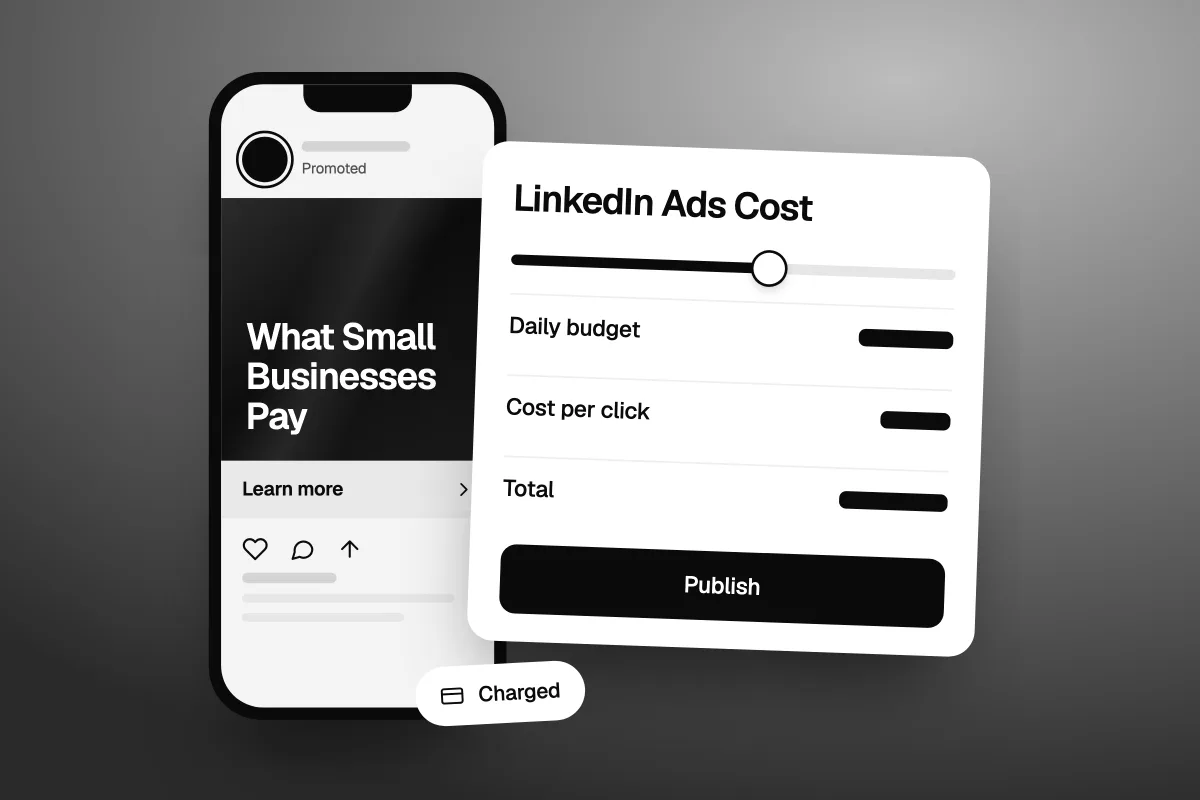
The cost for LinkedIn ads starts at a $10 daily budget, the minimum LinkedIn sets for any ad format, and from there you pay for clicks, impressions or message sends in an auction. There is no price list. What you pay depends on your bid and how many other advertisers want the same people. For a small business, the useful questions are the minimum, how billing works, and what a lead really costs you. LinkedIn ads cost whatever the auction says, so the math matters. All LinkedIn figures below were checked on LinkedIn's own pages on 10 November 2026.
The short answer
LinkedIn's minimum is $10 a day, and it suggests $25 a day for new advertisers. That is about $300 to $750 for a 30-day month. You pay per click, per 1,000 impressions or per message sent, set by auction. LinkedIn suits firms selling high-value work to people with a clear job title.
How much do LinkedIn ads cost?
LinkedIn ads cost whatever it takes to win the auction for your audience, with a floor of $10 a day. LinkedIn's ad pricing page puts it plainly: your cost is "based on the type of activity you're paying for and the ad auction." It adds that "the cost required to win the auction depends on the bid and the desirability of your target audience."
That second line is the key. A narrow, sought-after audience, like finance directors at mid-size firms, costs more than a broad one, because more advertisers bid for it. LinkedIn's help page on bidding strategies says the same: "there isn't a set cost per result. It's auction-based and not guaranteed inventory."
So nobody can honestly tell you a fixed price per click. Anyone who quotes one is quoting someone else's account. What you can control is three things:
- Your budget. The most you will spend per day or over the campaign.
- Your bid strategy. Let LinkedIn bid for you, cap the average cost, or set the bid yourself.
- Your audience. Who you target changes how many advertisers you compete with.
Here is what a month looks like at a few daily budgets, starting at LinkedIn's minimum:
| Daily budget | Where the number comes from | About 30 days |
|---|---|---|
| $10 | LinkedIn's minimum daily budget, any ad format | $300 |
| $25 | What LinkedIn suggests for new advertisers | $750 |
| $50 | Bottom of LinkedIn's suggested range for existing advertisers | $1,500 |
| $100 | Top of that range | $3,000 |
Those are ad spend only. Creative, landing pages and someone to run the account cost extra, whether that is your time or someone else's.
What is the minimum budget for LinkedIn ads?
The minimum daily budget is $10, and the minimum lifetime budget for a new campaign is $100. Both come from LinkedIn's guide to making the most of your budget, which says: "The minimum daily budget amount required to start on LinkedIn is $10, for any ad format."
| Rule | What LinkedIn says (checked 10 November 2026) |
|---|---|
| Minimum daily budget | $10, for any ad format |
| Minimum lifetime budget | $100 for new, inactive campaigns. Once the campaign launches, it adjusts to $10 times the number of days scheduled |
| Suggested starting budget | $25 a day for new advertisers, $50 to $100 for existing advertisers using USD |
| Minimum audience size | 300 member accounts, from LinkedIn's help page on targeting |
The minimum is not the same as a useful budget. At $10 a day you will get very few clicks in a month on a narrow B2B audience, and a handful of clicks tells you almost nothing. LinkedIn's own suggestion of $25 a day for new advertisers is a more honest starting point. Plan for at least a month before you judge it.
You can set a daily budget, a lifetime budget, or both. LinkedIn's guide recommends a lifetime budget with lifetime pacing to get the most from your spend. A lifetime budget also lets you set a custom schedule, such as weekdays only, which suits B2B buyers who browse LinkedIn at work.
The $10 minimum gets an ad running. It does not get you enough data to know whether the ad works.
How does LinkedIn charge: per click, per impression or per send?
It depends on your objective and your bid strategy. LinkedIn calls this "objective-based pricing". Its pricing page gives an example: pick the Website Visit objective and "you'll only be charged when someone clicks the link to your website."
The bidding help page lists three strategies and how each one bills:
| Bid strategy | How it works | What you are charged for |
|---|---|---|
| Maximum delivery | LinkedIn bids for you and aims to spend your whole budget | Impressions (CPM, cost per 1,000 impressions) |
| Cost cap | You set a target cost per result. LinkedIn tries to keep the average under it | Impressions |
| Manual bidding | You set the bid for each result yourself | Impressions, clicks, message sends or video views (CPM, CPC, CPS, CPV), depending on the objective and format |
In plain words:
- CPC (cost per click). You pay when someone clicks. Good when you want visits to a page and want to pay only for interest.
- CPM (cost per 1,000 impressions). You pay when the ad is shown, clicked or not. The automated strategies bill this way.
- CPS (cost per send). For message ads that land in a member's LinkedIn inbox. You pay for each message delivered.
- CPV (cost per view). For video ads.
For a small budget, manual bidding on a cost per click is the easiest to read. You see exactly what each visitor costs. Automated bidding can work well once a campaign has data, but on a tiny budget it has little to learn from.
What does a lead cost on LinkedIn?
A lead costs your total spend divided by the leads you get, and only your own account can tell you that number. LinkedIn does not publish an average, and figures you see quoted elsewhere come from other advertisers' accounts, with other audiences and offers. So work it out both ways: what a lead costs you, and what you can afford to pay.
Work out what a lead costs
Take the $25 a day LinkedIn suggests for new advertisers, over 30 days: $750. The table shows what each lead would cost at different results. The lead counts are examples to show the math, not a forecast.
| Month's spend | Leads (example) | Cost per lead |
|---|---|---|
| $750 | 3 | $250 |
| $750 | 10 | $75 |
| $750 | 25 | $30 |
Work out what a lead is worth
Now flip it. The most you can pay for a lead is what a client is worth to you, times the share of leads that become clients. Say a new client is worth $6,000 to you over the first year, and 1 in 10 leads turns into a client. Then each lead is worth $600 to you, before your other costs. Pay less than that per lead and LinkedIn can make money. Pay more and it can't. Our free ROAS calculator does this math for any ad channel.
This is why LinkedIn works for some businesses and burns money for others. A firm selling $500 jobs can rarely afford LinkedIn's auction. A firm selling $20,000 contracts often can.
Lead Gen Forms change the math
LinkedIn's Lead Gen Forms let people send their details without leaving LinkedIn. LinkedIn's Lead Gen Forms page says the forms "come pre-filled with accurate LinkedIn profile data" and work with Sponsored Content and Message Ads. Fewer steps is the point: nobody has to load your site and type their details. The trade-off is that a pre-filled form takes one tap, so some leads are less ready to talk. Plan to call or email every one of them fast, before they forget they asked.
Cost per lead is the wrong finish line. Count cost per booked call, then cost per client.
Are LinkedIn ads worth it for consultants and small B2B firms?
They can be, when your buyer has a clear job title and one client is worth thousands. LinkedIn's edge is targeting. Its help page on targeting options lists job title, job function, seniority, member skills, company size, company industry and company name, among others. That is LinkedIn's main draw: you can aim at "operations managers at logistics firms with 50 to 200 staff", not just at an interest.
That suits:
- Consultants and coaches who sell to business owners or managers.
- B2B services such as accounting, IT, recruiting or software.
- Agencies and firms with a big contract value and a long sales cycle.
It suits these businesses poorly:
- Local trades and home services. Homeowners aren't on LinkedIn looking for a plumber. Google and local ads fit better.
- Low-priced consumer products. The auction is built for business buyers.
- Anyone without a follow-up system. A LinkedIn lead that waits three days for a reply is money spent twice.
One more check before you start: the 300-member minimum audience. If your exact buyer list is tiny, you may need to widen it a little, for example by job function instead of exact title.
LinkedIn ads or Google and Meta ads: which should you run first?
Run Google first if people already search for what you sell. Run LinkedIn first if they don't search, but you can name their job title. Run Meta first if you sell to consumers or want cheap reach. Each platform finds a different kind of buyer:
| Platform | Who you reach | Best first channel when |
|---|---|---|
| Google search ads | People typing a problem into Google right now | Buyers search for your service, like "fractional CFO" or "IT support for law firms" |
| Meta (Facebook and Instagram) | Broad audiences by interest and behavior | You sell to consumers, or your offer is low-cost and easy to say yes to |
| People by job title, seniority, company size and industry | Your buyer has a clear role and one client is worth a lot |
If you are weighing Meta, our guide to Instagram ads cost shows how Meta's billing works. Local businesses should look at Nextdoor advertising cost before LinkedIn. And if you want to test a newer channel, ChatGPT ads now take advertisers too.
Our own view for a small B2B firm: start with Google search if there is any search volume for what you sell, because those people are already looking. Add LinkedIn once your landing page and follow-up work, and use it to reach buyers who would never search. Running both badly costs more than running one well.
Who should run your LinkedIn ads?
Whoever can also fix the landing page and the follow-up, because that is where most LinkedIn money is lost. We run LinkedIn, Google and Meta ads as part of Havstock Unlimited, along with the pages and the follow-up that turn clicks into booked calls. You pay the platform for the ads. You can see how we run campaigns on our ads service page.
We are the wrong choice if your whole LinkedIn budget is $300 to $750 a month. At $4,995 USD a month, our fee would dwarf your ad spend. At that size, run it yourself: one campaign, one audience, a manual cost-per-click bid, and a Lead Gen Form. Give it a month, then judge it on booked calls, not clicks.
FAQ
What is the minimum budget for LinkedIn ads?
LinkedIn's minimum daily budget is $10 for any ad format. The minimum lifetime budget for a new campaign is $100, and after launch it adjusts to $10 times the days scheduled. LinkedIn suggests new advertisers start at $25 a day, which is about $750 over 30 days. Figures checked 10 November 2026.
Do you pay per click on LinkedIn?
You can. With manual bidding, LinkedIn can charge per click, per 1,000 impressions, per message sent or per video view, depending on your objective and format. The automated strategies, maximum delivery and cost cap, charge by impressions. For a small budget, a manual cost-per-click bid is the easiest to track.
Why are LinkedIn ads expensive?
LinkedIn says the cost to win its auction depends on your bid and how desirable your audience is. Business buyers with clear job titles are an audience many advertisers want, so competition pushes prices up. You pay for precision: reaching a role at a type of company that other platforms can't target as directly.
How much should a small business spend on LinkedIn ads?
Start at LinkedIn's suggested $25 a day for new advertisers, about $750 a month, and run for at least a month before you judge it. Then compare your cost per booked call with what a client is worth. If one client covers several months of spend, LinkedIn can pay. If not, try Google first.
Are LinkedIn Lead Gen Forms worth using?
Often, yes. LinkedIn says the forms come pre-filled with profile data and work with Sponsored Content and Message Ads, so people can reply without leaving LinkedIn or typing their details. That removes steps. Some will be less ready to talk, so reply to every lead quickly and qualify on the first call.
Can I run LinkedIn ads to a very small audience?
Only down to a point. LinkedIn's targeting help says the minimum audience size to run an ad set is 300 member accounts. If your list of ideal buyers is smaller, widen the targeting a little, for example by job function or seniority instead of exact title, or add similar companies.
So what will LinkedIn ads cost you?
At minimum $10 a day, realistically $25 a day or more to learn anything, plus whatever the auction charges for your audience. The real test is not the click price. It is whether one client pays for months of spend. Work out what a lead is worth to you before you launch, reply to every lead fast, and judge the cost of LinkedIn ads on clients won.