
 Nathan Field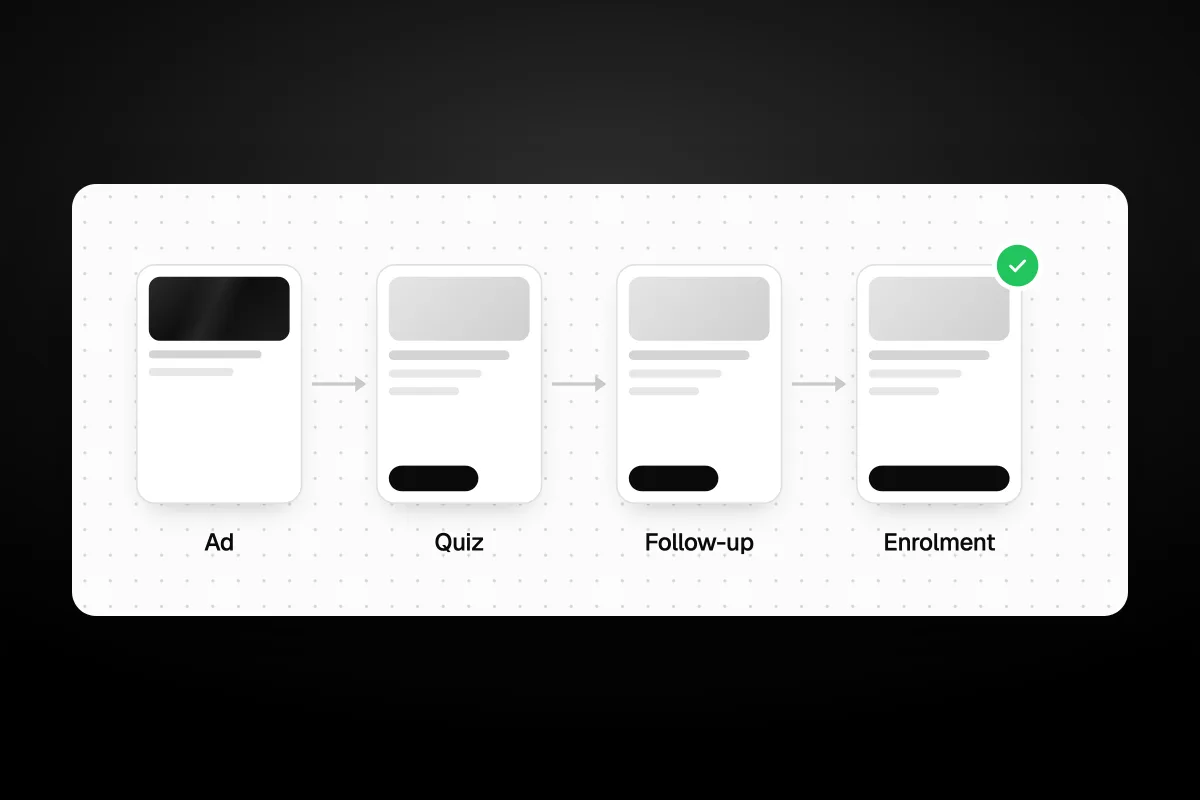
RTO marketing works when the ad, the page, the follow-up and the enrolment call are built as one system, with the ASQA rules built in from the start. Most RTOs have some of those parts. Few have them joined up. The gaps between them are where enrolments leak out.
This guide walks through the build order we follow for training clients, step by step, and shows where the compliance rules sit in each one. If you want the list of what usually goes wrong first, read 9 marketing mistakes RTOs make. This post picks up where that one ends.
This is general marketing guidance, not legal or compliance advice. Check your own obligations with your compliance adviser, your state funding contract and ASQA.
The short answer
To get more enrolments, market one course at a time. Send ads to a page or quiz built only for that course. Reply to every enquiry within minutes, then follow up for weeks. Track each lead through to enrolment. Show your RTO code, the exact course title and honest funding wording on every ad and page.
The rules and the results pull the same way more often than people think. A clear ad with the right code and honest funding lines puts off the wrong people before they cost you a phone call.
Why most RTO marketing advice falls short
Search "RTO marketing" and most of what you find falls into two camps: agencies selling ads, and compliance firms selling policy templates. The first camp barely mentions ASQA. The second rarely gets as far as an enrolment. A few guides still quote the 2015 Standards and VET FEE-HELP, even though the Standards for RTOs 2025 took over on 1 July 2025.
You need both halves. A campaign that breaks the rules can put your registration or your funding contract at risk. A campaign that follows every rule and brings in no one still costs you the intake.
Put the rules in at the start and they stop being a brake. They become part of why people trust the ad.
The RTO enrolment system, step by step
The path is short: ad, page or quiz, follow-up, enrolment. Getting each part right takes six steps.
1. Pick one course to push first
Do not launch a campaign for "all our courses". Each course has its own student, its own reasons and its own page. Mix them and every part of the funnel gets vaguer.
Pick the first course with four questions:
- Is it current and on your scope? Check it on training.gov.au, the National Register. Only market what is on your scope today.
- Do you have room? Seats, trainers, and placement spots if the course needs them. Filling a class you cannot deliver is a worse problem than an empty one.
- Is the outcome clear? A course tied to a job, a licence or the next step in a career is easier to explain in an ad than a general interest course.
- Do people already look for it? Type the course name into Google. If other providers are running ads on it, people are searching for it.
Start with the course that passes all four. When it works, copy the system to the next one.
2. Know who is enrolling and why
"Students" is not one audience. For most RTOs it is at least four:
- Career changers who want a new line of work and are not sure where to start.
- People already in the job who need the next qualification to move up.
- People who need a ticket or licence to keep working or to start a role.
- Employers paying to train their staff.
Each group needs a different ad. The career changer wants to know what the work is like. The employer wants to know how long staff will be away. Write to one group per campaign, in their words, and lead with the outcome. The unit list can sit further down the page.
One thing to leave out: lines that point at someone's situation, like "Out of work?" or "Struggling with bills?". Meta's ad rules block ads that assert or imply personal traits, including financial status. In VET marketing, those lines also look like the high-pressure selling that regulators went after in the VET FEE-HELP years.
3. Match the channel to how ready people are
The right channel depends on whether people already know they want the course. Here is how the main ones compare for an RTO.
| Channel | Who it reaches | Best for | Watch for |
|---|---|---|---|
| Google Search ads | People typing the course name or the job | Tickets, licences and qualifications people know by name | Ad text is marketing material. The same code and title rules apply. |
| Meta ads (Facebook, Instagram) | People who are not searching yet | Career change courses, paired with a quiz | Personal trait rules and funding claims |
| LinkedIn ads | Managers, HR teams and business owners | Employer-paid and leadership training | Clicks tend to cost more, so the page has to work hard |
| SEO and AI search | People researching courses and careers | Course pages that answer real questions | Slow to build. Think months, not weeks. |
| Email and SMS to past enquiries | People who asked before and did not enrol | New intakes and start dates | Consent and a working unsubscribe (Spam Act) |
Our take: if you can only fund one channel at the start, fund the one that matches your first course. Search ads for courses people already look up by name. Meta plus a quiz for courses people need to be talked into. Most RTOs end up running both, but not on day one.
4. Build a page or quiz for each campaign
Send each campaign to its own page. Not the homepage, not the course catalogue. One course, one message, one next step.
Near the top, a course landing page should show:
- The exact course code and title, as it appears on the National Register.
- Your RTO name and registration code.
- The outcome in plain words: what the course prepares people to do.
- How it is delivered (online, on campus or blended) and how long it takes, if you can state that accurately.
- One clear action, like "Book a call" or "Get the course guide".
Lower down, cover fees, funding options with their conditions, entry requirements, and the questions your enrolment team hears every week. Real student stories help too, with written consent for every name, photo and quote.
When a quiz beats a page. A quiz works when people do not yet know which course they need. Ask about their goal, their experience and how they want to study, then point them to a course. Get these parts right:
- Ask for contact details before the result, so anyone who stops is still someone you can follow up.
- Show a privacy notice at the form that says who will receive their details and why. Collect only what the RTO needs.
- Keep eligibility wording soft. Never tell someone they are eligible or funded. Say something like "Based on your answers you may be eligible. The provider will confirm before you enrol."
- Name the RTO on the result page, with the code and exact title of every course the quiz suggests. A quiz that only reveals the provider at the very end is a compliance risk.
Never tell a student they are eligible. Tell them they may be, and that the provider will confirm.
5. Reply in minutes, then follow up for weeks
Someone who enquires tonight is probably looking at other providers too. The first one to give a clear, helpful answer has the edge. But few people enrol off one message, so you need a follow-up system that runs every time, without anyone having to remember:
- Straight away: an SMS and an email that confirm the enquiry and offer a call time.
- Same day: a call from a real person on your enrolment team.
- Over the next few weeks: short emails that each answer one question. Cost and payment options. How long it takes and how study works. What the course leads to. What support looks like.
- Before each intake: a reminder to past enquirers who opted in, with the next start date.
Every message should match the RTO's pre-enrolment information on fees, refunds and entry requirements. Never contradict it. And only send marketing email and SMS to people who gave consent, with a working unsubscribe in every message.
AI chat can help, within limits. An AI chat on your site can answer course questions at 10pm and book a call with your team for the next morning. Train it only on approved course information. Tell it to hand every funding and eligibility question to a person. A chatbot that promises funding is still your RTO making that promise.
We go deeper on this step in how to automate lead follow-up without losing the human touch.
6. Track every lead through to enrolment
This is the step most RTOs skip, and it is the one that tells you where to spend. Your ad platform knows about clicks and leads. Your student management system knows about enrolments. If nothing joins them, you judge campaigns on the wrong number.
Set up a CRM that records, for every lead:
- The ad, page or quiz it came from.
- Whether they booked or took a call.
- Whether they enrolled, and in which course.
- Why they did not, if they told you.
Then work out the cost per enrolment for each campaign: ad spend divided by enrolments. A campaign with cheap leads and no enrolments is worse than one with dearer leads that fills a class. For the reporting side, see how to build a marketing dashboard that actually matters.
Judge campaigns on cost per enrolment. Clicks and leads are only on the way there.
Build compliance into the funnel, not on top of it
Most RTOs treat compliance as the last check. Someone builds the ad, then someone else looks for problems. That is slow, and good ads get pulled late. It works better the other way round.
ASQA's Information and Transparency practice guide sets out what marketing must include under the 2025 Standards. It applies to material published by the RTO and by any third party marketing for it. Here is where each main point goes in a funnel, and how it also helps you enrol people.
| Rule | Where it goes | How it helps enrolments |
|---|---|---|
| RTO registration code, or a link to your National Register entry | Every ad, landing page, quiz result and email | People check who they are studying with. A visible code answers that before they ask. |
| Exact training product code and title from the National Register | Ad copy and the page headline or sub-headline | Serious students often search by the full course title. Matching it puts you in front of people ready to enrol. |
| Say which services a third party delivers, if any | Course page and pre-enrolment information | No surprises after enrolment. |
| Funding shown with its conditions, in the RTO's approved wording | Any ad or page that mentions funding | Filters out people who will not qualify before they take up a call. |
| No guaranteed jobs, or completion times you cannot back | Everywhere, including chat and call scripts | Promises you cannot keep turn into refund requests and complaints. |
| Written consent for every student name, photo and story | Testimonials, reviews and case stories | Real stories are the proof people look for. Consent means you can keep using them. |
Two habits make this fast. Keep one approved list of course titles, codes and funding lines that everyone works from. And keep an approvals log that shows what went live, who approved it and when. Before we write a single ad for a training client, that approved list is the first thing we ask for.
Build the rules into the template, and every new ad starts compliant instead of waiting in a queue to be fixed.
If an agency runs your marketing
An agency, freelancer or lead generator that markets for you is generally a third party under the 2025 Standards, and the RTO stays responsible for what they publish. The FAQ below covers what that means in practice. It applies to us too. If you work with Havstock, you approve every ad, page and email before it goes live. Some state funding contracts also limit what third parties can do with funded programs, so check yours before any agency, including us, touches a funded course.
What results look like
Two training organisations we have worked with give a sense of what is possible. For one, we ran the ads and brought in leads at $2 each. For the other, we built a quiz funnel, ran the ads behind it, and brought in leads at $4 each.
Two honest notes on those numbers. First, results depend on the course, the market, the time of year and the budget. Treat them as examples, not promises. Second, a lead is only step one. A $2 lead who never answers the phone is not a bargain. That is why the tracking in step 6 matters more than any single ad.
What RTO marketing costs, and how long it takes
There are two costs: the ad spend that goes to the platforms, and the work to build and run the system. We will not quote you a cost per enrolment before we see your course and your market, and we would be wary of anyone who does. The budget method is in the FAQ below.
On timing, paid ads can bring enquiries as soon as they go live. Knowing which ads and pages actually work takes longer. Judge a new campaign on weeks of data, not the first few days. SEO and AI search take months to build, but they keep bringing people in when you pause ad spend.
FAQ
What is RTO marketing?
RTO marketing is how a registered training organisation finds and enrols students. It covers ads, course pages, quizzes, email and SMS follow-up, and SEO. Unlike most marketing, it runs under the Standards for RTOs 2025, state funding contracts and consumer law, so every claim, code and funding line has to be accurate.
Can an RTO use Facebook ads to recruit students?
Yes. Facebook and Instagram ads are a normal channel for RTOs. The same rules apply as anywhere else: your RTO code or a National Register link, the exact course code and title, conditional funding wording and no guarantees. Meta's own rules add one more. Do not imply the viewer's personal traits, like money trouble.
Does the RTO code need to be in the ad itself?
ASQA's guidance says advertisements and marketing materials must include the registration code, or a link to the RTO's entry on the National Register. Treat every ad, post and email as marketing material. The safe habit is to put the code in the ad text or image, not only on the landing page.
Are quiz funnels allowed for RTOs?
Yes, with care. Name the RTO and show its code on the quiz and the result. Put a privacy notice at the form that says who gets the details. Collect only what the RTO needs. Never tell someone they are eligible or funded. Say they may be, and that the provider will confirm.
Can an RTO use AI chat on its website?
Yes, if you control what it says. Train it only on approved course information, with the exact titles and codes. Have it hand funding, eligibility and RPL questions to a person. Whatever the chatbot tells a student, your RTO has said, so check its answers the same way you check an ad.
Is a marketing agency a third party under the 2025 Standards?
Generally, yes. Anyone who markets or recruits for you, including agencies, lead generators and affiliates, is treated as a third party. You need a written agreement, ASQA notified of the arrangement, and sign-off on what they publish. If they get it wrong, the finding lands on your RTO, not on them.
How much should an RTO spend on marketing?
We do not know of a reliable public benchmark for RTOs, and course values vary too much for one number to help. Start from the other end. Work out what an enrolment is worth, set the most you will pay to win one, and track cost per enrolment until your campaigns sit under it.
Where Havstock fits
Most RTOs do not need a full in-house team to run this. They need someone who can build each step and join them up.
Havstock Unlimited is a marketing subscription that covers all of it for $4,995 USD a month. Ads and ad creative, landing pages and quiz funnels, email and SMS follow-up, your own CRM, AI chat that answers questions and books calls, and a monthly results report. You add requests, we deliver them one at a time, and you approve everything before it goes live. No setup fee and no contract. Ad spend is paid to the platforms directly. If the model is new to you, here is how a marketing subscription works.
It will not suit every RTO. If your whole marketing budget is smaller than the fee, start with one well-built campaign run in-house. If you need your policies and procedures reviewed, hire a VET compliance consultant, not a marketing team. And if your campaigns lean on video, we do not film or edit, so the footage would need to come from your side.
If you want RTO marketing that fills classes, not just inboxes, start with the one course you most need to fill and build the system around it.