 Nathan Field
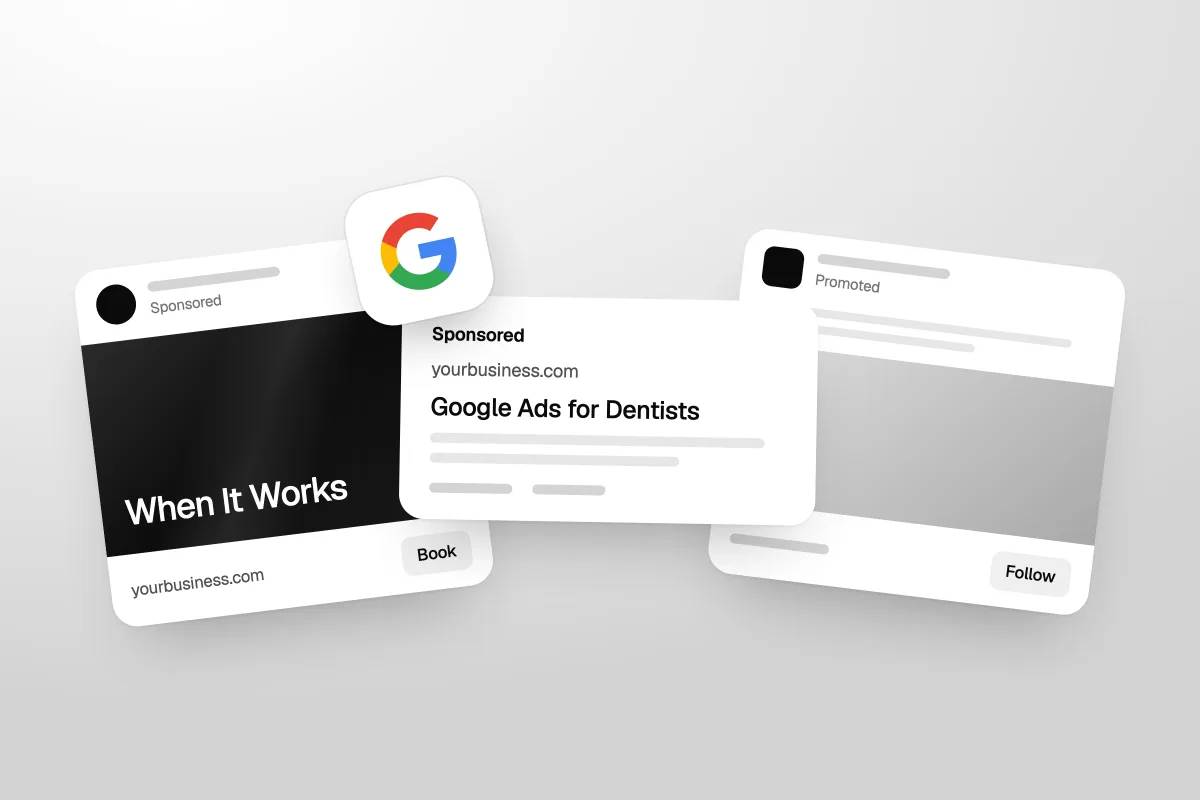
Google Ads for dentists work when they target people searching for a specific treatment near your practice, send them to a page about that treatment, and someone answers the phone. They are strongest for high-value or urgent care, such as implants and emergency visits. Google does not publish a cost per click for dentistry, so you set a budget, track new patients and work out your own cost per patient. This guide shows how.
The short answer
Google Ads can bring a dental practice new patients who are ready to book, because they show when people search. Budget by the day, track cost per new patient rather than cost per click, bid on treatment plus town searches, check Google's healthcare ad rules, and compare search ads with Local Services Ads, where dentists pay per lead.
Do Google Ads work for dentists?
Yes, when the basics behind them are solid. Google Ads put your practice at the top of the results when someone types "emergency dentist near me" or "dental implants [town]". That person wants care now. It is the opposite of social media, where you interrupt someone who was not thinking about their teeth.
Dental PPC tends to work best for:
- Urgent care. Toothache, a broken tooth, a lost filling. People search, call and book the same day.
- High-value treatments. Implants, clear aligners, veneers and full-mouth work, where one new patient can cover a lot of ad spend.
- New patients moving to the area. People search "dentist [town]" when they move, and a good first visit can turn into years of check-ups.
It tends to struggle when the ads send everyone to the homepage, when calls ring out at lunchtime, or when a practice bids on broad words like "dentist" across a whole city. Google Ads do not fix a weak front desk. They make it louder.
Google Ads put you in front of people who already want a dentist. Whether they book depends on your page and your phone, not the ad.
How much do Google Ads cost a dental practice?
You choose the budget, and Google's auction sets the price of each click. Google does not publish an average cost per click or per patient for dentists, and we will not repeat another blog's figure. Prices depend on your town, the treatment and how many practices bid on the same searches. Google's Keyword Planner, inside your Ads account, shows estimated bid ranges for your own keywords and area before you spend anything.
How the budget works, from Google's own help page (Google Ads Help, choose your bid and budget, checked 10 November 2026):
- You set an average daily budget. On a busy day, Google may spend up to two times that amount.
- Over a month, you are never charged more than 30.4 times your average daily budget. Google's example: a $10 daily budget caps the monthly charge at $304.
- To plan a monthly budget, multiply the daily budget by 30.4.
How to work out your cost per new patient
Track the whole path, not just clicks. The numbers below are made up to show the maths. They are not a benchmark.
| Step | Example number | Sum | Result |
|---|---|---|---|
| Daily budget | $50 | $50 x 30.4 | Up to $1,520 a month |
| Spend this month | $1,500 | - | - |
| Calls and bookings from ads | 40 | $1,500 / 40 | $37.50 per enquiry |
| New patients seen | 12 | $1,500 / 12 | $125 per new patient |
Whether $125 a patient is good depends on what a patient is worth to you over the years, not on the first visit. A patient who comes back twice a year and refers their family is worth far more than one cleaning. Our free customer lifetime value calculator shows what one patient is worth and how many you need to pay for your marketing.
What should a dentist bid on in Google Ads?
Bid on treatment plus place searches from people ready to book, and split them by how much each treatment is worth. One big campaign for "dentist" spends most of the money on the cheapest visits.
| Campaign | Example searches | Why it earns its own budget |
|---|---|---|
| Emergency | emergency dentist [town], toothache dentist open now | Urgent, books the same day, often becomes a regular patient |
| Implants | dental implants [town], implant dentist near me | High value per patient, longer decision |
| Cosmetic | veneers [town], teeth whitening near me, clear aligners [town] | High value, people compare practices |
| New patients | dentist [town], family dentist near me, kids dentist [town] | Steady volume, lower value per visit |
A few habits save a lot of wasted spend:
- Use phrase and exact match for your main searches, so your ads do not show for loosely related words.
- Add negative keywords early. Searches with "jobs", "salary", "school", "assistant" or "course" are people looking for work or training, not treatment.
- Target the area you really serve. Most patients will not drive across a city for a check-up.
- Run ads in opening hours for emergency campaigns, unless someone answers calls after hours.
- Check the search terms report every week and add the wasted ones as negatives.
For the free channels that make these ads cheaper, such as your Google Business Profile and reviews, see our list of dental marketing ideas.
What are Google's ad rules for dentists?
Most general dental ads run without special approval, but three rules catch practices out. We explain what Google's pages say. This is not legal advice, and state dental board rules on advertising also apply.
1. Prescription drug terms are restricted. Google restricts the use of prescription drug terms in ads, landing pages and keywords, and services that prescribe or sell prescription drugs online need to apply first (Google healthcare and medicines policy, checked 10 November 2026). If your practice offers treatments that use prescription products, check the policy before you name them in an ad or on the landing page.
2. Health is a sensitive category for targeting. Google's personalized advertising policy lists health among its sensitive interest categories. Advertisers promoting offers in those categories cannot use their own audience lists, such as remarketing to past site visitors or uploading a patient list (Google restricted targeting in personalized advertising, checked 10 November 2026). If Google treats your ads that way, plan on search ads and Google's own audiences instead of remarketing.
3. Your ads and landing page must match. Claims on the page, prices and offers should be the same as in the ad. An ad for "$99 new patient exam" that lands on a page with no such offer wastes money and can get flagged.
One small carve-out from the same healthcare page: ads only for dental insurance coverage are not restricted.
What should a dental Google Ads landing page have?
A dental landing page should match the search, answer the main worries and make booking take seconds on a phone. If someone searched "emergency dentist [town]", the page they land on should say "Emergency dentist in [town]" at the top, not "Welcome to our practice".
- A headline that repeats the search. Treatment and town.
- A tap-to-call number and online booking at the top and again further down.
- Insurance and payment. Which plans you accept, and any payment or financing options.
- Prices, where you can. Even a "from" price or a new patient offer removes a big worry.
- Real photos. The dentist, the team and the rooms. Not stock smiles.
- Reviews that mention the treatment on the page.
- Location, hours and parking. Small details, big effect on whether people book.
- A fast load on a phone. Someone with toothache will not wait for a slow page.
Then the phone. Every ad click that becomes a call needs a person, or a good system, to answer it. Our guides to a dental answering service and to speed to lead cover how practices stop losing booked patients to voicemail.
A new patient who reaches voicemail calls the next practice on the list. Your ad paid for that click either way.
Google Ads or Local Services Ads: which suits a dentist?
Many practices should run both, because they do different jobs. Google lists "Dentist" as an eligible health service for Local Services Ads in the US, and describes them as pay-per-lead listings for verified local providers, with budgets set by how many leads you want each week (Google Local Services Ads, checked 10 November 2026).
| Google search ads | Local Services Ads | |
|---|---|---|
| You pay for | Clicks | Leads, such as calls and messages |
| Control over searches | High. You choose keywords and treatments | Low. Google matches you to searches |
| Where people land | Your own landing page | Your Local Services profile, then a call or message |
| Setup | Campaigns, keywords, ads and pages | Business verification and a profile |
| Best for | Specific high-value treatments | General "dentist near me" style searches |
Our view: start Local Services Ads if your area has them, because you only pay for leads and the setup is light. Run search ads for the treatments you most want, like implants or emergencies, where you want control over the words and the page. Either way, judge both on cost per new patient seen, not cost per lead.
Should a dental practice run its own Google Ads?
A practice can run its own ads if someone has a few hours a week to check search terms, adjust bids and track patients back to the ads. Many cannot spare that time, which is when outside help pays for itself.
Havstock manages Google ads as part of its plans. Our Google Plan was $1,995 USD a month on our pricing page on 10 November 2026, with a website, Google profile updates, weekly ad changes, missed-call text back and a CRM included. Havstock Unlimited, at $4,995 USD a month, adds Meta and LinkedIn ads, funnels, email and more, with ad spend paid separately. You can see how we work with practices on our dental marketing page and the ad side on our ads management page.
It is the wrong choice for a practice spending a few hundred dollars a month on one campaign. At that size, a freelancer or doing it yourself costs less. Website companies that serve dental practices, such as ProSites, are another route if you mostly need a site.
FAQ
How much should a dentist spend on Google Ads per month?
Start with a budget you can afford to test for a couple of months, then judge it on cost per new patient. Google charges up to 30.4 times your average daily budget in a month, so a $30 daily budget means up to $912. Raise spend only on campaigns that bring patients in.
Is dental PPC worth it for a small practice?
It can be, if you pick a few high-value or urgent treatments, target your real area and answer every call. A small practice cannot outspend large groups on broad searches like "dentist", so focus on treatment and town searches where your practice is the closest good choice.
Can dentists use remarketing on Google Ads?
Possibly not. Google lists health as a sensitive interest category, and advertisers promoting those offers cannot use their own audience lists, which includes remarketing and customer list uploads. Google's own predefined audiences can still be used. Check how Google classifies your ads before building a remarketing campaign.
How long do Google Ads take to work for a dental practice?
Ads can bring calls within days of going live. Getting the cost per new patient down takes longer, often a few months of adding negative keywords, testing ads and improving landing pages. Track every new patient back to the ad that brought them, so you can see the trend.
Do I need a separate landing page for each dental treatment?
For your main campaigns, yes. A page about dental implants in your town converts implant searches far better than a homepage listing every service. Start with pages for your two or three most valuable treatments, then add more as each campaign proves it brings patients.
Are Local Services Ads available for dentists everywhere?
No. Google lists dentist as an eligible health category for Local Services Ads in the US, but availability depends on your location. Check Google's Local Services Ads page for your area. If they are not offered where you are, search ads are your main paid option on Google.
Where should a dental practice start?
Pick one treatment you want more of, build one page for it, and run one search campaign with a daily budget you can live with. Track calls, bookings and new patients seen, and work out your cost per new patient each month. That is how Google Ads for dentists become a planned source of patients. If you would rather have it run for you, see how Havstock Unlimited works.