 Nathan Field
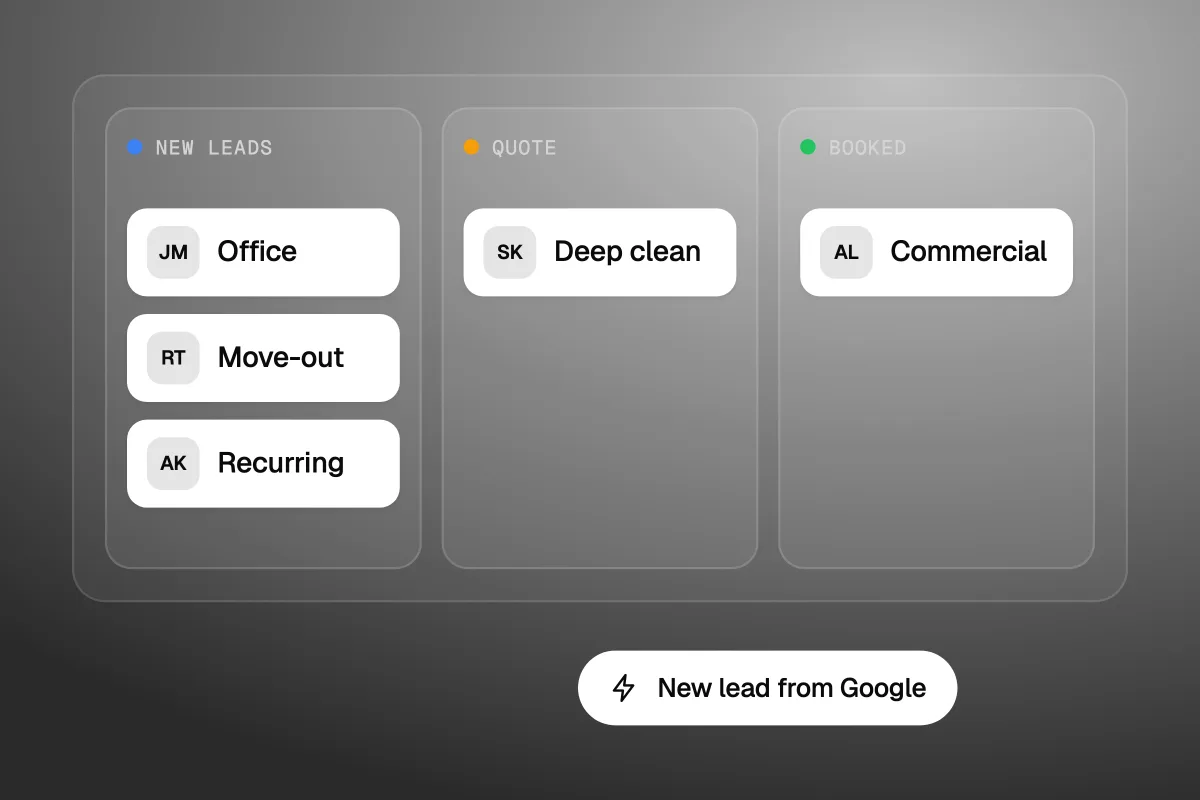
You get cleaning clients by answering enquiries fast, winning on Google with reviews, running a site with a page per service and area, and working referrals, then adding paid ads and bought leads last, while pushing hard for recurring contracts over one-off cleans. The order is what makes the money add up, and the recurring work is where a cleaning business actually grows. This guide walks the whole plan and shows where to spend first.
The short answer
Reply to every call and form in minutes. Fix your Google Business Profile and get a review after each job. Build pages for your services and areas, residential and commercial. Turn one-off cleans into Recurring contracts. Work referrals. Then run search ads and buy leads last. Judge every source on cost per won client, not cost per lead, and weigh whether it becomes recurring.
What is the best way to get cleaning clients?
The best way is to build cheap, owned sources first and rent leads last. Owned sources cost time and keep paying after you stop. Rented sources cost money every month and stop the day you stop. Get this backwards and you burn money on ads that land on a weak site, or buy leads for a phone nobody answers.
Here is the order that works for most cleaning businesses:
- Answer leads fast, and catch the ones you miss.
- Set up and clean your Google Business Profile.
- Ask every client for a review, the same day.
- Build a site with a page per service and area.
- Turn one-off cleans into recurring contracts.
- Work referrals and word of mouth.
- Run search ads, then buy third-party leads last to fill gaps.
Each step makes the next pay better. A strong profile makes ads cheaper. A recurring contract turns one sale into months or years of income. Skipping steps, or buying leads first, is the most common way cleaning clients end up costing far more than they should.
Build the owned sources first. Rent leads only to fill the gaps they leave.
Why does answering leads fast come first?
Because the enquiry you already have is cheaper than any new one. Someone who wants a quote for a house clean or an Office contract calls two or three cleaners and books the first one who picks up and sounds reliable. If your phone rings out while you are mid-clean, you hand that client to the next name on their list.
Measure it first. For 30 days, log every call, form and text: the source, whether you won it, and what it was worth. Ask each new caller how they found you. Most cleaning owners are surprised how many enquiries ring out while they are working or driving between jobs.
Then plug the leak. Ring more than one phone. Decide who answers during jobs. Send an automatic text to every missed call so the caller holds for you instead of dialling on. We give the exact wording in our guide to missed call text back. Reaching back out to old enquiries and past clients works too, which is what we cover in database reactivation.
How do cleaners win on Google Business Profile and reviews?
Your Google Business Profile is the free listing that puts you on the map for "cleaner near me" or "office cleaning [town]". It is the highest-value thing most cleaning businesses can fix this week, and you cannot buy your way up it. Google says plainly that "There's no way to request or pay for a better local ranking on Google" (Google Business Profile Help).
Google says local ranking comes down mainly to relevance, distance and how well known your business is, which includes reviews. Work the parts you control.
- Set up as a service-area business. You go to clients, so list one profile for your base with a service area and hide your address (Google guidelines for representing your business).
- Use your real business name. Padding it with keywords breaks the rules and risks a suspension.
- Pick the fewest categories that fit. House cleaning or commercial cleaning as the main one, then only real extras.
- List services by name. Regular home clean, Deep clean, Move-out clean, Office cleaning, end of lease, carpet cleaning.
- Add real photos. Your team in branded shirts, your kit, and clean, bright finished rooms. Not stock images.
Then reviews. Ask the day you finish, while the place is spotless and the client is happy. A short link texted after the job gets far more reviews than a card left on the bench. Reply to each one. Recent reviews that name the service and area help you show up when someone nearby searches for that exact clean.
The map runs on your profile and your reviews. Both are free, and both are earned one clean at a time.
Residential or commercial: which cleaning clients should I chase?
Residential and commercial cleaning are two different businesses, and the smart move is usually to pick one to lead with, not split your effort down the middle. Residential clients are easier to win, book faster, and decide on the spot, but each one is smaller and they come and go. Commercial clients, like an Office, a gym or a medical suite, take longer to win and often want a quote and a walkthrough, but a single contract can be worth more than a dozen homes and it runs for years.
Residential work covers regular home cleans, Deep clean jobs and Move-out cleans. It is a volume game: many small clients, won on speed, reviews and trust. Commercial work is a relationship game: fewer clients, won on reliability, insurance, and showing up without fail. Your site, your pitch and your pricing should match whichever you chase.
Many cleaning businesses start residential because it is faster to get going, then add commercial once they have a team they can trust to run a contract without them. If you want both, build a clear page for each so a facilities manager and a busy parent each land somewhere that speaks to them, instead of one page trying to do both jobs at once.
Why are recurring contracts the real prize?
Recurring contracts are the real prize in cleaning because they turn one sale into steady, predictable income. A one-off Deep clean or Move-out pays once, and then you are back out finding the next client. A Recurring weekly or fortnightly clean, or an ongoing Office contract, pays again and again with no new marketing cost after the first sale. That is what makes a cleaning business worth something.
So treat every one-off clean as a doorway to a recurring one. Finished a one-time Deep clean? Offer the plan that keeps the home that way: "I can come back every fortnight so it never gets to this point again, one flat price." You are already there, the client already trusts you, and the spotless result is your best sales pitch.
Build your week around the recurring book first, then slot one-off jobs into the gaps. A full round of recurring clients gives you cash you can count on, which makes hiring and planning possible. One-off cleans are good money, but a base of recurring contracts is what lets the business run without you chasing work every single week.
A one-off clean pays once. A recurring contract pays for months or years. Offer the plan on the last day of every job.
What should a cleaning website have?
A cleaning website needs one clear page per service and area, not a single page that lists everything. Search engines rank a page about "Office cleaning in [town]" above a homepage that mentions it once, and a client trusts a page that is about the exact clean they want.
Think in a grid. Down one side, your services: regular home clean, Deep clean, Move-out clean, Office cleaning, end of lease, carpet and window cleaning. Across the top, your areas. Each box is a page. Build the ones for the work you want more of first. You do not need the whole grid at once.
Every page needs the same bones. A plain headline that names the service and area. A short list of exactly what is included, because cleaning buyers worry about what you will skip. A few photos of real finished jobs. The reviews that mention that service. And one clear way to book a quote on every screen size. On a recurring page, make the offer obvious: set schedule, set price, same cleaner where possible. The site, the profile and the follow-up should work as one system, not three separate jobs.
When should a cleaning business run paid ads or buy leads?
Run paid ads only after the first steps are in place, and buy third-party leads last of all. Ads send strangers to your business, and your profile, site and fast reply decide whether those strangers become clients. Pay for clicks before that, and you fill a leaky bucket.
Start with search ads that show when someone types "move out cleaning [town]" or "office cleaners near me". They catch people who want the clean now, so they convert better than ads shown to people who were not looking. Point each ad at the matching service-and-area page, not your homepage. Set a cap you can lose, and track won clients and their value, not clicks. Because a recurring contract is worth so much, you can pay more to win one, as long as you measure the full value over time.
Third-party lead sites sell you an enquiry, often the same one they sold to several cleaners, so you race on speed and price and own nothing afterwards. Judge a bought lead on cost per won client, and reply in minutes. Read our Angi Leads review before signing up to anything, so you know how the billing and lead-sharing work. The trap is leaning on bought leads instead of your owned sources, which stop the day you stop paying.
How big is the cleaning market?
Cleaning is one of the largest trades there is, which means steady demand and heavy competition. The US Bureau of Labor Statistics counts 2,432,600 janitors and building cleaners in 2025, with employment projected to grow about 2 percent through 2035 and roughly 321,800 openings a year on average (U.S. Bureau of Labor Statistics).
A market that size means the clients are always there, and so are plenty of competitors chasing them. The cleaning businesses that win are the ones that answer fast, look strong on Google, and lock in recurring contracts instead of living clean to clean. That is how you get cleaning clients in a crowded field without racing anyone to the bottom on price.
FAQ
What is the fastest way to get cleaning clients?
Fix your Google Business Profile and get reviews after every job, while replying to new enquiries in minutes. Both are free and both put you in front of people ready to book. Google confirms you cannot pay to rank higher locally, so the work itself is what moves you up the map.
Should I focus on residential or commercial cleaning?
Lead with one. Residential clients book faster and decide on the spot but are smaller and churn. Commercial clients, like an Office or gym, take longer to win but a single contract can be worth more than a dozen homes and runs for years. Match your site and pitch to whichever you chase.
Why do recurring contracts matter so much?
Because they turn one sale into steady income. A one-off clean pays once, but a Recurring weekly or fortnightly client pays again and again with no new marketing cost. A base of recurring contracts is what makes a cleaning business stable enough to hire, plan and grow.
How do I turn a one-off clean into a regular client?
Offer the plan on the last day, while the place is spotless and the client is happy. Say it plainly: "I can come back every fortnight so it never gets this bad again, one flat price." You are already on site and already trusted, so that is the easiest sale you will ever make.
Are paid ads worth it for cleaners?
Yes, but only after your profile, reviews and site are solid. Ads send strangers to your business, and those three decide whether strangers book. Start with search ads aimed at ready buyers like Move-out or Office searches, and judge them on clients won and their lifetime value, not clicks.
Should I buy cleaning leads from Angi?
Only to fill gaps, and only after you measure cost per won client. These sites sell the same enquiry to several cleaners, so you race on speed and price. They can smooth a quiet patch, but they are rented, so never rely on them instead of the sources you own.
How do I get more Deep clean and Move-out jobs?
Build a clear page for each, name them in your Google profile, and gather reviews that mention them. These jobs often come from people searching in a hurry, so fast replies win them. Then offer a recurring plan afterwards, since a one-off Deep clean is a natural doorway to a regular clean.
Getting more cleaning clients is not one big push. It is a short list of jobs done in the right order: answer fast, win on Google, build a site per service and area, turn one-off cleans into recurring contracts, then pay for ads and buy leads last. If doing all of that on top of running the cleans sounds like too much, that is the gap Havstock Unlimited fills. We set up and run the whole system as one, on a flat monthly subscription, so you keep cleaning while the clients keep coming.
Recurring work is where the money is. See what a client is worth with our free customer lifetime value calculator.