
 Nathan Field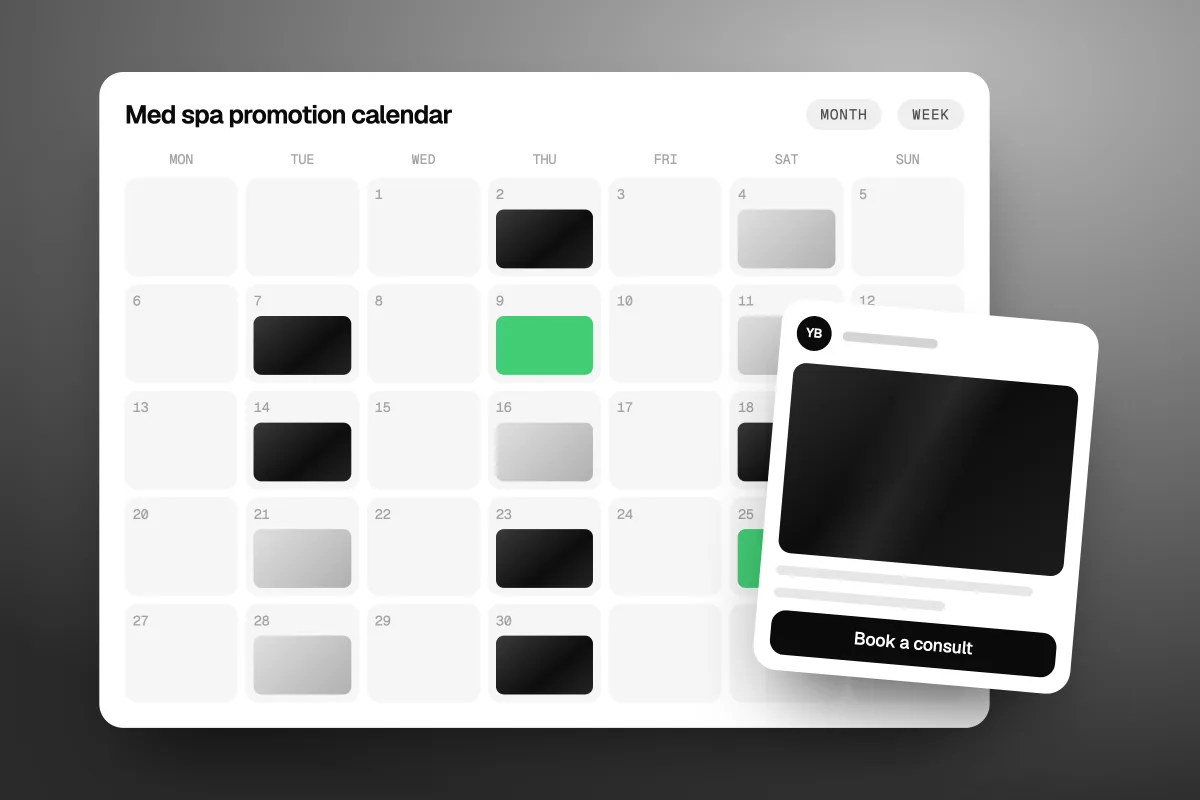
The best med spa marketing ideas are not new channels. They are the ones that turn the enquiries and clients you already have into booked consults and repeat visits. Most lists give you dozens of tactics with equal weight. This one ranks them, with why each works, a first step, and the rules to check. Many of your treatments are medical, so the rules are stricter than for a hair salon.
The short answer
Do these in order:
- Reply to every enquiry within minutes.
- Rebook every client before they leave.
- Offer one simple membership.
- Follow up every consult that did not book, and ask every client for a review.
- Only then pay for new patients with ads, one treatment at a time.
Promotions and discounts help too, but they have legal limits. Check the ad rules for medical treatments before anything runs.
Why repeat clients come first
A med spa lives on repeat clients. In the American Med Spa Association's 2024 State of the Industry report, an average of 73% of med spa patients were repeat patients. Patients spent an average of $527 a visit (AmSpa 2024 report recap).
So a new client is not worth one visit. They are worth every visit after it. An idea that brings in ten new faces who never return loses to one that brings back the clients you already won.
The market is getting crowded, too. The same report counted 10,488 med spas in the US, up from 8,899. More spas means more people who message three places in one evening and book with whoever answers first.
The best new client is the one who books a second visit.
Every idea, and the rule that comes with it
Here is the full list in the order we would do them.
| Rank | Idea | Rules to check |
|---|---|---|
| 1 | Reply to every enquiry in minutes | Consent before you text |
| 2 | Rebook before the client leaves | None |
| 3 | One simple membership | Your state's rules on plans that renew |
| 4 | Follow up every consult that did not book | Consent before you text |
| 5 | A review request after every visit | FTC and Google review rules |
| 6 | Google Business Profile and a page per treatment | Claims must be true |
| 7 | Before and after photos | Patient consent, HIPAA, FTC, Meta |
| 8 | Referral rewards | Your state's rules on referral rewards |
| 9 | Instagram and Facebook ads for one treatment | Meta's health ad policy |
| 10 | Google search ads for treatment searches | Google's healthcare ad policy |
| 11 | Promotions to your own list | Opt-in, unsubscribe, your state's rules on discounts |
| 12 | Events and local partners | Your state's rules on referral fees |
First: keep the clients and enquiries you have
1. Reply to every enquiry in minutes
People looking at a treatment often message a few spas at once, by form, DM, text or call. The first clear reply usually gets the consult. A reply the next morning often finds them booked somewhere else.
First step: pull your last 20 enquiries. Write down when each one came in and when someone replied. If the gap is often hours, fix this before you spend a dollar on ads.
The fix:
- Someone owns the phone and the DMs during opening hours.
- Every missed call gets a missed call text back from your number within seconds.
- Every web form gets an instant reply with a link to pick a consult time.
- "How much?" gets a real answer: a price range, or why you price at the consult, plus a time.
Missing lots of calls? Our guide to medical answering services compares the options.
Many med spas do not have a lead problem. They have a reply problem.
2. Rebook before the client leaves
Many treatments wear off or come in a series. The easiest time to book the next visit is at checkout, while the client is happy and in front of you. It costs nothing.
First step: add one line to your checkout routine. "Your next visit should be around this date. Shall I hold a time for you?" Then count how many clients leave with a next visit booked. That is your rebooking rate. Clients who say no should get a friendly reminder when they are due.
3. Offer one simple membership
A membership turns a repeat client into a planned one. You get steady monthly income. The client gets a better price and a reason to come back, because they have already paid.
First step: build one plan around the treatment your clients repeat most. A monthly fee, one treatment or a credit each month, and a member price on extras. If you cannot explain it in one sentence, it is too complicated.
Many states have rules on plans that renew and bill on their own. Check your state's rules, put the terms in writing and make cancelling easy.
4. Follow up every consult that did not book
"I'll think about it" is not a no. A treatment plan can cost a lot, and people need time. A friendly check-in a few days later wins some back.
First step: list everyone who had a consult in the last 60 days and did not book. Call or text each one this week. Only text people who agreed to get texts from you, and keep that consent on record.
You can automate these check-ins later. Start by hand, so you learn what people really ask.
5. Ask every client for a review
Choosing who puts a needle in your face is a trust decision, and reviews help you show up too: Google says more reviews and positive ratings can help a business's local ranking (Google Business Profile Help, checked 1 October 2026).
First step: text your Google review link to every client on the day of their visit. Every client, not just the happy ones.
Two rules. The FTC says it is fine to invite all your customers to post honest reviews, good or bad. Giving a discount in return for saying good things is where it goes wrong (FTC Endorsement Guides FAQ). And when you reply to a review, keep it general. Never mention their treatment.
For the full setup, read how to build a review and reputation system. For fake or unfair ones, see how to remove bad Google reviews.
Next: get found and get trusted
6. Fill in your Google Business Profile and give each treatment a page
People search for the treatment, not the spa: "laser hair removal near me", or "lip filler" plus their town. Your Google Business Profile and treatment pages are what show up.
First step: list every treatment as a service on your Google Business Profile. Add real photos of your space and team. Then write one page for your best-selling treatment. Say what it is, who it suits, what recovery looks like, a price range, and who does it.
The same pages feed AI answers too. Here is how to get recommended by ChatGPT and Google's AI. Keep every claim true. No "no downtime" unless there really is none, and no promised results.
7. Show before and after photos, the right way
Your work is visual, and people want to see results on someone like them. Before and after photos are often your most convincing proof. They also carry the most rules.
First step: write a photo consent form that says where photos can go: your website, social pages or ads. The client signs it before treatment. Shoot before and after in the same light and angle, with no filters.
- Consent. If HIPAA covers your practice, HHS says marketing that uses patient health information needs the patient's authorization, apart from a few narrow cases (HHS marketing guidance). Not sure if it covers you? Ask your lawyer, and get written consent either way.
- Typical results. The FTC says that if you cannot show a client's result is what people generally get, the ad must make clear what results people can generally expect. Your best result is not a typical result.
- Your state. Some states and medical boards have their own rules on patient photos in ads. Check your state's rules.
No signed consent, no photo. No exceptions.
8. Reward referrals
Clients who love their results already talk about you. A reward gives them a reason to do it on purpose.
First step: try a "give and get". The client gets a credit, and the friend gets a credit on their first treatment. Print it on a card at checkout and put it in your follow-up text.
Some states limit rewards for patient referrals in medical practices. Check your state's rules before you offer cash or credit. And if a client posts about you because of a reward, the FTC expects that reward to be disclosed.
Then: pay for new patients
Ads come ninth for a reason. If enquiries wait hours for a reply, ads just buy more enquiries that wait hours.
Ads multiply what is already there, good or bad.
We see this in our own work. Kourse, a client of ours, added $15K in monthly recurring revenue in one day after we redesigned its sales page. No new traffic. Different industry, same lesson: fix where people land before you pay to send more of them.
9. Instagram and Facebook ads for one treatment and one offer
Instagram and Facebook suit med spas: the work is visual and the audience is local. Each ad works best with one treatment and one next step, like a "Book a consult" button.
First step: pick one treatment with good margins and open provider time, and one offer. Send people to that treatment's page with a booking link, not your homepage.
Check the ad rules for medical treatments. Meta's health and wellness policy says ads for cosmetic procedures, injectables included, must target people 18 or older. When they do, the policy allows before and after pictures. It bans ads that put down how someone looks, and promises of a specific result within a set time without a qualifier. Prescription weight loss treatments fall under Meta's separate drugs policy (Meta Health and Wellness policy, checked 1 October 2026). Meta updates this page, so reread it before each campaign.
10. Google search ads for treatment searches
Search ads catch people looking for a treatment right now. That is the warmest traffic you can buy.
First step: start with one campaign for one treatment in your area. Send every click to the matching treatment page.
Check the ad rules for medical treatments. Google restricts prescription drug terms in ads, landing pages and keywords (Google Ads Healthcare and medicines policy, checked 1 October 2026). Botox is the brand name of a prescription drug, so an ad that names it can be rejected. Write around the treatment instead. Ask your medical director to approve every ad before it runs.
Med spa promotion ideas
A good promotion brings a new client in or a past client back. A bad one teaches everyone to wait for the next sale.
11. Send promotions to your own list
Your client list is the cheapest audience you have. You already paid to win them. Email and text them a few times a season with one useful note and one offer. Only send to people who agreed to hear from you, with an unsubscribe link in every email.
Promotions that tend to work:
- A consult credit. The consult fee comes off the treatment if they book.
- A first-visit price on an entry treatment, like a facial.
- Series pricing for treatments that take several sessions.
- Gift cards before Valentine's Day, Mother's Day and the holidays.
- Member perks in quiet weeks, instead of a public discount.
- A waitlist for a new treatment or device.
Discounts on medical treatments: the limits
Deal sites look like an easy way to fill a quiet week, but they carry a legal risk. In a 2018 AmSpa article, lawyer Alex Thiersch called selling medical treatments on deal sites "a textbook example of fee-splitting", because the site keeps a share of the fee. He also noted that some states, like Illinois, make an exception for deal sites (AmSpa).
So before you discount a medical treatment, or pay anyone a share of what a client spends, check your state's rules and ask your medical director. And keep the offer honest: the price you show is the price they pay.
The discount is not the point. The second visit is.
12. Events and local partners
An open evening lets nervous first-timers meet your providers. Partners like bridal shops, salons and gyms already have your kind of client.
First step: plan one small evening around one treatment, with a consult offer for anyone who books that night. Ask each guest to bring a friend.
Careful with partners. Paying a partner per client sent is a referral fee, so check your state's rules first. Swapping gift cards or sharing an event is simpler.
A simple med spa promotion calendar
Plan promotions for the year, not the week you are quiet. Ask your medical director which treatments suit which season.
| When | Promotion |
|---|---|
| January | Member perks and a new-year consult offer |
| February | Valentine's gift cards |
| Spring | Treatments that take several sessions, like laser hair removal, started early |
| May | Mother's Day gift cards and pairs offers |
| Summer | Facials and skin care, plus a waitlist for fall treatments |
| Fall | Treatments your providers prefer away from summer sun |
| November and December | Gift cards and packages |
For the planning side, see how to build a content calendar that drives business.
Popular ideas that rarely book a consult
Subscription boxes, hashtag campaigns, guerrilla stunts and mindfulness sessions show up on a lot of lists. They rarely book a consult, and they eat the time you need for ideas 1 to 5. Posting more on your own feed is similar: good as proof, but posts alone rarely fill a calendar.
A first-month plan
A limit, up front: we have not run marketing for a med spa yet. We do this work for local service businesses, coaches and training providers. A med spa specialist will know your booking software and state rules better than we do.
If a med spa owner asked us where to start, this is the first month we would plan:
- Week 1. Time the replies to the last 20 enquiries. Turn on missed call text back and instant form replies.
- Week 2. Add the rebooking line at checkout. Call every consult from the last 60 days that did not book.
- Week 3. Start the review request. Write the photo consent form. Draft one membership.
- Week 4. Fix the Google Business Profile and write one treatment page. Only then plan the first ad.
None of this is clever. It is the work that slips when the owner is also the injector. That is what Havstock Unlimited is for: one team that runs your ads, site, follow-up and reviews for a flat monthly fee. See how Havstock Unlimited works, read how a marketing subscription works, or see what we would do on our med spa marketing page.
When marketing is not the problem
Marketing cannot fix a full book. If your providers are booked out for weeks, more enquiries will only annoy people. Hire, add hours or raise prices first. And if consults happen but nobody books, look at the offer and the consult itself before you look at ads.
FAQ
How do you market a medical spa?
Start with the clients and enquiries you have. Reply to every enquiry fast, rebook clients at checkout, offer a membership and ask every client for a review. Then build your Google Business Profile and treatment pages. Add paid ads last, one treatment at a time, written to the platform's health ad rules.
How much do med spas spend on marketing?
You will see rules of thumb quoted as a share of revenue. We could not find a primary source we trust for any of them. A better way: decide what you can pay to win one client, based on what a client spends over time. Keep each channel only while it books clients at or under that cost.
Who is the target market for medical spas?
Mostly women, and mostly in midlife. AmSpa's 2024 report found 89% of med spa patients are female, and 54% of female patients are 35 to 54 years old. Your own client list is the best guide, so check who books most at your spa.
Can a med spa use before and after photos in ads?
Often, yes, with limits. Meta's policy allows before and after pictures for cosmetic procedures in ads aimed at people 18 or older. You need the client's written consent, and if HIPAA covers you, their authorization. Show typical results, not just your best. Some states have extra rules, so check your state's rules.
Can med spas offer discounts or Groupon deals?
Discounts can be fine, but deal sites carry a legal risk. Because the site keeps a share of the fee, AmSpa has called it a textbook example of fee-splitting. Some states, like Illinois, make an exception. Check your state's rules and ask your medical director before you discount a medical treatment.
What are good med spa promotions for the holidays?
Gift cards are the easiest win, because the buyer brings you a new client. Add packages for clients who want a series, and member perks to fill quiet weeks in January. Plan them a month ahead, send them to your own list first, and keep the terms short and honest.
If you only do one thing this week, time your replies to the last 20 enquiries. That one number will tell you more about which med spa marketing ideas to start with than any list, including this one.