 Nathan Field
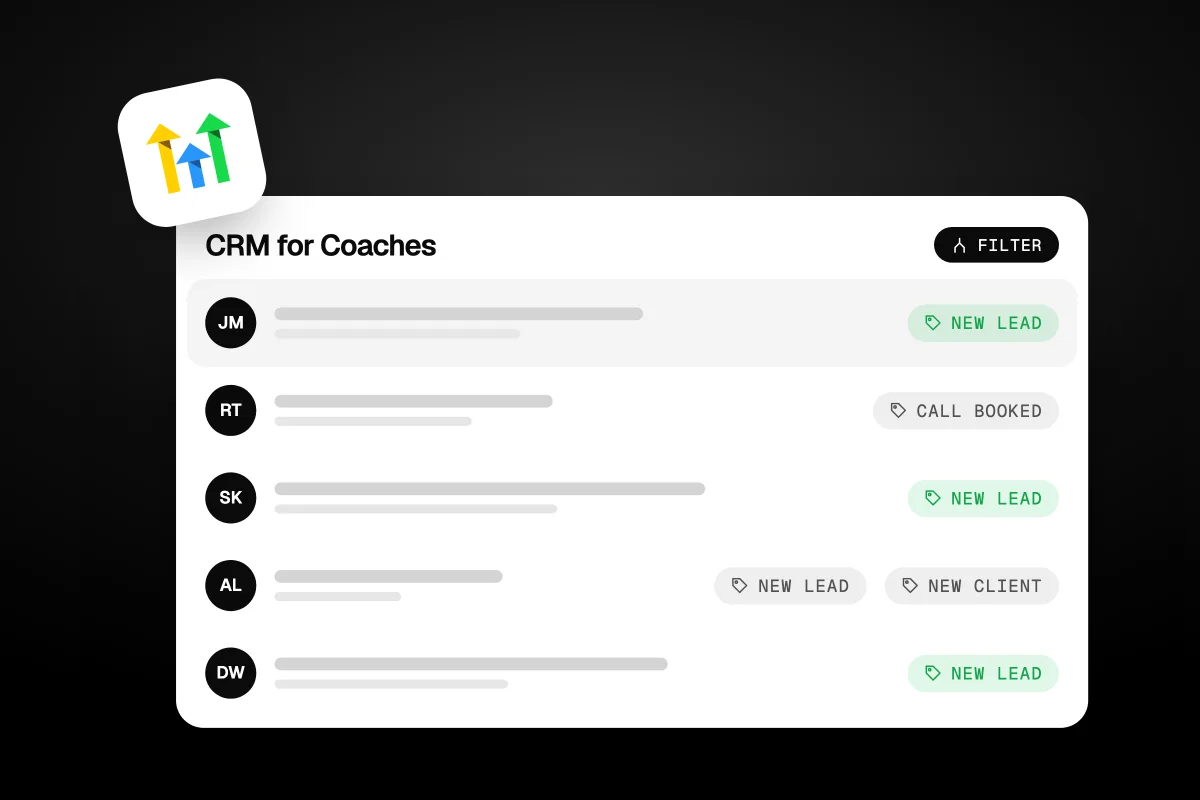
A CRM for coaches has one main job: get a stranger from "interested" to a booked discovery call, then to a paying client, without you chasing each step by hand. Any CRM for coaching needs lead capture, a booking calendar, follow-up for people who didn't buy, payments and a clean start for new clients. Everything else is extra. Below is what each of those jobs looks like, how GoHighLevel, HoneyBook and Dubsado compare on their own pricing pages (checked 16 November 2026), and when a simpler tool is the better call.
The short answer
Coaches who book clients one by one through referrals can run on HoneyBook (from $29 a month, billed yearly) or Dubsado (from $335 a year). Coaches who sell with ads, funnels, webinars or programs need lead capture and follow-up at volume, which is where GoHighLevel (from $97 a month) fits. Pick by how clients find you, not by features.
What is a CRM for coaches?
A CRM for coaches is the system that tracks every person who might buy from you, and what happens next with each one. It holds their details, where they came from, whether they booked a call, what you offered and whether they paid.
Most coaches start with a calendar link, a payment link and a notes app. That works until it doesn't. A lead fills in a form, books a call, doesn't show, and nobody follows up. A past client asks about your next group program and the email gets buried. The CRM is what stops those gaps.
The same tool works for consultants. A CRM for consultants does the same jobs with longer sales cycles and proposals instead of packages. If you sell both, one system covers you.
What should a coaching CRM do?
A coaching CRM should handle five jobs: capture leads, book discovery calls, follow up with people who didn't buy, take payments, and onboard new clients. If a tool does these five well, you can ignore most of its other features.
Capture leads in one place
Leads come from your website, social posts, a lead magnet, podcast guests and referrals. A CRM pulls them all into one list and tags where each came from. That tag matters later. It tells you which channel brings clients, not just clicks. Our guide on how to get coaching clients covers the channels themselves.
Book discovery calls
The booking calendar is the heart of most coaching sales. A good one shows your real availability, asks a few qualifying questions, sends reminders by email and text, and moves the contact to "Call booked" on its own. No-shows are the big leak here. Reminders cut them, and a follow-up for people who miss the call saves some of the rest.
Follow up with people who didn't buy
Most people don't buy on the first call. Some need a week. Some need the next cohort. Without a follow-up system, they drift. Your CRM should put every "not yet" into a short sequence: a recap email the same day, a check-in a few days later, and a note when your next program opens.
Take payments
Coaching is paid in packages, payment plans, retainers and programs. The CRM should send invoices or a checkout link, handle payment plans, and mark the contact as a new client when they pay.
Onboard new clients
The first week sets the tone. When someone pays, the CRM can send the welcome email, the intake form and the link to book the first session, all at once. If you run a group program, it can also add them to your course or community.
Pick your CRM by how clients find you. A referral business and an ads business need different tools.
What can coaches skip?
Coaches can skip most features built for agencies, e-commerce and big sales teams. You probably don't need:
- Sub-accounts or client accounts, unless you also run marketing for other businesses.
- Deal scoring, territory rules or sales forecasting.
- A power dialer, unless you sell by outbound calls.
- A dozen pipelines. One pipeline for new clients is enough for most solo coaches. Add a second only for a separate offer, like a group program.
The trap is paying for a bigger tool and then using 10% of it. If your business runs on referrals and a few calls a week, start small.
How do GoHighLevel, HoneyBook and Dubsado compare for coaches?
HoneyBook and Dubsado are client management tools built for service businesses: proposals, contracts, invoices and client portals. GoHighLevel is a marketing CRM: funnels, forms, calendars, texting, email campaigns and automation in one account. Prices below are from each vendor's own pricing page, checked 16 November 2026.
| Tool and plan | Price on its page | Booking calendar | Automations | Trial |
|---|---|---|---|---|
| HoneyBook Starter | $29 a month, billed yearly | Listed as "1 session", email-only reminders | Not in Starter's feature list | 30 days, no card (its FAQ) |
| HoneyBook Essentials | $49 a month, billed yearly | Unlimited sessions, email and SMS | Yes | Same |
| HoneyBook Premium | $109 a month, billed yearly | Unlimited sessions, email and SMS | Yes, plus unlimited team members | Same |
| Dubsado Starter | $335 a year | No scheduling | No automated workflows | 21 days of Premier, no card |
| Dubsado Premier | $525 a year | Yes | Yes | Same |
| GoHighLevel Starter | $97 a month, or $970 a year | Yes, booking calendars | Yes, workflow builder | 14 days standard, 30 days on our special link |
What the table doesn't show:
- HoneyBook limits lead forms by plan. On its pricing page, Starter allows up to 2 live lead forms, Essentials up to 10, Premium unlimited. Essentials allows up to 2 team members.
- Dubsado's Starter is a records tool, not a sales tool. Its pricing page shows 1 active lead capture form and no scheduling or automated workflows. Most coaches would need Premier. Dubsado includes 3 extra users free.
- GoHighLevel charges usage on top. Its pricing page marks email, SMS, calling and some AI features "Usage based charges apply". Budget for the texts and emails you send, not just the plan.
GoHighLevel also includes things HoneyBook and Dubsado don't focus on: a website and funnel builder, courses, communities, a social planner and two-way texting. If you sell a group program or an online course, that matters. If you sell one-to-one packages by referral, it may be more than you need. To try it with your own offer, our special link gets you a 30-day free trial of GoHighLevel (we may earn a commission from this link) plus a free live bootcamp. Sign up on GoHighLevel's own site and you get the standard 14 days, with no bootcamp.
What does a coaching CRM cost?
A coaching CRM costs from about $28 a month (Dubsado Starter's $335 a year, on our maths) to $97 a month or more for a full marketing CRM, before usage fees. The real cost depends on three things:
- Billing period. HoneyBook's headline prices are billed yearly. Dubsado shows yearly prices only. GoHighLevel shows $97 a month or $970 a year for Starter.
- Usage. On GoHighLevel, texts, emails and calls are billed by use. On HoneyBook, SMS reminders sit in Essentials and up.
- The tools it replaces. If a CRM replaces your scheduler, your email tool, your funnel builder and your course host, the price compares with all of those added up, not with one of them.
A simple way to decide what you can spend: work out what one client is worth over the time they stay with you. Our free customer lifetime value calculator does the maths. If one extra client a quarter pays for a year of the tool, the price is not the problem. Setup time is.
The cheapest CRM is the one you actually keep using after the first month.
When is a simple tool enough?
A simple tool is enough when most clients come by referral, you book a few calls a week, and you sell one-to-one packages. HoneyBook or Dubsado will send the proposal, the contract and the invoice, and give clients a portal. You don't need funnels, texting campaigns or a course host.
This is where we'd steer some coaches away from GoHighLevel. It is a big tool with a lot of parts. If you won't use the funnels, the texting or the automations, you are paying for an empty toolbox and learning a harder system.
If you won't use the funnels, the texting or the automations, a big CRM is just a harder way to send invoices.
A bigger CRM makes sense when:
- You run ads or content that brings in more leads than you can follow up by hand.
- You sell a group program, a course or a membership, not just one-to-one time.
- You want lead capture, booking, payments, email, texting and your course in one login.
- You lose people between "booked a call" and "paid" because nobody follows up.
Our post on GoHighLevel workflow automation for coaches and consultants shows what that follow-up looks like once it is built.
How do you set up a coaching CRM in a week?
You can set up a working coaching CRM in a week if you build only what you need, in order. Here is the order we use when we build one:
- Day 1: Stages. New lead, Call booked, Call done, Offer made, New client, Not now. Keep it that short.
- Day 2: One form and one calendar. A lead form on your site and a discovery call calendar with three qualifying questions. Connect both to the pipeline.
- Day 3: Reminders. Email and text reminders before every call, and a follow-up message for no-shows.
- Day 4: Follow-up for "not yet". A same-day recap and two check-ins over the next two weeks. Stop it the moment they pay.
- Day 5: Payments. Your packages as products, with payment plans if you offer them. Paying moves the contact to New client.
- Day 6: Onboarding. Welcome email, intake form, first session link. If you run a program, add the course or community access.
- Day 7: Import and test. Bring in your past leads and clients, tagged. Book a test call as a fake lead and walk every step.
If you use GoHighLevel, its workflow builder handles days 3 to 6. Our GoHighLevel workflows guide explains how triggers and actions fit together. And if you want to build it alongside a guide, start your 30-day free trial with the free live bootcamp, which GoHighLevel describes as a live class on launching your business in HighLevel in under an hour.
Build the follow-up for people who said "not yet" before you build anything fancy. That is where coaches lose the most clients.
Who builds and runs it?
GoHighLevel is the tool. Someone still has to do the work: write the follow-up, build the funnel, set up the calendar and keep the lists clean. Many coaches would rather coach. If you would rather hand that part over, see how Havstock Unlimited works. We build and run marketing systems on GoHighLevel for coaches. At $4,995 USD a month it is built for coaches already selling with ads or launches. A coach just starting out is better off building the seven-day setup above alone.
If you also run an agency on the side, the needs change. Our CRM for marketing agencies guide covers sub-accounts and client reporting.
FAQ
What is the best CRM for coaches?
There isn't one best CRM for every coach. Referral-based one-to-one coaches do well with HoneyBook or Dubsado, which handle proposals, contracts and invoices. Coaches who sell with ads, funnels, webinars or programs need lead capture and follow-up at volume, where GoHighLevel fits. Choose by how clients find you, then test on a free trial.
Is HoneyBook good for coaches?
Yes, for coaches who sell packages one to one. It sends proposals, contracts and invoices, and has a client portal. Watch the plan limits: Starter, at $29 a month billed yearly, lists its scheduler as "1 session" and allows up to 2 lead forms. Essentials adds unlimited sessions, SMS reminders and automations, at $49 a month billed yearly.
Is Dubsado or HoneyBook better for coaches?
They do similar jobs. Dubsado's Premier plan, at $525 a year, includes scheduling and automated workflows, and Dubsado includes 3 extra users free. HoneyBook Essentials costs $49 a month billed yearly and adds SMS reminders. Try both: Dubsado's trial is 21 days and HoneyBook's FAQ says 30, neither needing a card.
Is GoHighLevel good for coaches?
It suits coaches who sell with funnels, ads, webinars, group programs or courses, because it puts forms, calendars, texting, email, payments and courses in one account. It is more than a referral-only coach needs. Starter is $97 a month on its pricing page, checked 16 November 2026, plus usage charges for texts and calls.
Do coaches really need a CRM?
Not on day one. With a few leads a month, a calendar link, a payment link and a spreadsheet will do. You need a CRM when leads start slipping: calls booked with no reminder, no-shows never followed up, or past clients you forget to tell about a new program. That is usually earlier than coaches think.
Can I use the same CRM for coaching and consulting?
Yes. A CRM for consultants does the same core jobs: capture leads, book calls, follow up and take payment. Consulting usually adds proposals and longer sales cycles. HoneyBook and Dubsado handle proposals well. GoHighLevel handles longer follow-up well. If you do both, one CRM with two pipelines keeps it simple.
Is there a free trial of GoHighLevel for coaches?
Yes. GoHighLevel's pricing page offers 14 days. Our special link gives a 30-day free trial plus a free live bootcamp. The bootcamp page says you won't be charged the subscription during the trial, but communication surcharges may apply, so texts and calls still cost money.
So, which CRM for coaches should you pick?
Start from how clients find you. Referral coaches selling one-to-one packages should pick HoneyBook or Dubsado and keep it simple. Coaches selling programs with ads, funnels or launches need a CRM for coaches that captures leads, books calls and follows up at volume, which is the job GoHighLevel was built for. Whichever you choose, build the follow-up first.