 Nathan Field
A CRM for insurance agents should catch every lead fast, track every quote sent until it is bound or lost, and start each renewal conversation before the customer starts shopping. That is the sales side. Policies, carriers and commissions belong in an agency management system (AMS), which is a different tool. Most independent agents need both, or one product that covers both well enough. Below is what each type does, what the main tools cost on their own pricing pages (checked 10 November 2026), and when GoHighLevel fits.
The short answer
An insurance agent needs a CRM for leads, quotes and follow-up, and an AMS or rater for policies and carriers. AgencyZoom works alongside your AMS, from $149 a month. AgencyBloc's AMS+ combines both for health and benefits agents, from $109. GoHighLevel, from $97, suits agents who live on calls, texts and follow-up campaigns.
What does an insurance agent need from a CRM?
An insurance agent needs a CRM that turns leads into quotes, quotes into policies, and policies into renewals, without anyone relying on memory. That breaks down into a short list:
- Fast first contact. Reply to internet leads within minutes, before they talk to another agent. The CRM should alert the right agent and send a text the moment a lead lands. Our guide to speed to lead explains why the first five minutes matter.
- A pipeline that matches how you sell. New lead, Contacted, Quote sent, Bound, Lost. Every lead has a stage and a next step.
- Quote follow-up. Many quotes don't close on the first call. The CRM should chase each one with texts, emails and call tasks until the prospect says yes or no.
- X-date tracking. When a prospect says "my policy renews in March", that date should trigger a follow-up in February, not get lost in a notes field.
- Renewal reminders. Every renewal is a chance to keep the client, or lose them to a cheaper quote. The CRM should start that conversation weeks before the date.
- Cross-sell prompts. An auto client with no home policy is a warm lead. Tags and lists make those people easy to find.
- Calling and texting from one place. Insurance is a phone business. Calls, texts and emails should log to the contact record on their own.
- Consent records. Who agreed to be called or texted, and when. More on that below.
Notice what is not on the list: rating quotes with carriers, storing policy documents and tracking commissions. Those are AMS jobs.
The policy lives in the AMS. The next conversation lives in the CRM.
Is a CRM the same as an agency management system?
No. An agency management system runs the book of business: clients, policies, carriers, documents, endorsements and commissions. A CRM runs the selling: leads, quotes, follow-up and campaigns. Some products do a bit of both, which is why the line gets blurry.
| Job | CRM | Agency management system (AMS) |
|---|---|---|
| New leads and lead sources | Core feature | Basic, if at all |
| Sales pipeline and quote follow-up | Core feature | Basic, if at all |
| Texts, emails and call tasks | Core feature | Varies |
| Policies, carriers and documents | Not its job | Core feature |
| Commissions and accounting | Not its job | Core feature |
| Comparative rating with carriers | Not its job | Often through a rater |
The vendors say this themselves. AgencyZoom's pricing page answers the question "Does this replace my AMS?" with: "No, AgencyZoom acts as an extension to your AMS." EZLynx, on the other side, sells an agency management system plus a comparative rater that, by its own count, connects to over 330 carriers.
So the real question for most independent agents is not "CRM or AMS". It is "which CRM sits next to my AMS, and do they talk to each other?"
Which CRMs do insurance agents use?
Agents usually weigh three kinds of tool: insurance CRMs like AgencyZoom and AgencyBloc, AMS platforms like EZLynx, and general CRMs like GoHighLevel. Each one starts from a different job:
| Tool | What it is | Best fit |
|---|---|---|
| AgencyZoom | Insurance sales CRM that sits next to your AMS | P&C agencies that want pipelines, renewal automation and producer tracking |
| AgencyBloc AMS+ | Combined CRM and AMS built for health, senior and group benefits | Health, Medicare and benefits agencies |
| EZLynx | Agency management system and comparative rater | Independent P&C agencies that need rating and policy management |
| GoHighLevel | General CRM with calls, texts, email, funnels and automations | Agents who sell mostly by phone and text and want marketing in the same tool |
One name you may still see in older lists is Radius (RadiusBob). Its own site now says it "is no longer being sold to new customers". AgencyBloc bought it in 2022, and its sales tools now live inside AgencyBloc's AMS+.
Can GoHighLevel work as an insurance agent CRM?
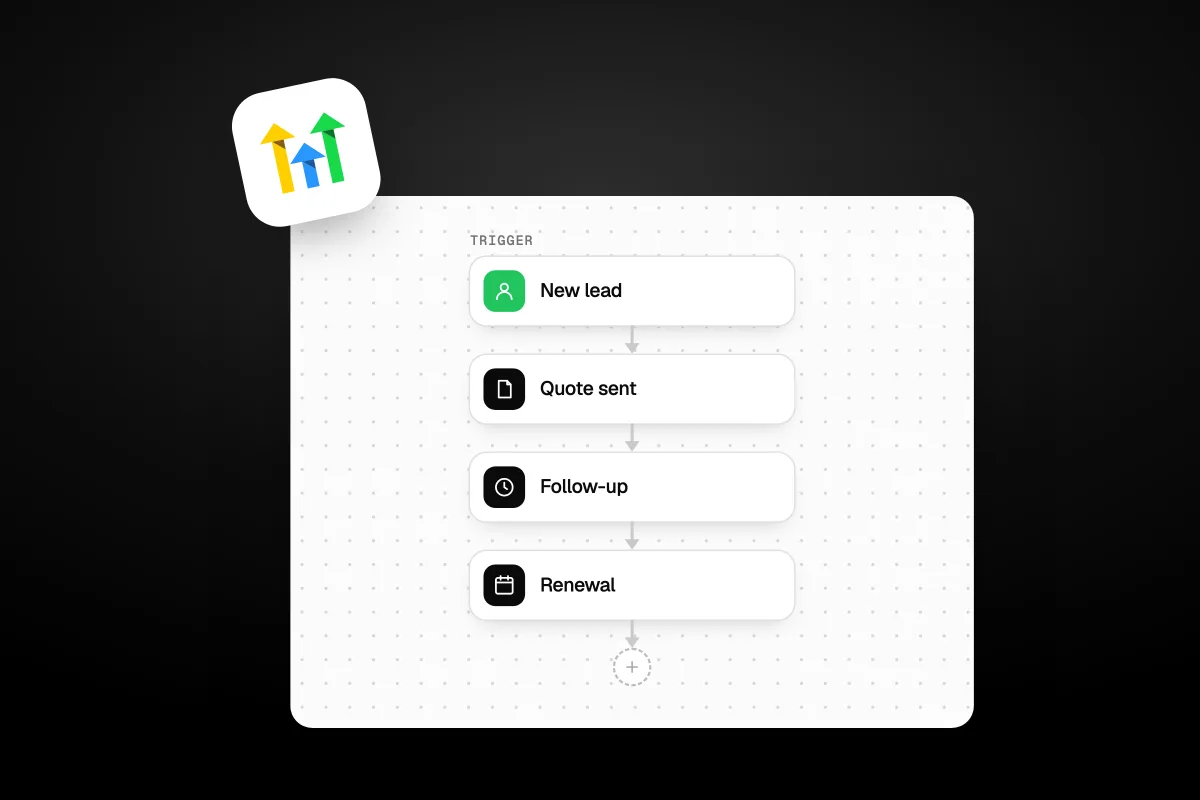
Yes, for the sales and follow-up side, and that is where many agents lose the most business. GoHighLevel gives you pipelines, two-way texting and email, a workflow builder for automations, calendars, forms and landing pages in one account. Its pricing page lists unlimited contacts and unlimited users on every plan. If you want to see it with your own leads, our special link gets you a 30-day free trial of GoHighLevel (we may earn a commission from this link) plus a free live bootcamp. Sign up on GoHighLevel's own site and you get the standard 14 days, with no bootcamp.
Here is how an agent would usually set it up:
- A new business pipeline with stages like New lead, Contacted, Quote sent, Bound and Lost.
- A renewal pipeline where each client lands a set number of days before the renewal date, so someone reviews coverage before a competitor calls.
- Workflows that text every new lead within a minute, follow up on each quote sent, and create call tasks for a person.
- A call queue. GoHighLevel's built-in power dialer works through a list one call at a time, logging each outcome. Our guide to the GoHighLevel power dialer shows how it works and what calls cost.
- Tags for cross-sell, such as "auto only" or "no umbrella", so you can run a campaign to the right people.
Two setup steps catch agents out. First, texting US numbers from a business number needs A2P 10DLC registration with the carriers, and that takes time to get approved. Our GoHighLevel A2P registration guide walks through it. Second, GoHighLevel knows nothing about your policies until you bring the data in, by import, by integration, or through a tool like Zapier.
GoHighLevel will chase a quote for six weeks without getting bored. It will not rate the quote for you.
How much does an insurance CRM cost?
Insurance CRMs with published prices run from about $97 to $349 a month for a small agency, and AMS platforms are usually quote only. Here is what each vendor's own page showed on 10 November 2026:
| Tool | Price a month | What the price covers |
|---|---|---|
| AgencyZoom | Essential $149, Growth $199, Pro $349 (independent agencies) | Up to 7 users on every plan. Renewal automation and two-way texting from Growth. AMS integrations listed, some at extra cost. 20% off yearly. 14-day free trial |
| AgencyBloc AMS+ | Grow from $109, Accelerate from $139, Elevate from $169 | CRM and AMS for health, senior and benefits. Email marketing, landing pages and lead forms from Grow. Built-in calling and call queues on Elevate |
| EZLynx | Quote only | Priced by the number of users and the products you need |
| GoHighLevel | Starter $97 ($970 a year), Unlimited $297 | Unlimited contacts and users. Starter includes 3 sub-accounts, which is plenty for one agency. Calls, texts and some features are billed by usage on top |
GoHighLevel's prices come from its pricing page, checked 10 November 2026. AgencyZoom also shows separate tabs for Allstate and Farmers agents. If you are captive, check the tab for your carrier.
The sticker price is only part of it. Add the cost of your AMS if the CRM doesn't replace it, any integration fees, phone and text usage, and the hours it takes to build pipelines and automations. A $97 tool that nobody sets up costs more than a $349 tool that runs every day.
If GoHighLevel is on your shortlist, test it on one lead source first. Start a 30-day free trial with our special link, build one pipeline and one quote follow-up, and see if your team uses it.
When is GoHighLevel the wrong pick for an insurance agent?
GoHighLevel is the wrong pick when your day runs on rating, policy service and commissions rather than on leads and follow-up. It is a general marketing CRM. It is not an insurance agency management system.
Skip it, or keep it to marketing only, if:
- You need comparative rating. Quoting many carriers from one entry is what raters like EZLynx's are for.
- Most of your work is servicing existing policies. Endorsements, certificates and claims follow-up belong in an AMS.
- You want producer comp and commission tracking out of the box. AgencyZoom and AMS platforms are built for that.
- You sell health, Medicare or group benefits and want the CRM and AMS built for that market in one place. AgencyBloc's AMS+ is aimed squarely at it.
- Nobody on your team will build and maintain the automations. An empty GoHighLevel account does nothing.
That last point is the one we see most. GoHighLevel is the tool. Someone still has to do the work: build the pipelines, write the follow-up, keep the lists clean and check the texts are compliant. If you would rather hand that part over, see how Havstock Unlimited works. We set up pipelines and follow-up on GoHighLevel for clients as part of our CRM and automations service. At $4,995 USD a month it is built for agencies with real lead volume. A solo agent is better off building one pipeline on GoHighLevel's Starter plan, or buying AgencyZoom Essential.
How do you follow up on quotes and renewals without dropping leads?
Give every quote and every renewal a date, an owner and an automatic next step, so nothing depends on someone remembering. Here is a simple version that works in any of the CRMs above:
- New lead: text within a minute, call attempt right away, then a set rhythm of calls and texts over the next few days.
- Quote sent: a text that day with a short summary, a check-in two days later, a call task at day five, and a last friendly message at two weeks. Then move it to Lost with a reason, and an X-date if they gave you one.
- X-date: a reminder 30 to 45 days before the prospect's current policy renews, with a call task. This is how a "not now" gets a second chance.
- Renewal: start the review well before the renewal date, so you reach the client before a cheaper quote does. A short text asking if anything has changed, a new car, a new driver, a renovation, opens the conversation.
- After a policy is bound: a thank-you, a review request, and a cross-sell check a few months later.
Old quotes are worth a second look too. A list of people who got a quote last year and never bought is a warm list. Our guide to database reactivation shows how to message them without annoying anyone.
Check the calling and texting rules first
Calling and texting leads comes with federal rules, and state rules on top. The FCC's consumer guide to unwanted robocalls and texts says that "commercial texts require written consent" when sent with an autodialer, and that people "may opt out of any robocall or robotext at any time and in any reasonable manner". We are not lawyers and this is not legal advice. Read the FCC's page, check your state's rules, and ask your own lawyer how they apply to your lead sources, especially bought leads. Then store the consent record in your CRM next to each contact.
FAQ
Which CRM suits a small insurance agency?
It depends on what you need most. AgencyZoom, from $149 a month for up to 7 users, sits beside your AMS for P&C sales. AgencyBloc AMS+ suits health and benefits agencies, from $109. GoHighLevel, from $97, suits agents who sell by phone and text. Prices checked 10 November 2026 on each vendor's page.
Do I need a CRM if I already have an AMS?
Often yes. An AMS holds policies, carriers and commissions. A CRM chases new leads, open quotes and renewals with texts, emails and call tasks. Some AMS platforms include basic sales tools, so check yours first. AgencyZoom describes itself as an extension to your AMS, not a replacement for it.
Can GoHighLevel connect to my agency management system?
GoHighLevel's pricing page doesn't list insurance AMS integrations. You can import contacts and policy dates, or connect tools through Zapier or webhooks, depending on what your AMS allows. Ask your AMS provider which integrations it supports before you build anything. If a live sync matters, an insurance CRM with a listed integration may fit better.
Is Radius CRM still available?
Not for new customers. RadiusBob's own site says it is no longer sold to new customers. AgencyBloc acquired it in 2022, and its core sales tools have lived inside AgencyBloc's AMS+ since 2024. Current Radius users are still supported. New buyers are pointed to AMS+ instead.
How much does GoHighLevel cost for an insurance agent?
GoHighLevel's Starter plan is $97 a month, or $970 a year, on its pricing page checked 10 November 2026. It includes unlimited contacts and users and 3 sub-accounts. Calls and texts are billed by usage on top. Our special link gives a 30-day free trial instead of the standard 14 days.
Can I text insurance leads from my CRM?
Yes, but check the rules first. The FCC says commercial texts sent with an autodialer require written consent, and people can opt out at any time. Business texting in the US also needs A2P 10DLC registration. Keep each lead's consent record in the CRM, and ask your own lawyer about your lead sources.
So which CRM should an insurance agent pick?
Pick the AMS or rater your carriers and service work need, then pick the CRM that makes sure every lead gets a fast reply, every quote sent gets chased, and every renewal starts early. For P&C agencies that means AgencyZoom next to the AMS. For health and benefits, AgencyBloc. For agents who sell by phone and text and want campaigns in the same place, GoHighLevel is a strong, low-cost CRM for insurance agents.