 Nathan Field
Email marketing for lawyers works best as follow-up, not cold outreach: a short sequence to every new lead until they book or say no, clear emails once they book, and a steady, useful note to past clients so they remember you when a friend needs a lawyer. That is three audiences and three kinds of email. Below is what to send each one, when to send it, the rules to check before you hit send, and what the tools cost. Tool prices were checked on each vendor's own page on 10 November 2026. This is marketing guidance, not legal or ethics advice. Your state bar's rules decide what you can send.
The short answer
Send new leads a short sequence over about a week until they book. Send booked clients a confirmation and a reminder. Send past clients a useful update once a month or once a quarter. Keep each email plain, honest and easy to opt out of. Check your state bar's advertising rules and the FTC's CAN-SPAM guide before you start.
Does email marketing work for law firms?
Yes, for the people who already know your name: leads who asked for help, clients you have now, and clients you helped before. Email is where you keep in touch with them for almost nothing per message. It does not work well as a way to find strangers, and for a law firm, cold email to people who need legal help raises solicitation questions you should check with your bar first.
Legal work has a long gap between "I need a lawyer" and "I hired one". People ask a question, go quiet, talk to a spouse, and come back. Some of those leads are lost simply because nobody followed up. A good sequence keeps the door open without anyone in the office having to remember. Our guide to legal intake shows where email fits in the steps from first contact to signed client.
Email also brings repeat and referral work. A family law client may need help again years later. An estate planning client has children who will need wills. A business client hires lawyers every year. None of them will think of you if the last time they heard from you was the final invoice.
Before you pay for more leads, follow up properly on the ones you already have.
What emails should a law firm send to new leads?
Send a short sequence that moves each new lead toward a booked consultation, then stops the moment they book or say no. Here is a simple version for a lead who filled in a form but didn't book:
| When | Example subject line | What it says |
|---|---|---|
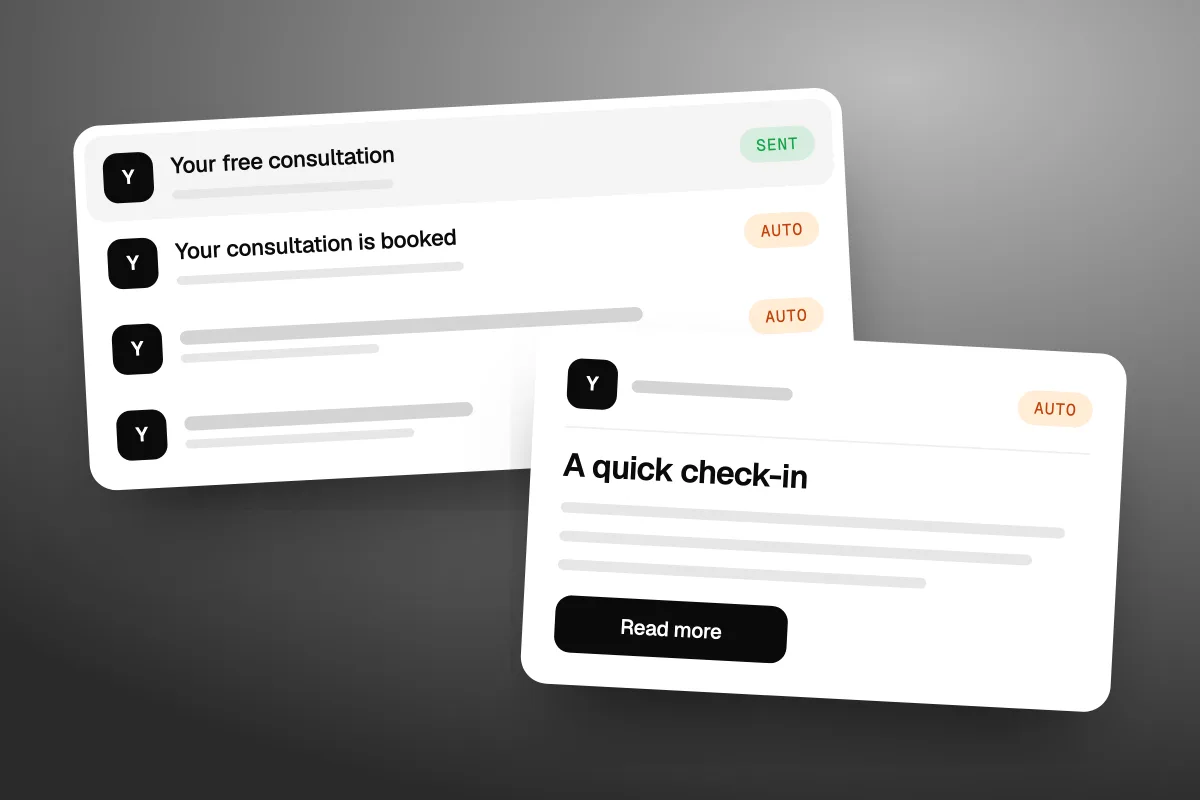
| Within minutes | Your free consultation | Thanks for reaching out. Who will speak with you, how long it takes, and a link to pick a time. Only promise a free consultation if you offer one. |
| Next day | What to expect when you call us | How the first call works, what to have ready, and how your fees are set, in plain words. |
| Day 3 or 4 | A quick check-in | One or two lines: still need help? Reply to this email or book here. |
| Day 7 | Should we close your file? | A polite last note. If they don't need help now, no problem. The door stays open. |
A few rules that make this work:
- Speed beats polish. The first email should go out on its own the moment the form comes in, even at 11pm.
- Stop when they act. The sequence must end when someone books, replies or says no. That means it has to run from your CRM or intake tool, which knows who booked. Nothing annoys a new client like a "still interested?" email the day after they signed.
- Write like a person. Short, plain, from a named lawyer or intake coordinator. No banner images, no "Dear Valued Client".
- Keep case details out. Marketing email is not the place for anything about their matter. Ask them to call or book instead.
Emails once they book
When the consultation is booked, the job changes from selling to showing up. Send a confirmation straight away with a subject like "Your consultation is booked". Say the date and time, the address or video link, who they will meet, what to bring, and how to reschedule. Send a reminder the day before. If they don't show, send one kind note with a link to rebook.
After the consultation, if they haven't hired you yet, a short follow-up a few days later answers the question they forgot to ask. Two or three of those, then stop.
What should a law firm send to past clients?
Send past clients something useful often enough that they remember you, and rarely enough that they don't unsubscribe. What counts as useful depends on your practice:
| Practice area | What past clients find useful | Natural moments to email |
|---|---|---|
| Estate planning | Reminders to review a will or trust after life changes | A yearly review reminder, new tax year, a change in the law |
| Business law | Plain-English notes on rules that affect small companies | Year end, filing deadlines, new regulations |
| Family law | Practical guides on co-parenting plans and order changes | Back to school, holidays, a year after the case closed |
| Personal injury | Safety tips, "what to do after a crash" guides to share | A thank-you at case close, then a light newsletter |
| Real estate | Home buying and selling checklists | Spring market, a year after closing |
Three kinds of email do most of the work with past clients:
- The close-out email. A thank-you when the matter ends, a short note on any next steps they need to remember, and an easy way to reach you. Some firms add a review request here. Check your bar's rules on testimonials first.
- The periodic check-in. A short personal note with a subject like "A quick check-in": has anything changed that we should know about? This suits estate planning and business clients best.
- The newsletter. One useful topic per issue, written for a client, not a lawyer. Firm news only when it matters to them.
Old leads who never hired you are worth a careful message too. Our guide to database reactivation explains how to win back old leads without spamming anyone.
One rule to read closely before you ask for referrals: ABA Model Rule 7.2(b) says a lawyer "shall not compensate, give or promise anything of value to a person for recommending the lawyer's services", with a short list of exceptions. Your state's version may differ. Ask your bar before you offer anything for a referral.
A good referral email doesn't ask for a referral. It reminds a happy client what you do.
How often should a law firm send emails?
Send new leads several emails in their first week, booked clients only what they need for the appointment, and past clients one email a month at most. Here is how we would set the pace:
| Audience | How often | When to stop |
|---|---|---|
| New leads | 3 to 5 emails over about 7 days | When they book, reply, say no, or the sequence ends |
| Booked consultations | Confirmation, then a reminder the day before | After the consultation |
| Consulted, not yet hired | 2 or 3 emails over 2 weeks | When they hire you or say no |
| Past clients | Monthly or quarterly | When they unsubscribe |
If you can't write something useful every month, send quarterly. A good email four times a year beats a thin one every week. Watch your unsubscribe rate after each send. If it climbs, send less or say more.
What are the bar rules for law firm emails?
The rules that matter most are your state bar's versions of the ABA Model Rules on lawyer advertising and solicitation, plus the federal CAN-SPAM Act for commercial email. We will point you to them. We won't interpret them, because rules vary by state and we are not your ethics counsel.
The ABA Model Rules (your state's version applies)
- Rule 7.1 says a lawyer "shall not make a false or misleading communication about the lawyer or the lawyer's services." That covers every email you send, subject lines included.
- Rule 7.2(d) says any communication made under that rule "must include the name and contact information of at least one lawyer or law firm responsible for its content."
- Rule 7.3 covers solicitation. Its main ban is on soliciting by "live person-to-person contact" for pecuniary gain. Part (c) adds that a lawyer shall not solicit someone who "has made known to the lawyer a desire not to be solicited", or where "the solicitation involves coercion, duress or harassment."
The ABA's comment on Rule 7.3 also says a communication is not a solicitation if it is "in response to a request for information". That is worth reading in full alongside your state's rule, because it bears on emails to people who filled in your form. These are model rules. Each state adopts its own version, and some differ. Read your state bar's advertising rules, and ask its ethics hotline if you are unsure.
CAN-SPAM for commercial email
The FTC's CAN-SPAM compliance guide lists the main requirements. Among them: "Don't use deceptive subject lines", "Identify the message as an ad", "Tell recipients where you're located", and honor opt-out requests "within 10 business days." The guide says each email in violation can bring penalties of up to $53,088. It also says transactional or relationship messages are exempt from most of the Act's provisions, which may cover some emails to current clients. Read the guide to see where your emails fall.
In practice, a decent email tool handles the unsubscribe link and the address footer for you. Your job is honest subject lines and content that matches them.
Which email tool should a law firm use?
Use the tool that knows who your leads and clients are, which is usually your CRM or intake software, and add a newsletter tool only if that one can't send well. The sequences above only work if they stop when someone books, so the email has to sit next to the booking data. Prices checked 10 November 2026:
| Tool | What it is | Price | Email features |
|---|---|---|---|
| Mailchimp | General email marketing tool | Free under 250 contacts. Essentials from $13 a month, Standard from $20, Premium from $350 (USD) | Free has no automation flows and caps sends at 500 a month. Essentials allows flows of up to 4 steps. Standard allows up to 200 flows |
| Lawmatics | Legal CRM and intake | Quote only, minimum 3 users | Email marketing and marketing automation on Premium and Enterprise, with 50,000 email sends a month listed |
| Clio Grow | Clio's client intake and CRM tool | No price shown on the Clio Grow page | Clio says you can "send birthday greetings, event invitations, and firm updates by email", with automated intake follow-up |
Mailchimp is fine for a newsletter to past clients. It is weaker for lead follow-up, because it doesn't know who booked unless you connect it to your intake system. Legal CRMs know who booked, which makes the new lead sequence safer. For a full comparison of legal CRMs and their prices, see our guide to CRM for law firms.
Who writes and runs it?
Writing the sequences once is a day's work. Keeping a monthly newsletter going for years is where many firms stall. That is the part we do. Havstock Unlimited covers email sequences, newsletters, the CRM that runs them, and the ads and website that bring the leads in, for one monthly fee. You can see how it works on our email marketing service page, or how we approach marketing for law firms as a whole. You review and approve every email before it goes out, so your bar's rules stay in your hands.
We are the wrong fit for a solo lawyer with a small list. At $4,995 USD a month, it only pays off for a firm with steady lead flow. If that is not you, write the four new-lead emails above, put them in your intake tool, and send a quarterly newsletter on Mailchimp's free or Essentials plan.
FAQ
Is email marketing allowed for lawyers?
Generally yes, within your state bar's advertising and solicitation rules and the federal CAN-SPAM Act. ABA Model Rule 7.1 bans false or misleading communications, and Rule 7.3 covers solicitation. States adopt their own versions, so read yours and ask your bar's ethics hotline if unsure. This is not legal advice.
What should a law firm's first email to a new lead say?
Thank them, say who will speak with them and how long the first call takes, and give a link to book. If you offer a free consultation, say so plainly. Keep it short, sign it from a named person, and leave out anything about their case. Send it within minutes of the enquiry.
How many follow-up emails should a law firm send?
For a new lead who hasn't booked, three to five emails over about a week is a sensible pace, then stop. After a consultation, two or three follow-ups over two weeks. Past clients need one email a month at most. Always stop the moment someone books, replies or asks you to stop.
Do law firm emails need an unsubscribe link?
Commercial emails do under CAN-SPAM. The FTC's guide says to tell recipients how to opt out and to honor requests within 10 business days. It also says transactional or relationship messages are exempt from most provisions. Most email tools add an unsubscribe link and your address automatically. Your bar may have further rules.
Can a law firm use Mailchimp?
Yes. Mailchimp is free under 250 contacts and from $13 a month on Essentials, checked 10 November 2026. It suits a newsletter to past clients. For new lead follow-up, a legal CRM or intake tool is safer, because it knows who has booked and can stop the sequence automatically.
What should a law firm newsletter include?
One useful topic per issue, written for clients, not lawyers. A recent change in the law explained plainly, a checklist people can use, or an answer to a question clients often ask. Add firm news only when it matters to readers. Keep it short, and give one clear way to get in touch.
So where should a law firm start with email?
Start with the four new-lead emails, because they rescue leads you already paid for. Then add the booking confirmation and reminder. Then a quarterly note to past clients. Check your state bar's rules and the CAN-SPAM guide once, build it in the tool that knows who booked, and let it run. That is email marketing for law firms that pays without anyone having to remember. For where those leads come from, read our guide to law firm lead generation.