 Nathan Field
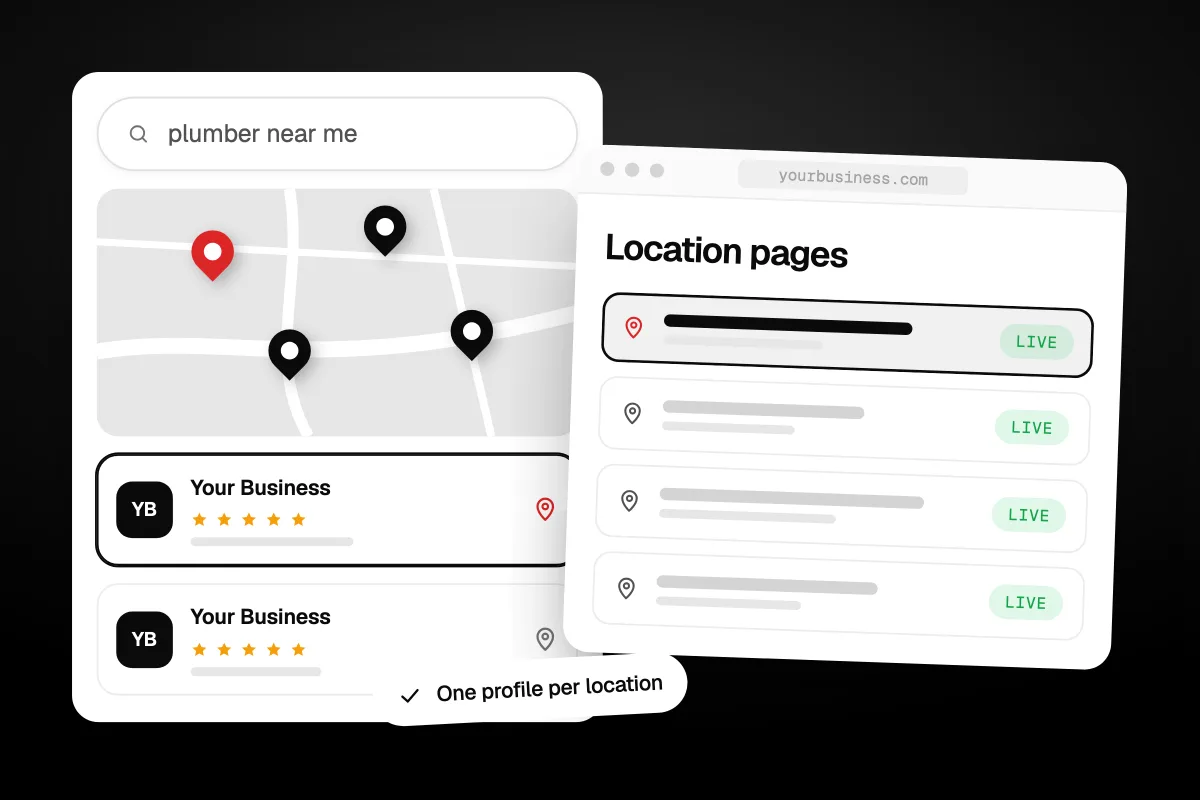
Franchise SEO is the work of getting every location of a franchise found on Google, Google Maps and in AI answers, without the locations and the brand getting in each other's way. The SEO part is rarely the hard part. The hard part is deciding who owns what: the brand website, each location page, each Google Business Profile and the reviews.
We read Google's own rules and the US franchise disclosure rule on 18 October 2026. One note first: Havstock has no franchise clients. What follows is our view, from reading the rules and from the local SEO we do for businesses with one location. It is not legal advice.
The short answer
- Website: one brand site, with one real page for each real location.
- Profiles: one Google Business Profile per location, same brand name, a staffed address.
- Ownership: write down who owns each profile and page before anyone starts.
- Locator: plain links to every location page, not only a search box.
- Reviews: every location asks every customer, the same way.
What is franchise SEO?
It is local SEO, done many times over, under one brand. A single shop has one website and one Google profile. A franchise has a brand website, maybe hundreds of location pages and hundreds of profiles. Each location may have a different owner.
The brand wants to rank for its name. Each location wants to show up when someone nearby searches "plumber near me". Those need different pages, and rules so one does not undo the other.
Most franchise SEO problems start as ownership problems. Sort out who controls what, and the SEO gets much easier.
Who owns what: franchisor vs franchisee
Every other step depends on this. Here is the split most franchise guides describe. Your agreement may differ.
| Part | Usually run by | What a franchisee can often do |
|---|---|---|
| Brand website and domain | Franchisor | Ask for changes to their own location page |
| Location pages | Franchisor builds them, franchisee sends the local details | Send photos, team names, services and local offers |
| Google Business Profile | Shared. Many guides say the brand should own it and the franchisee should manage it | Update hours, add photos and posts, reply to reviews |
| Reviews | Each location | Ask customers for them and reply |
| Local ads | Depends on the ad fund rules | Run their own ads, if the agreement allows it |
| Local links and sponsorships | Franchisee | Sponsor a local team, join the local business group |
What does your franchise agreement say about SEO?
In the US, Item 11 of the Franchise Disclosure Document must describe the advertising program. That rule is in the FTC's Franchise Rule (16 CFR 436.5, checked 18 October 2026). It includes "The circumstances when the franchisor will permit franchisees to use their own advertising material", and whether you must join a local or regional ad co-op.
Read Item 11, then your agreement's parts on advertising, websites and the trademark. Look for answers to these:
- Can you have your own website, or only a page on the brand site?
- Who owns the Google Business Profile for your location?
- Can you run your own Google or Meta ads? Do they need approval first?
- Who pays for local SEO: you, the ad fund, or both?
- What happens to the page, the profile and the phone number if you sell or leave?
If the agreement says nothing, agree it in writing now. Have a franchise lawyer check anything you sign.
Who should own the Google Business Profile?
Google gives each profile owners and managers. Its help page on managing users (checked 18 October 2026) says "As the owner, you have full control over the profile." Managers can do nearly everything else. "The only exception is they can't add or remove users or remove the profile."
Our view: the brand should be the primary owner of every location's profile, and the franchisee a manager. The profile stays safe when a location changes hands. The franchisee can still update hours, add photos and reply to reviews, which is the work that matters most.
Plan handovers early. Google says "A profile must have at least one other owner or manager to transfer primary owner access to." New owners and managers also wait 7 days before they can manage some features. So add the new owner well before a sale closes.
Write down who owns each profile before anyone starts. It is the hardest thing to fix later.
If you are a single franchisee, you may only control your own location page and profile. That is fine. Those two are where most local customers find you.
One real page for each location
Every location needs its own page on the brand site. It is the page your Google profile links to.
The risk is a page that copies every other page with the town name swapped. Google's spam policies (checked 18 October 2026) call one version of this doorway abuse. One example given is "Having multiple domain names or pages targeted at specific regions or cities that funnel users to one page". The same page warns against "Using generative AI tools or other similar tools to generate many pages without adding value for users".
A shared brand paragraph on each page is fine. Google's page on duplicate URLs says "Some duplicate content on a site is normal and it's not a violation of Google's spam policies." But when pages look almost the same, Google "clusters them together" and picks one to show. So 200 pages that read the same may show up as one.
What goes on a location page?
- The exact name, address and phone number on the Google profile.
- Opening hours, including holiday hours.
- The services this location offers, and any it does not.
- Real photos of this location and its team.
- The local owner or manager, with a line about them.
- Reviews from this location's customers.
- A way to book, call or get a quote from this location.
The brand builds one template. Each location fills it with facts only it knows. That is what makes the pages different.
Should you make pages for towns with no location?
Be careful. A page for every suburb near a store, with the same text and a new town name, is close to Google's doorway example. List the towns a location serves on that location's page. Add a town page only when you have something real to say about it.
| Real location page | Doorway page | |
|---|---|---|
| Address | A real, staffed location | No location, or the same one as ten other pages |
| Text | Facts only this location has | The same text with a new town name |
| Where it leads | Book or call this location | A link off to some other page |
A simple test: hide the town names. Could a customer still tell your location pages apart?
Subfolders, subdomains or separate sites?
We would put every location in a subfolder of the brand site, like brand.com/locations/austin. Several page one guides say the same. It is a common view among SEO people, not a Google rule.
One site is easier to keep fast and correct, and the brand's menus can link straight to each location. BizIQ's guide (checked 18 October 2026) also notes that "Many franchisors prohibit independent websites to protect the brand."
A store locator Google can crawl
Many franchise sites have a map with a search box. But if typing into a box is the only way to reach a location page, there is no link for Google to follow.
Google's guide to crawlable links (checked 18 October 2026) says it can generally follow a link only when it is an a tag with an href attribute. Links added with JavaScript are fine if they use that same markup.
So keep the map, and add a plain list under it: every region, city and location, each one a normal link to its page. Link that list from the footer. Then check in Google Search Console that the pages are indexed.
Google Business Profile rules for many locations
Google's guidelines for representing your business (checked 18 October 2026) set the rules. These matter most for a franchise:
- One profile per location. "Do not create more than one page for each location of your business, either in a single account or multiple accounts."
- The same name everywhere. "All locations must have the same name unless the business's real world representation consistently varies from location to location." Google also says "Including unnecessary information in your business name isn't permitted", and its examples rule out store codes.
- Franchisees can use the brand name. Google allows it for "an authorized and fully dedicated seller of the branded product or service, sometimes known as a franchisee".
- A real, staffed address. No virtual offices or remote mailboxes. A location that serves customers on site should be "staffed by your team and able to receive customers during its stated hours."
- Service-area businesses, like cleaning franchises that go to the customer, get one profile for the central office with a service area, and hide the address.
Break these and a profile can get into trouble. Here is what to do if a Google Business Profile is suspended, and why a business may not show on Google Maps.
Bulk verification for 10 or more locations
Google's bulk verification page (checked 18 October 2026) covers businesses with "10 or more locations of the same business". The details that matter:
- "Duplicate, suspended, or disabled profiles don't count towards the 10 Business Profile minimum."
- "Agencies with more than one business in one account can't bulk verify." So this is a job for the brand's own account.
- The steps: sign in to Business Profile Manager, choose Verifications, then Chain, then Start. Fill in the form and submit it. Uploading a spreadsheet alone does not send the request.
With fewer than 10 locations, you verify each profile on its own. Our guide to Google Business Profile verification walks through that.
Use business groups, not shared logins
Google's help page calls business groups "a more secure way to manage and share access to your Business Profiles with co-workers." Put head office on the group, and give each franchisee access to their own profile only.
Reviews for every location
Each location's reviews sit on its own profile. A great review in Denver does nothing for the store in Tampa.
Google's rules on fake engagement (checked 18 October 2026) apply to every store. You must not pay or give discounts or free goods for reviews. You must not "Discourage or prohibit negative reviews, or selectively solicit positive reviews from customers". And "Merchants requesting that staff solicit a certain number of reviews" is listed as rating manipulation.
So don't give each store a review quota. Ask every customer, the same way, with a text or email linking to that location's profile. Then decide who replies: the local owner or the brand. Our guides on how to respond to negative reviews and removing bad Google reviews work for each location.
Every location needs its own reviews. A famous brand name does not fill an empty profile.
NAP consistency: name, address, phone
NAP means name, address and phone number. For each location, those three should match exactly on the location page, the Google profile and every listing, like Yelp, Apple Maps and Bing. Write "Suite 4" or "#4", not both.
Give each location its own local phone number. When a location moves, closes or changes hands, update everything that week. Keep one sheet with a row per location: name, address, phone, hours, profile owner and page link.
Franchise SEO and AI search answers
People now ask ChatGPT and Google's AI answers for "the best gym near me". Google's page on AI features and your website (checked 18 October 2026) says "There are no additional requirements to appear in AI Overviews or AI Mode, nor other special optimizations necessary." What still helps includes "Making sure that important content is available in textual form" and "Checking that your Merchant Center and Business Profile information is up-to-date".
So it is the same work as above. Hours, services and addresses written as text on each location page. Profiles kept current. Reviews coming in. That is what SEO and AEO mean in practice: being found in Google search and in AI answers. Here is more on how to get recommended by ChatGPT. Be wary of anyone selling a special AI file that promises you a spot.
Who should do your franchise SEO?
Our view, by size:
| You are | You likely control | Who should do it |
|---|---|---|
| One franchisee, one location | Your profile, your reviews, the details on your page | You, a few hours a month, with the brand's help |
| A franchisee with several locations | Profiles, reviews and local ads for each, if allowed | One marketing team or agency for all of them |
| A small or growing franchisor | The brand site, templates and profiles | An in-house marketer plus an agency |
| A franchisor with 200 or more locations | Everything at brand level | A specialist multi-location platform or agency |
At 200 locations, much of the job is software: bulk updates to hours, review alerts and reports for each store, and access for hundreds of owners. Use a platform or agency built for that.
How to choose a franchise marketing agency
Whether you are a franchisor or a franchisee with several sites, ask these before you sign:
- Who will own the profiles, pages and ad accounts? The answer should be you or the brand, never the agency.
- Will you build one page per real location, or a page for every nearby town?
- Will you read our franchise agreement's marketing rules first?
- Can you report by location? Calls, bookings and leads for each store, not one total.
- Is the price per location, or for the whole network?
- What happens when we leave? You should keep everything.
Prices on page one vary a lot. BizIQ's pricing page (checked 18 October 2026) says organic SEO packages "start at $1,500 per month", without saying if that is per location. Boulder SEO Marketing's guide (checked 18 October 2026) puts agency-managed franchise SEO and GEO at "$20,000 per month and up", and its own flat-rate pilot in the "$5,000 to $10,000 range" for a whole network. Those are their prices, not a market average.
Whoever you hire, the profiles, pages and ad accounts should stay in your name.
Where Havstock fits, and where it does not
Havstock Unlimited costs $4,995 USD a month, month to month. It is a marketing subscription: one small team does the whole marketing job, one request at a time, most done in about 48 hours. That covers SEO, location pages, ads, email, follow-up and the CRM.
It can make sense for an owner of several franchise locations, or a small franchisor, who wants all of the marketing done, not only SEO, and whose agreement allows outside help. If that is you, see how Havstock Unlimited works. You can try it for a week, with 75% back if you are not happy.
It will not suit you if:
- You are a single franchisee who only controls one profile. This guide costs you time, not $4,995 a month.
- You run 200 locations and need bulk tools and a team sized for that.
- Your franchise agreement bans outside marketing help or local ads.
And again: we have not done SEO for a franchise yet.
FAQ
What is franchise SEO?
Franchise SEO is local SEO for a brand with many locations. It covers the brand website, one page per location, one Google Business Profile per location, reviews and listings. The extra part is deciding who does what, since the franchisor and each franchisee usually control different pieces. Getting that split right comes before any ranking work.
Should each franchise have its own domain or a subfolder?
In our view, a subfolder on the brand site, like brand.com/locations/austin. One site is easier to keep fast and consistent, and the brand's menus can link straight to each location. This is a common view among SEO people, not a Google rule. Check your agreement too, because many franchisors do not allow separate franchisee websites.
How do I avoid duplicate content with multiple locations?
Give each location page facts only that location has: its address, hours, team, photos, services, reviews and local offers. A shared brand paragraph is fine. Google says some duplicate content is normal and not against its spam policies. But near-copy pages with only the town name swapped can be grouped together, and only one gets shown.
Can a franchisee do their own SEO?
Often, for part of it. Most franchisees can update their Google profile, add photos, ask for reviews, reply to them and send local details for their page. The website and the brand name are usually controlled by the franchisor. Read Item 11 of your disclosure document and your agreement before you hire anyone or run ads.
How much does franchise SEO cost?
It depends on how many locations you have and who does the work. On page one, BizIQ lists organic SEO packages from $1,500 a month, and Boulder SEO Marketing says agency-managed franchise SEO starts at $20,000 a month. A single franchisee doing the basics pays mostly in time. Always ask if a price is per location or per network.
How do you verify Google Business Profiles for many locations?
With 10 or more locations of the same business, use bulk verification. Sign in to Business Profile Manager, choose Verifications, then Chain, then Start, and fill in the form. Duplicate or suspended profiles don't count toward the 10. Agencies with more than one business in one account can't bulk verify, so the brand's own account should apply.
Franchise SEO gets much simpler once the ownership is written down. Make one sheet with every location, who owns its profile and page, and its exact name, address and phone number. Then fix the location pages one at a time, starting with your busiest stores. That sheet is the first thing any agency should ask you for.